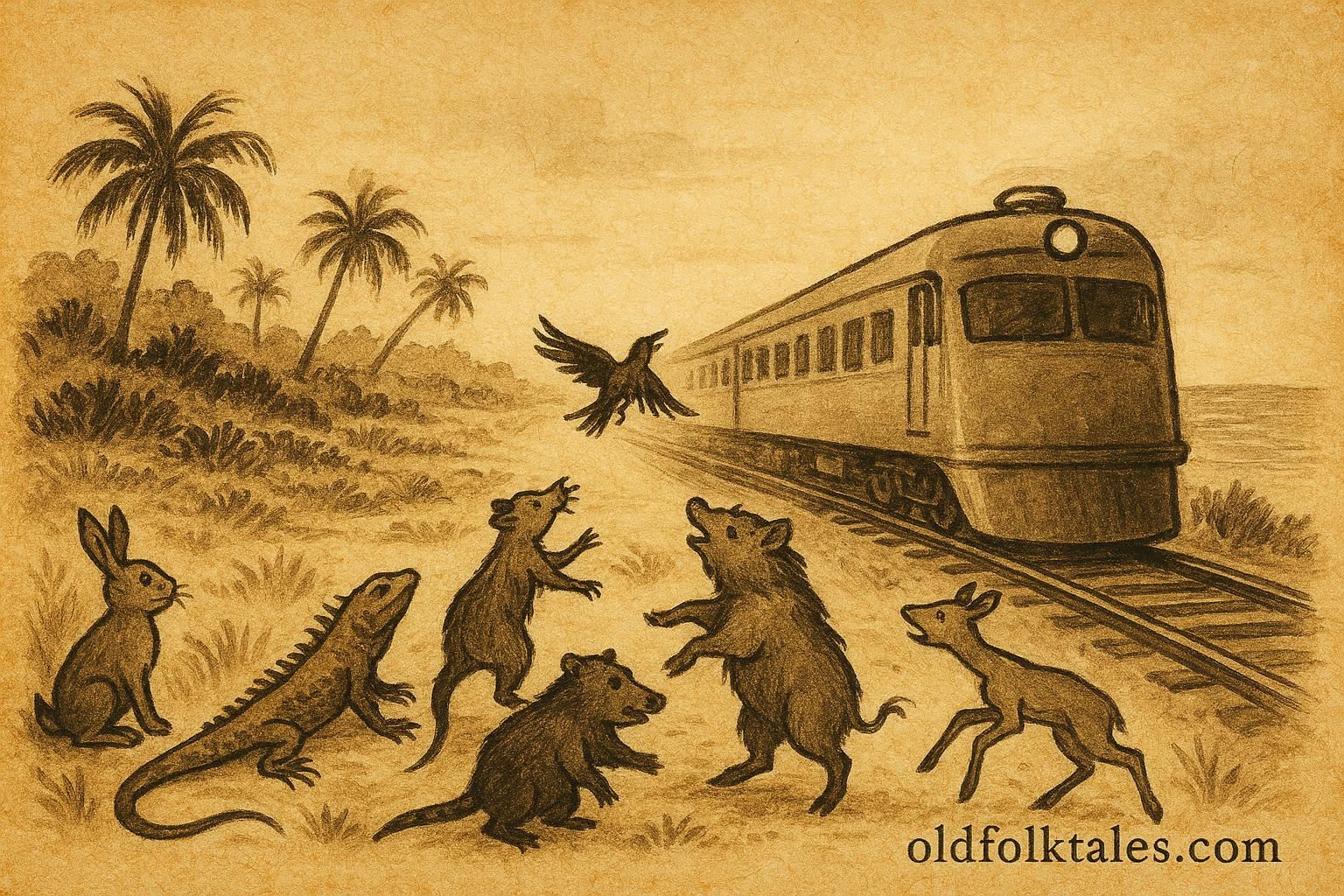
In the days when animals still gathered to listen to wonders and carried their lessons on their bodies, word spread through Nassau of a strange marvel moving along the island’s edge. It was called the Fireless Train. Unlike the noisy engines people later came to know, this train breathed no smoke and carried no burning coal. It glided forward in silence, as if pushed by unseen hands, and its cars shimmered with a quiet power that stirred curiosity in every living creature that heard of it.
The track of the Fireless Train ran close to bush and shoreline, cutting past scrubland where animals sheltered from the sun and near paths where people once walked between settlements. No flame lit its way, yet it moved. No whistle cried out, yet it arrived. For the animals, this alone was reason enough to gather and watch.
One by one, they came from the forest, the wetlands, and the rocky ground. They crept close, peered from behind trees, and circled the rails with cautious steps. Each animal believed that boarding the Fireless Train might bring advantage, excitement, or a story worth telling. Some hoped it would carry them swiftly to better feeding grounds. Others wanted nothing more than to say they had ridden the wonder everyone spoke about.
The first animals stepped forward boldly, climbing onto the cars with confidence. They tested the smooth surfaces, sniffed the air for danger, and laughed at the idea of a train that needed no fire. But the Fireless Train did not behave as ordinary things do. It responded not to strength or cleverness, but to balance, patience, and respect.
As the train shifted and moved, some animals found themselves startled by its sudden glide. Those who rushed without care slipped or stumbled. Those who crowded others were squeezed and bent. Each mishap was met not with harm, but with lasting change. When the train rolled on and the animals leapt back to the ground, they were no longer quite the same.
Still, the sight drew more creatures. Watching from the side did not discourage them; it tempted them. Each believed that their own way would succeed where others had failed. One animal tried to jump aboard at the last moment, clinging awkwardly as the car moved. Another attempted to ride high, puffed with pride, only to be pressed low by the motion. Laughter rippled through the gathering as the Fireless Train continued its quiet journey.
With every attempt, the pattern repeated. The train offered no cruelty, yet it gave no favors. Those who underestimated it learned humility. Those who pushed too hard learned restraint. And when the animals stepped away at last, the marks of their encounter remained on their bodies as reminders of what had happened.
By the time the Fireless Train reached the end of its visible track and slipped away from sight, the animals stood together in uneasy silence. They examined one another and began to understand. The odd shapes, stretched limbs, flattened features, and unusual markings they now carried were not punishments. They were stories written in flesh, signs of the choices each animal had made when faced with something unknown.
From that day forward, whenever animals noticed their differences, the elders spoke of the Fireless Train. They explained that these forms came from boldness without thought, curiosity without care, and the belief that every marvel exists for personal gain. The tale passed from generation to generation, woven into laughter and warning alike.
And so, when people later asked why animals look the way they do, the answer was given simply. It was the Fireless Train that taught them, long ago, how actions shape form and how wonder demands respect.
Moral Lesson
The Fireless Train teaches that curiosity must be guided by wisdom. Rushing into the unknown without patience or respect can leave lasting consequences, while careful attention to balance and humility helps one move safely through life’s wonders.
Knowledge Check
1. What is the Fireless Train in this Bahamian folktale?
The Fireless Train is a magical, steamless train that moves without fire and teaches animals lessons through experience.
2. Why do the animals try to board the Fireless Train?
They are driven by curiosity, excitement, and the hope of gaining advantage or adventure.
3. How do the animals change after riding the Fireless Train?
Their physical forms are altered, reflecting the mistakes or carelessness they showed while boarding.
4. What type of story is The Fireless Train?
It is a humorous “why” folktale explaining animal characteristics.
5. What cultural traditions influence this story?
The tale blends African narrative structures with Bahamian environmental observation.
6. What lesson does the Fireless Train symbolize?
It symbolizes how behavior and choices shape outcomes and identity.
Source: Bahamian folktale, Bahamas
Adapted from “The Fireless Train” in Bahamian Songs and Stories, Library of Congress Recording AFS 8378B, collected from Nassau, Bahamas, 1935.
Cultural Origin: Nassau, Bahamas