In a village where the land was dry and work was hard to find, there lived a poor boy who owned little more than his hope and his willingness to listen. His clothes were worn thin by sun and labor, and his meals were often small, yet he carried himself with quiet patience. One day, through chance rather than fortune, the boy came into possession of a tiny horse so unimpressive that others laughed when they saw it.
The horse was called Toussel.
Explore the ancestral legends of Canada, Mesoamerica, and South America’s Indigenous tribes.
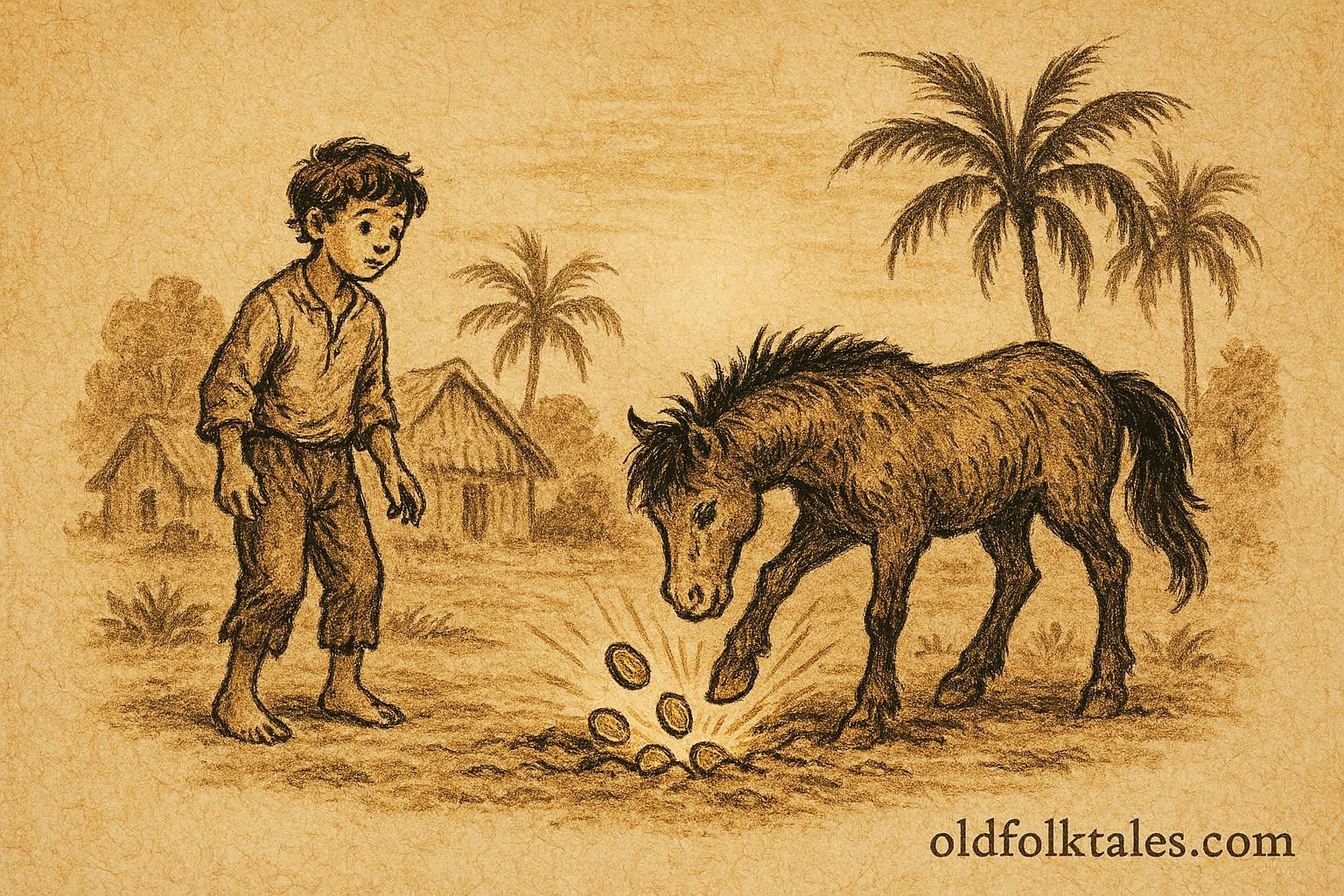
Toussel was small, rough-coated, and no taller than the boy’s chest. Its legs were thin, its mane uneven, and its eyes calm but watchful. Those who passed by mocked the boy, telling him he had been cheated. A horse like that, they said, could pull nothing, carry nothing, and earn nothing. But the boy did not turn the animal away. He had learned that what comes freely may still carry purpose.
That night, as the boy sat beside Toussel in a shed, the horse spoke.
Its voice was gentle and steady, neither loud nor commanding. Toussel told the boy not to fear his size or appearance, for he was no ordinary horse. When need arose, Toussel said, he would help, but only if the boy listened closely and followed instructions without greed or impatience.
In the days that followed, the boy’s troubles grew heavier. Hunger pressed on him, and the world offered little mercy. When he finally asked Toussel for help, the horse struck the ground lightly with its hooves. From the earth beneath them appeared gold coins, bright and solid. Toussel warned the boy to take only what he needed and no more. The boy obeyed, and for the first time, his days were no longer ruled by hunger.
Word of the boy’s sudden comfort spread, and soon powerful men took notice. The ruler of the land, hearing whispers of magic, summoned the boy and demanded proof of his fortune. Fearing punishment, the boy turned again to Toussel. The horse did not tell him to bring gold or boast of power. Instead, Toussel advised him to ask the ruler for something that seemed worthless: an old wooden box forgotten in a corner of the palace.
The ruler laughed but agreed. When the box was opened at Toussel’s instruction, it revealed wonders that proved the boy’s honesty and wisdom. Each time the ruler tested him with a new demand, Toussel guided the boy to answer not with strength or wealth, but with cleverness and restraint.
Rivals grew jealous. They tried to steal Toussel or trick the boy into revealing his secrets. Yet Toussel remained loyal, warning the boy of danger and advising him how to escape harm. When impossible tasks were set before the boy, Toussel showed him that the smallest request, wisely chosen, could undo even the greatest challenge.
In time, the boy’s patience and good judgment earned him honor and respect. Through Toussel’s guidance, he gained not only riches but the hand of a princess, not by force or deception, but by proving his worth through humility and insight. Toussel never asked for reward, only loyalty and trust.
When the boy no longer needed help, Toussel vanished as quietly as he had come, leaving behind the lesson that true power often arrives in humble form.
Moral Lesson
Toussel the Little Horse teaches that wisdom, patience, and loyalty are greater than strength or appearance. True value is often hidden, and success belongs to those who listen carefully and act with restraint.
Knowledge Check
1. Who is Toussel in the folktale?
Toussel is a small magical horse who helps a poor boy through advice and supernatural aid.
2. Why do others underestimate Toussel?
Because of his small size and plain appearance.
3. What kind of help does Toussel provide?
He produces riches and offers clever guidance to solve impossible tasks.
4. What recurring advice does Toussel give the boy?
To ask for small, seemingly worthless items that later prove powerful.
5. What cultural theme does Toussel represent?
The importance of animal helpers and hidden power in African-influenced folklore.
6. What lesson does the story teach?
That cleverness and humility are stronger than force and greed.
Source: Caribbean folktale, Americas
Adapted from Toussel the Little Horse in The Magic Orange Tree by Diane Wolkstein.
Cultural Origin: Caribbean Americas with African folkloric influence