In the highlands near Cap-Haïtien, where the warm Caribbean wind carries the scent of salt and sugarcane, there lived a young woman who often gazed at the sky. Every night, she watched the Moon rise above the hills, its silver light gliding over the palm leaves like a gentle hand. Her neighbours said she was dream-filled, but her heart yearned for something greater, beauty, peace, and mystery beyond the earth’s reach.
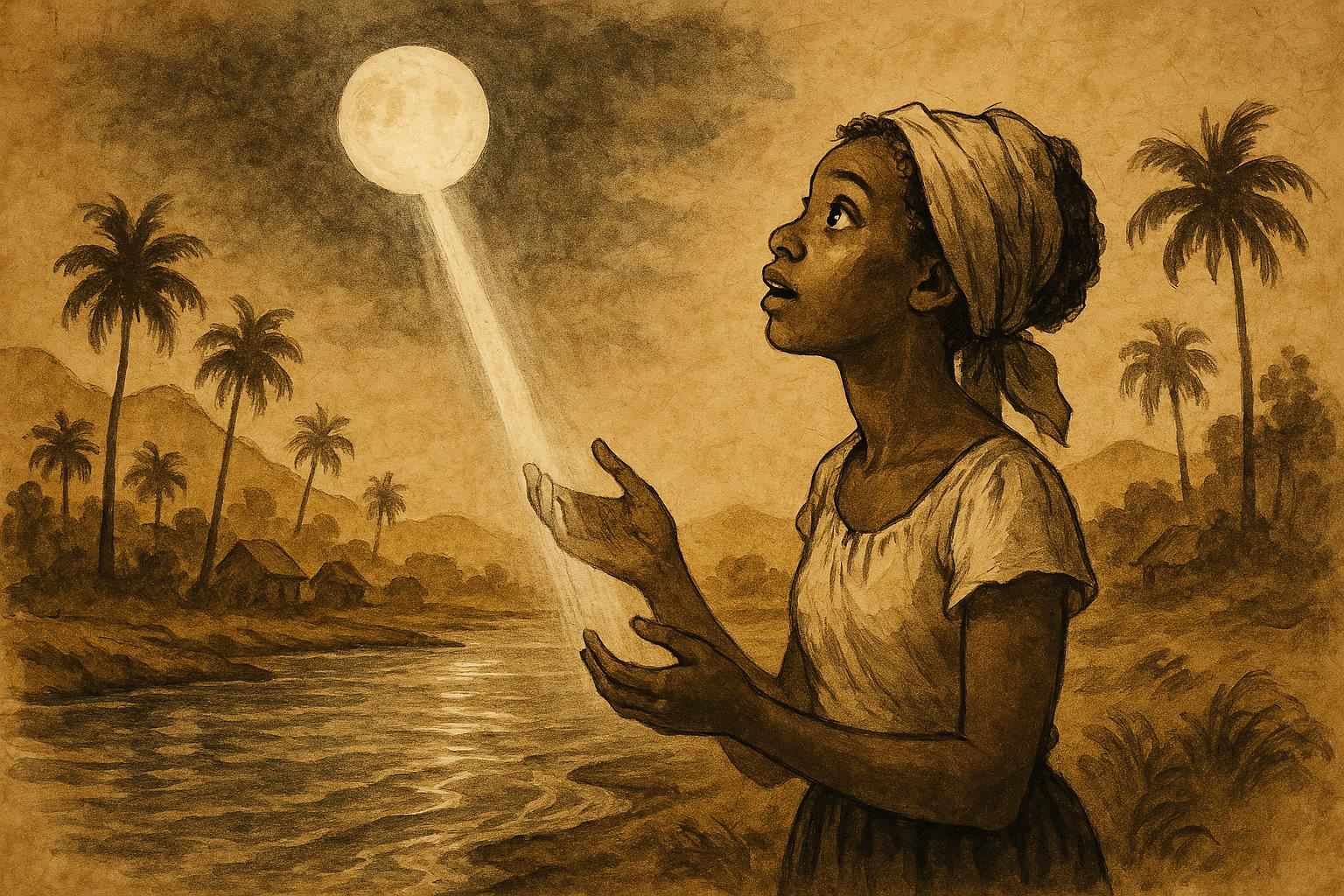
One quiet evening, while she bathed by the riverside, the air turned still. From the heavens, a soft radiance descended, a beam so bright that it turned the river to silver. Out of that beam stepped the Moon, tall and luminous, his eyes glowing like white fireflies in the dark. He spoke softly, calling her by name, and asked her to be his wife.
Overcome by awe and love, she accepted. The Moon wrapped her in his light and carried her up, far beyond the clouds, to his shining palace in the sky. There, everything sparkled, walls of moonstone, floors of mist, gardens of light. The young woman’s days were filled with beauty, yet her heart began to ache for the world she had left behind, for her mother, her friends, and the sounds of the sea.
The Moon, seeing her sorrow, warned her gently:
“If you look down upon the earth again, you may never return as you were.”
But longing has a power that even light cannot bind. One night, while the Moon slept, she walked to the edge of his glowing garden. Through a curtain of clouds, she looked down, and saw her mother standing before their hut, hands lifted in grief, calling her name. The sight pierced her soul. Tears fell from her eyes, shining as small stars.
In her despair, she leapt from the sky. The heavens shuddered, and a rain of light followed her. She fell not as a woman, but as a shower of silver fire, her spirit breaking into countless stars that glittered across the night. From that day, the people said, the Moon looked dimmer, as though wrapped in sorrow.
When the crescent Moon rises thin and low, the elders whisper that he is mourning his lost bride. They point to the bright evening star and say it is she, the woman who married the Moon, shining ahead of him to guide his nightly path.
This tale, carried through generations of Haitian storytellers, reminds listeners of the delicate balance between love and desire, between reaching for the divine and honouring one’s roots.
Moral Lesson
Longing for what lies beyond reach can bring both beauty and sorrow. True wisdom lies in cherishing the light already within one’s world.
Knowledge Check
1. Who is the main character in “The Woman Who Married the Moon”?
A young woman from Cap-Haïtien who longs for the beauty of the Moon and marries him.
2. What does the Moon symbolise in this Haitian folktale?
The Moon represents divine beauty, mystery, and the eternal longing between earth and sky.
3. What is the moral of the story?
The tale teaches that reaching for the impossible may bring wonder but also heartbreak.
4. What cultural beliefs influence this story?
It reflects Haitian Vodou cosmology, especially the symbolism of Damballah (the serpent of creation) and Ayizan (the mother spirit).
5. How does the woman’s spirit appear after her fall?
Her spirit becomes the evening star, shining in remembrance of her celestial love.
6. What region of Haiti is this folktale from?
The story originates from the Cap-Haïtien region in northern Haiti.
Source: Adapted from the Haitian folktale “The Woman Who Married the Moon” in The Magic Orange Tree and Other Haitian Folktales, collected by Diane Wolkstein (1978).
Cultural Origin: Haiti (Vodou cosmology, Northern Haiti / Cap-Haïtien).