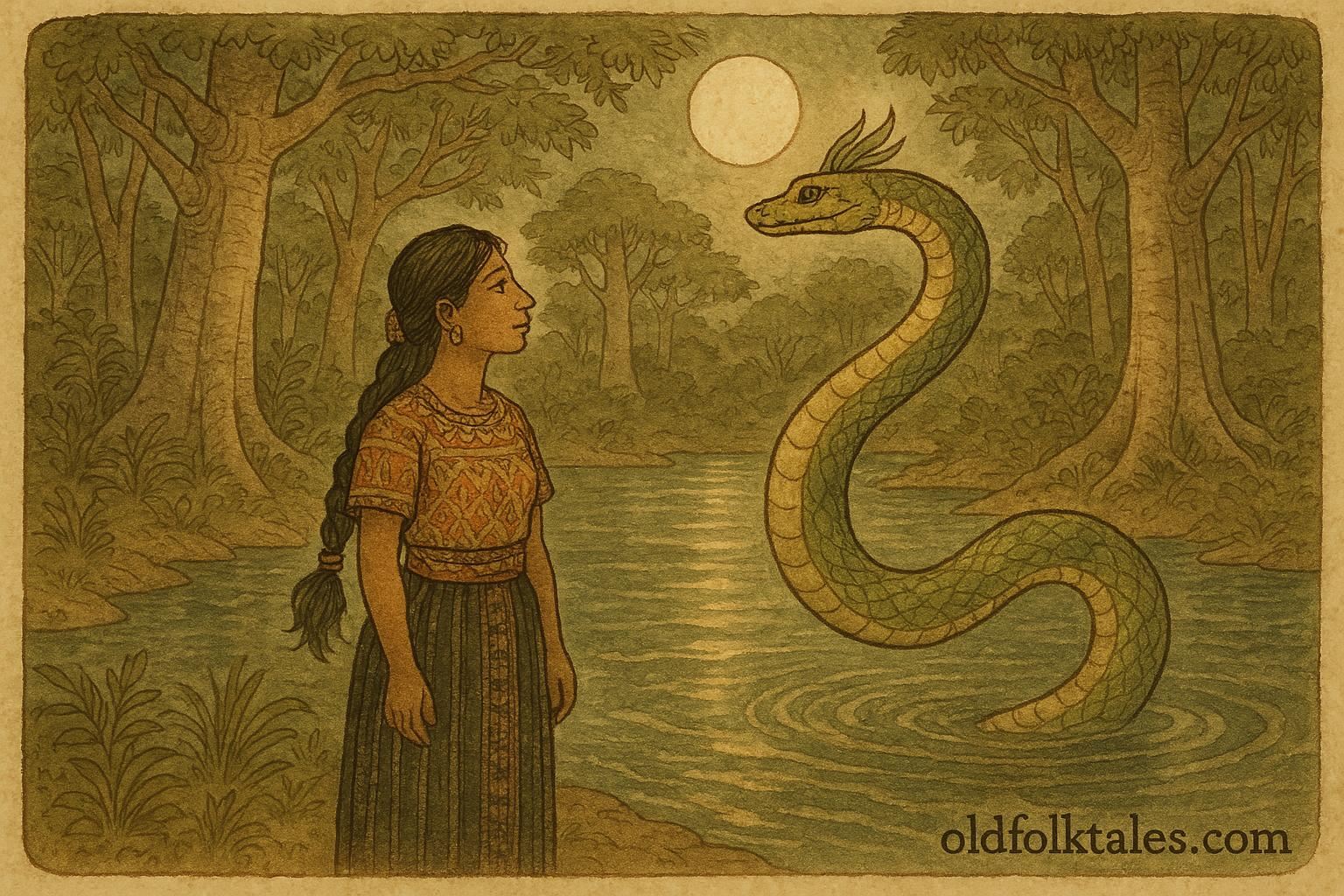
In the lush highlands of Guatemala, where mist clings to the green mountains and rivers run like silver threads through the forest, there lived a young woman known for her beauty and kindness. Each morning she walked to the riverbank to fetch water, humming softly as the sunlight danced on the rippling surface. The villagers often warned her not to linger too long by the water, for the spirits of the river were said to enchant those who listened too closely. But she only smiled, believing the forest and rivers to be her friends.
One day, as she filled her clay jar, she heard a song unlike any other, deep, sweet, and full of sorrow. The melody rose from the heart of the river, echoing softly through the trees. She looked around but saw no one. Then, from the shimmering water, a handsome young man emerged. His eyes gleamed like wet jade, and his voice carried the rhythm of flowing streams.
He greeted her gently, saying he had come to the river each day to hear her sing. They spoke until the sun began to fade behind the mountains. From that day on, they met daily at the same spot. The villagers noticed her joy and the light in her eyes, but she told no one about the stranger. Love had grown quietly between them, a love both human and otherworldly.
When he asked her to marry him, she agreed without hesitation. They performed a secret ceremony beneath the ceiba trees, the sacred guardians of the forest. The river wind whispered through the leaves as they pledged their vows. But as soon as the final words were spoken, the young man turned toward the water. “I must go home now,” he said. “Follow me if your heart is true.”
Confused but trusting, the woman followed him. As he stepped into the river, his body began to shimmer, twisting and lengthening. Before her eyes, his form transformed into a magnificent serpent, scales glistening with emerald and gold. She gasped, trembling in both awe and fear. The serpent turned his great head toward her, his voice still soft: “Do not be afraid. This is who I am.”
Torn between love and terror, she hesitated only a moment before stepping into the river after him. The water enveloped her in its cool embrace, and she was carried deep below the surface to a hidden realm of light and shadow. There, upon a stone throne carved with ancient symbols, her serpent husband coiled in majesty. Water spirits moved like silver mist around them, singing songs older than the mountains.
Though frightened, the woman remained faithful. She lived beside the serpent lord in his watery palace, and in time she bore children, half-human, half-snake, their bodies graceful and strong. They grew quickly, their laughter echoing like ripples across the current. The river itself seemed to bloom with life wherever they swam.
Years passed, and the villagers began to notice that the woman no longer came to fetch water. Only her footprints remained near the river’s edge. One day, a terrible drought struck the land. The fields withered, and the river began to shrink. Desperate, the villagers gathered at the dry banks, remembering the woman who had once vanished into the water. The elders said, “She lives with the spirit of the river. We must call to her and her children for mercy.”
They brought offerings, flowers, maize, and clay bowls filled with honey, and placed them by the water. As they prayed, a gentle rain began to fall. The river swelled once more, and life returned to the valley. From that time onward, whenever drought threatened, the villagers would bring gifts to the river, whispering prayers to the serpent woman and her children, the guardians of the rain.
Even today, the Q’eqchi’ people of Alta Verapaz speak of the woman who followed her heart into the depths, becoming one with the sacred river. Some say that on quiet evenings, when the moonlight touches the water, her song can still be heard — soft and haunting, carried by the serpent spirits that dwell beneath the surface.
Moral Lesson
The story teaches that true love recognizes spirit beyond form, and that devotion and respect for nature’s mysteries bring harmony between humans and the natural world.
Knowledge Check
1. Who is the main character in this folktale?
A young Guatemalan woman who falls in love with a mysterious stranger from the river.
2. What is the true identity of the stranger?
He is a powerful serpent spirit, guardian of the river’s life and balance.
3. What transformation occurs after their marriage?
The woman discovers her husband’s serpent form and joins him beneath the river.
4. Who are their children, and what do they represent?
Their half-human, half-snake children become river spirits who bring rain and fertility.
5. How do the villagers honor the serpent woman and her descendants?
By bringing offerings to the river during droughts to ensure rain and renewal.
6. What is the cultural meaning of this tale?
It reflects Q’eqchi’-Maya beliefs in the sacred bond between humans, love, and nature’s elemental spirits.
Source: Adapted from the Q’eqchi’-Maya folktale “The Woman Who Married a Snake” in Leyendas de Guatemala by Miguel Ángel Asturias (CulturaGuate.com PDF Edition, 2022).
Cultural Origin: Guatemala (Q’eqchi’-Maya folklore)