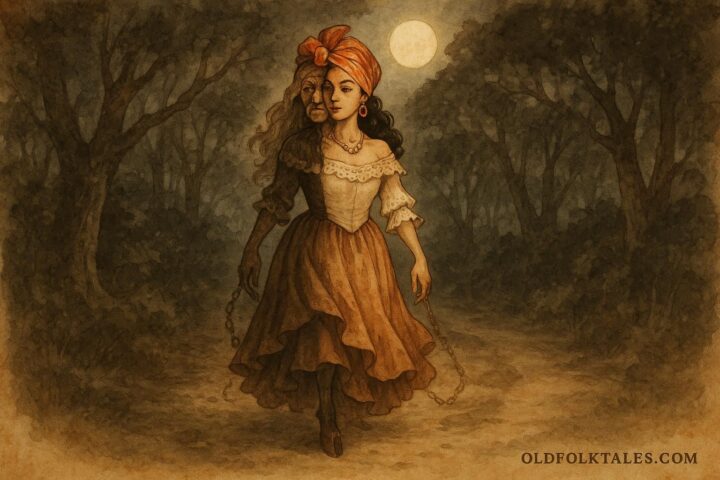
At the quiet edge of Roseau, where the village thinned into bush and shadow, there stood a small, weathered house that most people avoided. It belonged to an old woman who lived entirely alone. By day she appeared ordinary, if distant, moving slowly through the market or along the roadside, her eyes lowered and her words few. Yet whispers followed her footsteps, for the villagers believed she was no ordinary woman. They said she was a soucouyant, a witch who preyed upon her own community under cover of darkness.
In Roseau, such fears were not taken lightly. Stories of soucouyants had been passed down for generations, warning that these beings walked among the living, hidden behind familiar faces. By night, it was said, a soucouyant would remove her skin, leaving it behind like an empty garment. Freed from her human form, she would rise into the air as a glowing ball of fire, drifting silently through the village in search of the sleeping and the vulnerable.
For a long time, these tales remained only rumors. But then a troubling pattern emerged. A neighbor living not far from the old woman noticed his young child growing weak. Each morning, the child woke paler than the day before, exhausted and listless, despite having eaten and rested well. No illness could explain the steady decline. The father listened closely as elders spoke in hushed tones of nocturnal visitations and unseen forces that drained life itself.
Determined to uncover the truth, the man resolved to watch. One night, after the village lamps had dimmed and silence settled over Roseau, he hid himself near the old woman’s house. The moon hung low, casting pale light across the yard. Hours passed before movement stirred within the small dwelling.
At last, the old woman emerged. She glanced about cautiously, then stepped into the shadows. What happened next confirmed every fear the village had harbored. Slowly and deliberately, she peeled away her skin, placing it carefully into a large mortar hidden near the house. What remained rose upward, transforming into a fiery glow that lifted into the sky and vanished toward the sleeping village.
The man stood frozen, both terrified and resolute. Remembering the old teachings, he approached the mortar and found the skin exactly as described in the stories. From his pocket, he took salt and hot pepper, common household items but known throughout Dominica as powerful spiritual defenses. He rubbed them thoroughly into the skin, ensuring every surface was covered, then retreated to wait.
Just before dawn, the glowing fire returned, descending silently into the yard. The soucouyant reached for her skin and pulled it on once more. Instantly, her cries shattered the stillness. She screamed in agony, writhing as the salt and pepper burned against her flesh. Her pain was so great that she called out for help, pleading for mercy and relief.
Her cries drew the villagers from their homes. As they gathered, they recognized the old woman at once, her secret finally exposed. In her suffering, she revealed what she truly was, confirming the suspicions that had haunted Roseau for so long. The power of simple substances, guided by knowledge and vigilance, had broken her disguise.
By sunrise, the threat was gone. Whether the soucouyant fled, perished, or was cast out, the tale does not say. What remained was a village freed from fear and reminded that evil often hides close at hand. From that day forward, the people of Roseau remembered the importance of awareness, communal responsibility, and the protective wisdom handed down by their ancestors.
Moral Lesson
This folktale teaches that danger does not always come from strangers, but can exist within familiar spaces. It emphasizes vigilance, shared knowledge, and the belief that ordinary tools, when guided by wisdom, can protect a community from hidden harm.
Knowledge Check
1. Who is the central figure in The Witch of Roseau?
The central figure is an old woman revealed to be a soucouyant living on the edge of the village.
2. What is a soucouyant in Caribbean folklore?
A soucouyant is a witch believed to shed her skin and drain the life force of sleeping victims.
3. Why does the neighbor begin to suspect the old woman?
His child grows weak without illness, matching signs associated with soucouyant attacks.
4. What role do salt and hot pepper play in the story?
They are traditional spiritual protections used to expose and defeat witchcraft.
5. What does the witch’s scream symbolize?
It represents the exposure of hidden evil and the loss of deceptive power.
6. What cultural belief does the story reinforce?
It reflects Caribbean beliefs about internal threats and communal vigilance against witchcraft.
Source and Cultural Origin
Source: Caribbean Quarterly, Vol. 8, No. 4, Folklore Research in Dominica (1962), via dLOC
Cultural Origin: Roseau, Dominica