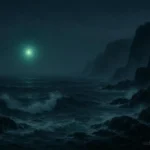
Long ago, before humans counted time by the rising and setting of the sun, before the stars were named and charted, the Cree people looked up to the heavens and saw stories written in light. One of the most enduring of these tales is that of the Great Bear and the Seven Hunters, a legend of courage, loyalty, and the eternal bond between family and nature.
In a vast forest that stretched across the northern lands, a family of hunters lived in peace. The father was a great warrior known for his strength and kindness, and his seven sons were skilled hunters who followed in his footsteps. They hunted only what they needed and always gave thanks to the spirits of the animals they took. The forest loved them for their respect, and the winds carried songs of their good deeds.
But one fateful spring, a monstrous bear came down from the mountains. Its roar echoed like thunder, shaking the trees and frightening the animals from their homes. The bear was enormous, with fur as dark as night and eyes that gleamed with fury. No arrow could pierce its hide, and no trap could hold it. The people called it Misabe, the Great Bear.
Explore the ancestral legends of Canada, Mesoamerica, and South America’s Indigenous tribes
The Great Bear began to hunt the hunters. It destroyed the family’s camp and struck down their father before disappearing into the forest. The brothers gathered around their fallen father, vowing that they would not rest until the Great Bear was defeated. “We will avenge our father,” said the eldest. “We will chase Misabe until the spirits themselves guide our arrows.”
The brothers prepared for the long hunt. They crafted new weapons, prayed to the sky spirits for courage, and painted their faces with red and black to show their purpose. When dawn came, they followed the tracks of the Great Bear into the deep forest.
For days they traveled, through rain and wind, over rivers and through mountains. They saw the bear’s massive footprints pressed into the mud, but every time they drew near, the creature vanished into the shadows. They learned its ways, how it moved silently despite its size, how it could vanish like smoke among the trees.
Each night, the brothers camped beneath the open sky. As the fire crackled, they would look up at the stars and draw courage from their father’s spirit, believing that he watched them from above. The youngest brother often whispered, “Maybe one day, we too will join the stars.” The others would smile, thinking it only a dream.
Summer passed into autumn, and the bear’s trail led them higher into the mountains where the air was thin and the snow never melted. At last, one morning, they saw Misabe resting in a clearing, its breath rising like clouds of mist. The brothers crept closer, their hearts pounding. The eldest drew his bow and let fly an arrow tipped with obsidian.
The arrow struck the bear’s side but did not kill it. Misabe roared, shaking the mountain itself, and fled into the sky. The brothers did not hesitate, they followed. With each stride, their feet grew lighter until the earth fell away beneath them. The sky opened above, and suddenly they were running among the stars.
The Great Bear climbed higher, leaving a trail of light behind. The brothers spread out in pursuit, each one shining with the fire of courage and love. The oldest ran closest to the bear, his bow always drawn, while the youngest followed behind, his heart full of awe.
Every year, the Cree people say, this chase continues. In the spring, the Great Bear rises in the northern sky, waking from its winter sleep. The Seven Hunters follow close behind, their bright stars forming a great arc across the heavens. As summer comes, the hunters draw nearer, and the bear bleeds red as its wounds open, a sign seen in the red leaves of autumn. When winter falls, the bear grows weak and sinks below the horizon, and the hunters rest, waiting for the chase to begin again.
The people still look up at night and see the Great Bear and the Seven Hunters shining above them. The Big Dipper is the bear, and the stars that trail behind it are the hunters who never give up. The Cree say this story teaches that bravery and love do not end with death, they rise beyond it, written forever in the stars.
Generations of storytellers have passed the legend from one campfire to another, reminding each listener of the courage to face great challenges and the strength that comes from standing together. The stars shift, the seasons change, but the chase never ends.
The Great Bear still runs, and the Seven Hunters still follow, their eternal pursuit lighting the sky with the memory of family, courage, and the unbreakable bond between the earth and the heavens.
Explore French-Canadian legends and First Nations myths in our Canadian Folktales collection
Moral Lesson
The story of the Great Bear and the Seven Hunters teaches that love, loyalty, and courage live beyond life itself. It reminds people that unity gives strength and that even in loss, our spirits can rise to shine forever. The stars are not distant strangers, they are our ancestors, watching over us and keeping their promises for all time.
Knowledge Check
1. Who was Misabe in the story of the Great Bear and the Seven Hunters?
Misabe was the giant bear that killed the brothers’ father and became the creature they pursued across the sky.
2. Why did the seven brothers decide to hunt the Great Bear?
They wanted to avenge their father and prove their loyalty and courage as hunters.
3. How did the brothers manage to follow the bear into the sky?
As they chased the bear up the mountain, their determination and spirit lifted them into the heavens.
4. What does the Great Bear become in the night sky?
The Great Bear became the Big Dipper constellation, and the Seven Hunters became the stars that follow it.
5. What natural event does the story use to show the bear’s wounding?
The changing color of the leaves in autumn represents the blood of the wounded bear.
6. What is the main message of the legend for the Cree people?
It teaches courage, unity, and the eternal connection between humanity, nature, and the spirit world.
Source
Adapted from Cree Legends and Stories from the West Coast by Basil Johnston (1981) and Stars and the Sky: Cree Celestial Legends (University of Manitoba Press).
Cultural Origin
Cree First Nations, Plains and Woodland regions of Canada