In the deep winters of old Quebec, when the snow lay thick upon the rooftops and the rivers were frozen in silence, the people of the small parishes found warmth not only in their hearths but in their gatherings. Dances were a cherished escape from the cold and the monotony of rural life. The halls were simple wooden rooms lit by lanterns and candles, filled with laughter, fiddles, and the tapping of boots on rough-hewn floors.
One evening, in a small village by the Saint Lawrence River, a dance was held to celebrate the end of the harvest season. The air was crisp, and the stars sparkled like frozen embers above the darkened fields. Inside the parish hall, the air was alive with joy. Young men adjusted their collars nervously, and young women, cheeks flushed with excitement, tied ribbons in their hair. The musicians tuned their fiddles, and the sweet sound of reels and jigs filled the air.
Among the dancers was a girl named Marguerite. She was bright, kind-hearted, and known for her graceful steps. No one in the parish could match her on the dance floor, and whenever she twirled, it was said that even the fiddles played sweeter. Her father, a cautious man, had always warned her, “Remember, my child, midnight belongs to no mortal. Leave the floor before the church bell tolls twelve.”
Discover the vibrant legends of Guatemala, Honduras, and Costa Rica in our folktale collection.
Marguerite would smile and promise to obey, for she was a good girl and devout in her faith. But that night, with laughter echoing around her and the air so full of life, she forgot her father’s warning.
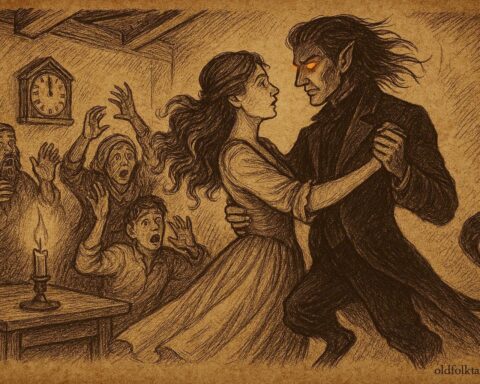
As the candles burned low and the snow drifted softly outside, a sudden chill swept through the room. The door creaked open, and a stranger stepped in. He was tall, dressed in fine black clothes, with a silver buckle on his boots that gleamed in the candlelight. His face was handsome but pale, and his eyes seemed to shine with a strange light that caught Marguerite’s attention at once.
The crowd fell silent for a moment, unsure of who this newcomer might be. But when he smiled and asked to join the dance, the fiddler raised his bow again, and the music resumed. The stranger moved like no man the villagers had ever seen. His steps were swift and perfect, his turns elegant, and when he held Marguerite’s hand, she felt both exhilaration and unease.
The two danced tirelessly. Around them, the crowd clapped and cheered. The fiddlers, inspired by the stranger’s rhythm, played faster and faster until the very air seemed to vibrate with sound. Marguerite’s heart pounded in her chest. She felt as though she could dance forever.
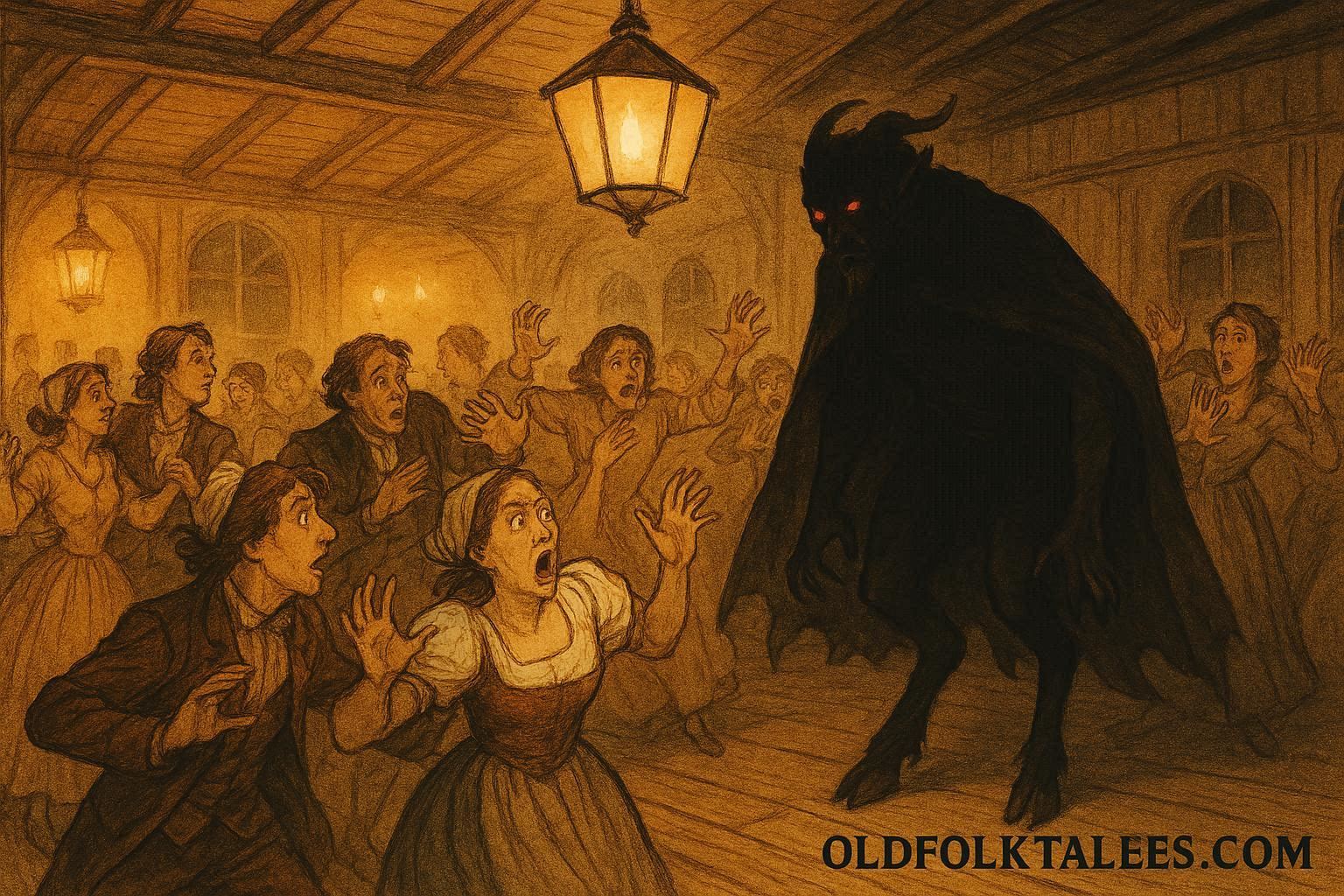
Then, a sharp-eyed girl standing nearby gasped. In the flicker of the candles, she saw something that froze her blood. Beneath the stranger’s fine trousers, where his shoes should have been, were not feet at all but cloven hooves like those of a goat.
She screamed, “Stop the dance! His feet! Look at his feet!”
The music faltered. Marguerite stopped mid-step and looked down. For a brief moment, she saw the truth, the glint of hoof and the faint smell of sulfur in the air. She stumbled backward in terror as the stranger’s smile twisted into something dark and cruel. The lights flickered, and the fire in the stove flared as though fed by unseen wind.
The crowd screamed and rushed toward the doors, but they would not open. The stranger laughed, and his voice filled the hall like thunder. “You dance well, my dear Marguerite,” he said, his eyes blazing red. “Come, let us finish our dance in the place where the fire never dies.”
Marguerite fell to her knees and cried out, “Save me! Holy Mary, protect me!”
At that very moment, the parish priest, Father André, who had been returning from a neighboring village, heard the cries. He burst through the door, raising a small crucifix. The light from the candles grew brighter, and the laughter of the Devil turned into a roar of fury. With a shout, Father André sprinkled holy water and prayed aloud. The stranger staggered backward, his form flickering like smoke in the firelight. Then, with a great crack of thunder, he vanished, leaving behind only the smell of burning sulfur and a scorched mark upon the wooden floor.
The hall fell silent except for the sound of the wind outside. Marguerite wept, trembling as the priest placed his cloak around her shoulders. The villagers crossed themselves, their faces pale with fear. That night, no one spoke loudly, and no one stayed up late.
In the days that followed, Marguerite withdrew from the dances she once loved. She spent her time in prayer, visiting the church every morning at dawn. Though she never again set foot in the parish hall, she was grateful for her deliverance and devoted her life to faith. The story of that night spread from village to village, and people spoke of it whenever the winter dances began.
It is said that sometimes, when the music grows too wild or the hour grows too late, a gust of cold air enters the hall. The candles flicker, and the fiddler’s bow falters, as if to remind everyone of the Devil who once came to dance. And so the people learned to end their joy before midnight, lest darkness claim it again.
Explore French-Canadian legends and First Nations myths in our Canadian Folktales collection
Moral Lesson
The story of The Devil at the Dance teaches the importance of moderation and vigilance. It warns against temptation disguised as pleasure and reminds people that joy without restraint can invite danger. Faith and moral awareness protect the heart, even when evil appears charming and beautiful.
Knowledge Check
1. Who was Marguerite and what was she known for?
She was a young woman in the village, admired for her grace and skill in dancing.
2. What warning did Marguerite’s father give her?
He told her never to dance past midnight because that time belongs to the spirits, not humans.
3. What made the stranger at the dance so captivating?
He was a mysterious, elegant dancer who moved with perfect skill and charm.
4. How did the villagers discover the stranger’s true nature?
A girl noticed that his feet were cloven like a goat’s, revealing that he was the Devil.
5. Who saved Marguerite from the Devil?
The village priest, Father André, entered with a crucifix and drove the Devil away with holy water and prayer.
6. What lesson did the villagers learn from this event?
They learned to practice moderation, avoid temptation, and end their festivities before midnight to stay safe from evil.
Source
Adapted from Canadian Legends and Folklore by W. H. Blake (1925).
Cultural Origin
Quebec, French-Canadian Folklore