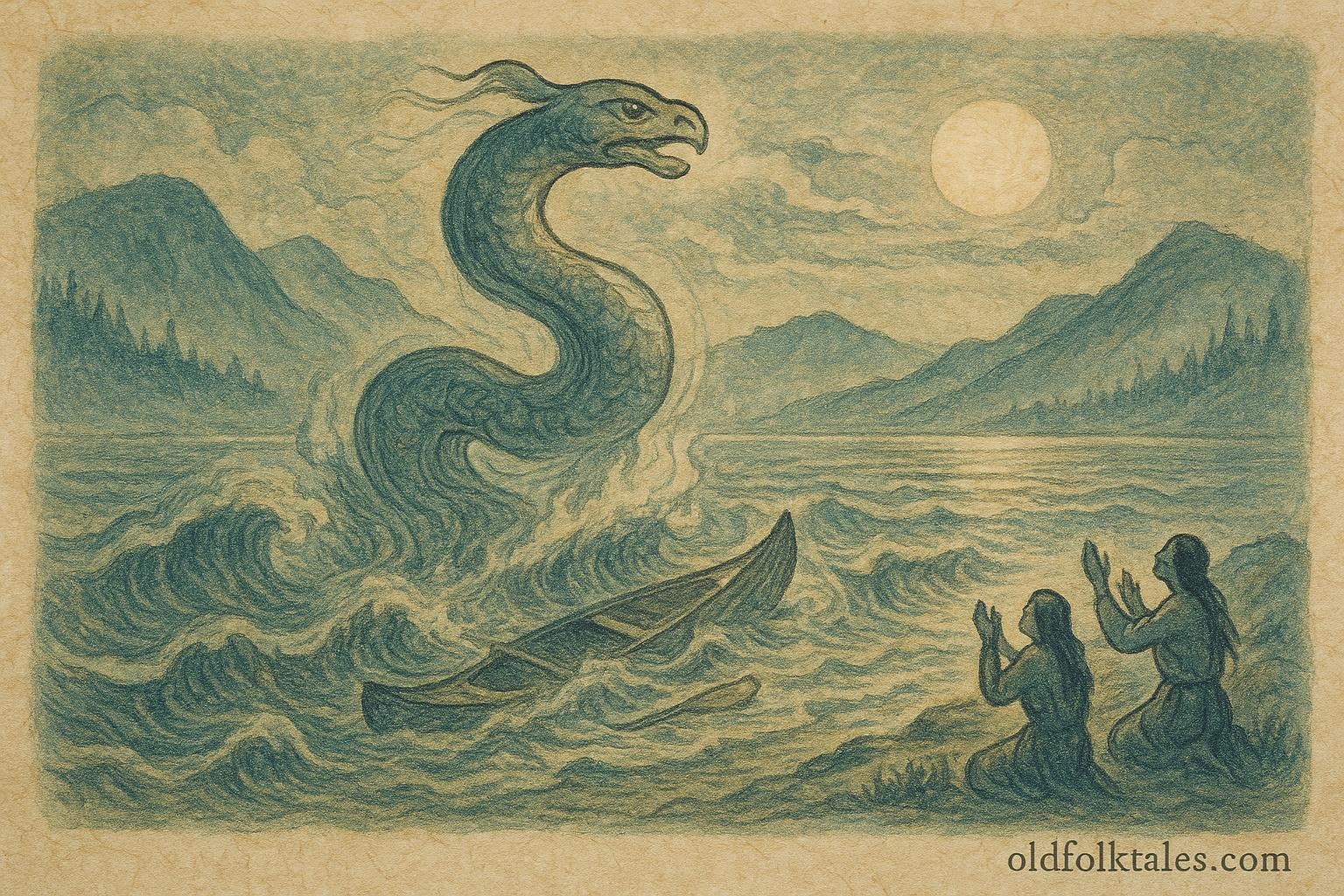
Beneath the wide blue skies of the Okanagan Valley lies a lake so deep and still that the mountains seem to lean over its surface to see their own reflections. Long before towns rose upon its shores and boats cut across its waters, the Okanagan people knew the lake as sacred. They called it the home of N’ha-a-itk, the powerful spirit who guarded its depths.
To the Syilx people, N’ha-a-itk was not a creature of fear, but one of reverence. It was the keeper of balance, the guardian of all waters that nourished the valley. The elders taught that every ripple upon the lake carried the spirit’s breath and that all who crossed its waters must do so with respect and prayer.
Explore the land of La Llorona, trickster coyotes, and magical realism in Mexican folklore
For generations, the people lived by these teachings. They approached the lake with offerings, small bundles of sage, cedar, or beads, dropped gently into the waves. They whispered words of gratitude for fish, for water to drink, and for the cool winds that came off the surface during hot summers. The lake was alive, and N’ha-a-itk was listening.
The Journey Across the Lake
One summer, a group of young travelers prepared to cross the great Okanagan Lake. They were strong, full of pride, and eager to reach the far side where a gathering was to be held. The sun shone bright upon the water as they loaded their canoe with food and gifts, laughing among themselves.
An elder, seeing them from the shore, called out a warning. “Remember to greet N’ha-a-itk before you cross. The water is not ours to command. It belongs to the spirit who sleeps beneath it.”
But the travelers, full of confidence, waved off the advice. “We are skilled paddlers,” they said. “The lake is calm, and we will cross it quickly.”
Without offering tobacco or song, they pushed their canoe into the still water and began to paddle.
At first, the journey was easy. The lake stretched before them like glass, the reflection of the sky so perfect that they seemed to be floating through the heavens. Laughter echoed across the surface as they raced each other, their paddles cutting through the mirror-like calm.
But as they reached the deep heart of the lake, the laughter began to fade.
The Rising of the Spirit
A shadow passed beneath the canoe. The water darkened as though a cloud had crossed the sun, yet the sky remained clear. A sudden chill rippled through the air.
One of the travelers leaned over the edge, peering down into the depths. He saw movement far below, a shifting darkness that seemed to breathe. “Did you see that?” he whispered.
Before anyone could answer, the lake began to heave. The canoe rocked violently, waves rising where moments before there had been calm. The travelers shouted in alarm, trying to steady themselves, but the water grew wilder still.
From beneath the surging waves came a sound, low and thunderous, like the rumble of the mountains themselves. Then the water erupted.
The surface split apart as N’ha-a-itk rose, immense and terrible, surrounded by swirling foam. The spirit’s form was hidden by mist and spray, part serpent, part shadow, shimmering with the colors of the lake itself. Its voice filled the air and the hearts of those who heard it.
“You cross my waters without honor,” it thundered. “You forget the gifts that keep you alive. You take, and you do not give.”
The canoe tilted sharply, and the travelers were thrown into the storming water. The waves swallowed their cries as the wind roared around them. Only those who remembered the elder’s words called out in prayer. “Forgive us, N’ha-a-itk! We meant no harm!”
The Offering of Peace
When the survivors finally reached the shore, they were trembling and breathless. The lake, once their path, had nearly become their grave.
They gathered together on the sand, weeping for those who had been lost to the deep. The elder who had warned them approached slowly, his face solemn but kind.
“You forgot the old ways,” he said. “The lake is alive. It hears your words and feels your actions. N’ha-a-itk does not destroy without reason. The spirit teaches through balance, punishing disrespect, rewarding humility.”
The travelers bowed their heads in shame. That night, they built a small fire by the water’s edge. Around it, they placed their gifts, woven blankets, food, and small carved figures of animals. They sang the old songs of apology and thanks, letting their voices drift across the waves.
For a long time, the lake remained silent. Then, slowly, the wind softened. The surface grew still. The stars reflected once more upon the calm water.
The people felt the spirit’s forgiveness in the quiet that followed. N’ha-a-itk had accepted their offering.
The Legacy of the Lake Spirit
From that day onward, the Syilx people renewed their covenant with the lake. Each crossing began with prayer. Offerings were made before fishing, and words of thanks were spoken after each catch.
The elders reminded the young ones: “The lake is our mirror. Treat it with respect, and it will keep its peace. Forget that respect, and the waters will remember.”
Even now, when the wind rises suddenly upon Okanagan Lake or strange ripples appear where none should be, the people say that N’ha-a-itk stirs in its depths, reminding humankind to honor the living world.
Explore the ancestral legends of Canada, Mesoamerica, and South America’s Indigenous tribes.
Moral Lesson
N’ha-a-itk: The Spirit of Okanagan Lake, teaches that nature is sacred and alive. Respect and humility sustain harmony, while arrogance brings imbalance. Through reverence and gratitude, humans and the natural world remain in peaceful coexistence.
Knowledge Check
- Who is N’ha-a-itk in Syilx (Okanagan) legend?
N’ha-a-itk is the sacred water spirit who lives in Okanagan Lake and guards its balance. - What happened when the travelers disrespected the lake?
N’ha-a-itk rose in anger, stirring the waters into waves that overturned their canoe. - How did the survivors calm the spirit?
They made offerings and sang prayers of apology, showing respect and humility. - What does the legend of N’ha-a-itk symbolize?
It symbolizes the sacred relationship between humans and nature, and the need to honor all living forces. - How do the Syilx people show respect to the lake today?
They continue to offer prayers and gratitude before crossing or fishing in Okanagan Lake. - What moral lesson does the story teach?
That harmony depends on humility and reverence for the natural world’s spirits and powers.
Source: Adapted from The Story Begins: Mi’kmaq and Okanagan Legends, The Confederacy of Mainland Mi’kmaq (1996).
Cultural Origin: Syilx / Okanagan First Nations, British Columbia, Canada.