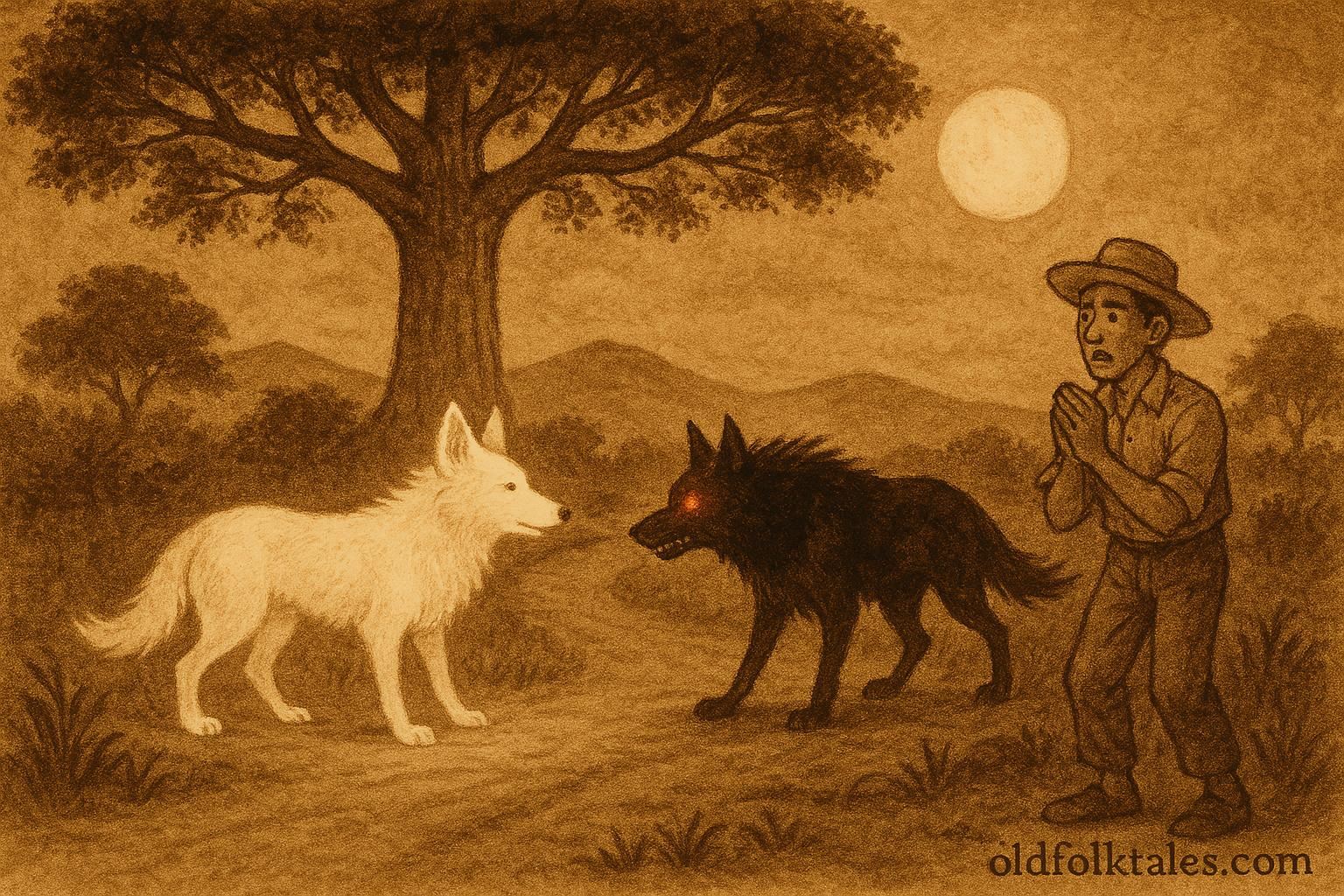
In the deep heart of Nicaragua, where folklore still breathes through the whispering winds and moonlit paths, people speak in hushed tones of El Cadejo, not one creature, but two. The first, a white dog of gentle glow, protects travellers with pure hearts. The second, black as midnight and fierce as sin, stalks those who wander in vice and darkness. Together, they embody the eternal struggle between good and evil, a warning carried by every Nicaraguan night breeze.
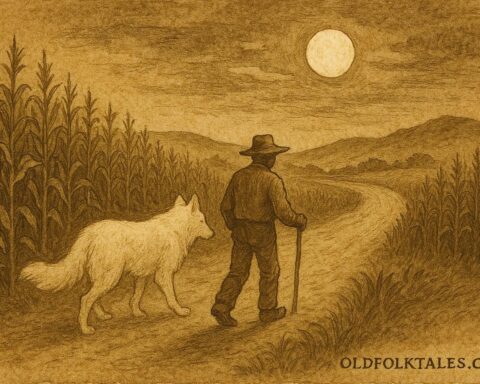
It is said that the White Cadejo appears as a radiant dog, its fur glimmering like mist touched by moonlight. When it walks, its paws leave no sound, only the faint scent of flowers and the calm of protection. Villagers believe it guards the innocent, the weary labourer returning home, the lonely wanderer who prays for safety, and the youth tempted by the shadows of the road.
Click to read all South American Folktales — timeless stories from the Andes to the Amazon.
The Black Cadejo, however, is a thing of dread. It slinks through the dark, eyes burning red like coals from hell’s own hearth. Its breath reeks of sulfur, its chains clinking as if dragging the sins of men. Where the White Cadejo brings peace, the Black Cadejo brings terror and ruin, feeding on fear and guilt. Those who cross its path are said to go mad, fall ill, or vanish before sunrise, taken by their own corruption.
Long ago, a farmer from a Nicaraguan village mocked the tales. He was strong, proud, and fond of rum. “Stories for children!” he laughed. One evening, he travelled to the next village for a festival, drinking deep into the night. By the time he staggered back, the moon was high and the road was empty, save for the distant cry of a night bird and the rustle of the ceiba trees.
As he stumbled along the dirt road, a shape emerged ahead, a black dog, large and silent, its eyes glowing red. The farmer froze, the drink in his veins turning to ice. He tried to move, but his legs trembled. The Black Cadejo began to circle him, its breath heavy, its tail lashing the ground like thunder. Every step it took was a promise of doom.
Desperate, the farmer whispered a prayer, the first in many years. “God, protect me… Holy Mother, save me…”
Then, as if the heavens heard, a soft light bloomed beside him. From the shadows came another dog, white as dawn, its eyes kind but fierce. The two Cadejos faced each other, growling low, circling in a clash older than time.
They fought through the night, light against darkness, good against evil. The ground shook, the air filled with sparks of fire and feathers of light. The farmer, trembling, watched in awe and terror. At last, as the first sunbeam touched the horizon, the White Cadejo stood victorious, and the dark one dissolved into mist.
When morning came, the farmer found himself at his doorstep, dusty, shaken, and alive. His neighbours said they had heard howls echoing through the hills, one of rage, the other of triumph. From that day, the man never drank again. He became known for his kindness, for he believed the White Cadejo still watched over him, reminding him that every deed summons its spirit.
In Nicaraguan villages, elders still warn the young: “Walk straight, and the White Cadejo will guard your steps. Stray into sin, and the Black Cadejo will follow your shadow.” Whether a tale or a truth, the story endures, teaching that our actions attract the guardians we deserve.
Moral Lesson
Walk a righteous path, for good or evil walks beside you, and your spirit decides which one stays.
Knowledge Check
1. What is El Cadejo in Nicaraguan folklore?
El Cadejo refers to two supernatural spirit dogs, one white, one black, representing good and evil.
2. What does the White Cadejo symbolize?
The White Cadejo symbolizes protection, purity, and divine guidance for those with good hearts.
3. What is the nature of the Black Cadejo?
The Black Cadejo embodies evil, temptation, and punishment for the corrupt or immoral.
4. What lesson did the farmer learn in the tale?
He learned that one’s actions determine their fate, righteousness invites protection, while wickedness brings destruction.
5. Why do Nicaraguans still tell this folktale today?
It serves as a moral reminder that one’s spirit and choices attract either light or darkness.
6. What is the origin of the Cadejo legend?
The story originates from Central American folklore, especially Nicaragua, where it reflects cultural beliefs about moral duality and spiritual guardianship.
Source
Adapted from Cuentos y Mitos de Nicaragua by Mauricio Valdez; Nicaragua.com – Folklore Overview
Cultural Origin: Nicaragua (Central American Folklore)