In the vibrant hills of Gonaïves, where the drumbeat of Vodou ceremonies echoes through the air and the scent of roasting plantains mingles with sea breeze, lived a man named Malice, known across Haiti as Brother Trickster. Wherever Malice went, laughter and trouble followed close behind. His tongue was quick, his eyes sharp, and his heart, though clever, was not always kind.
One sultry afternoon, Malice sat beneath a mango tree, fanning himself with a palm leaf, plotting his next mischief. He overheard two villagers whispering about a mountain spirit who owned a magical drum. “They say,” murmured one, “that when the drum is played, everyone within earshot must dance, and while they dance, their deepest secrets pour out like rain.”
Alternate Options:
Malice’s eyes glistened. A drum that forces truth? he thought. I could make a fortune with that! Without a second’s hesitation, he set off toward the misty mountain where the spirit was said to live.
The path wound through dense jungle alive with the hum of insects and the cry of parrots. As night fell, a silvery mist covered the rocks, and before him appeared the Spirit of the Drum, tall, glowing faintly like moonlight on water, holding a carved drum that seemed alive.
Malice bowed low, pretending humility. “Oh great spirit,” he said, “I wish only to borrow your drum, just for one night, to bring joy to my poor village.”
The spirit’s gaze was deep and calm. “My drum is sacred,” it said, voice rumbling like thunder. “It reveals truth. Use it for joy, and it will bless you. Use it for deceit, and it will curse you.”
Malice pressed his hands together. “Bless me or curse me, I’ll only use it for laughter!” he promised with a grin that hid his cunning intent.
The spirit sighed, then handed him the drum. “At dawn, you will return it.”
When Malice reached the village, he wasted no time. He placed the drum in the square and cried, “Come, friends! Let us dance! Let us sing! Let us forget our troubles!” The villagers, drawn by curiosity and the promise of celebration, gathered around.
With a sly smile, Malice struck the drum. BOOM! BOOM! BOOM! The rhythm burst into the night, and at once, every villager began to sway, their feet tapping uncontrollably. Laughter turned to gasps as mouths opened, and secrets spilled like confessions to the wind.
“I hid my husband’s rum!” cried one woman.
“I borrowed my neighbour’s goat and never returned it!” shouted another.
“I love the tailor’s daughter!” wailed a blushing young man.
The crowd roared with both laughter and embarrassment. But Malice, standing proud, shouted, “If you wish the drum to stop, pay me one coin each!”
The villagers begged and pleaded, tossing their gourdes and coins at his feet until he was rich with silver. The drum fell silent, and Malice strutted home, pockets jingling.
But before dawn, the ground trembled. From the forest came a low, rising beat, BOOM… BOOM… BOOM…, and the Spirit of the Drum appeared once more. “You have used sacred rhythm for greed,” the spirit intoned. “Now the drum will play for you alone.”
Malice laughed nervously. “No need for that, friend! Take your drum, take your—”
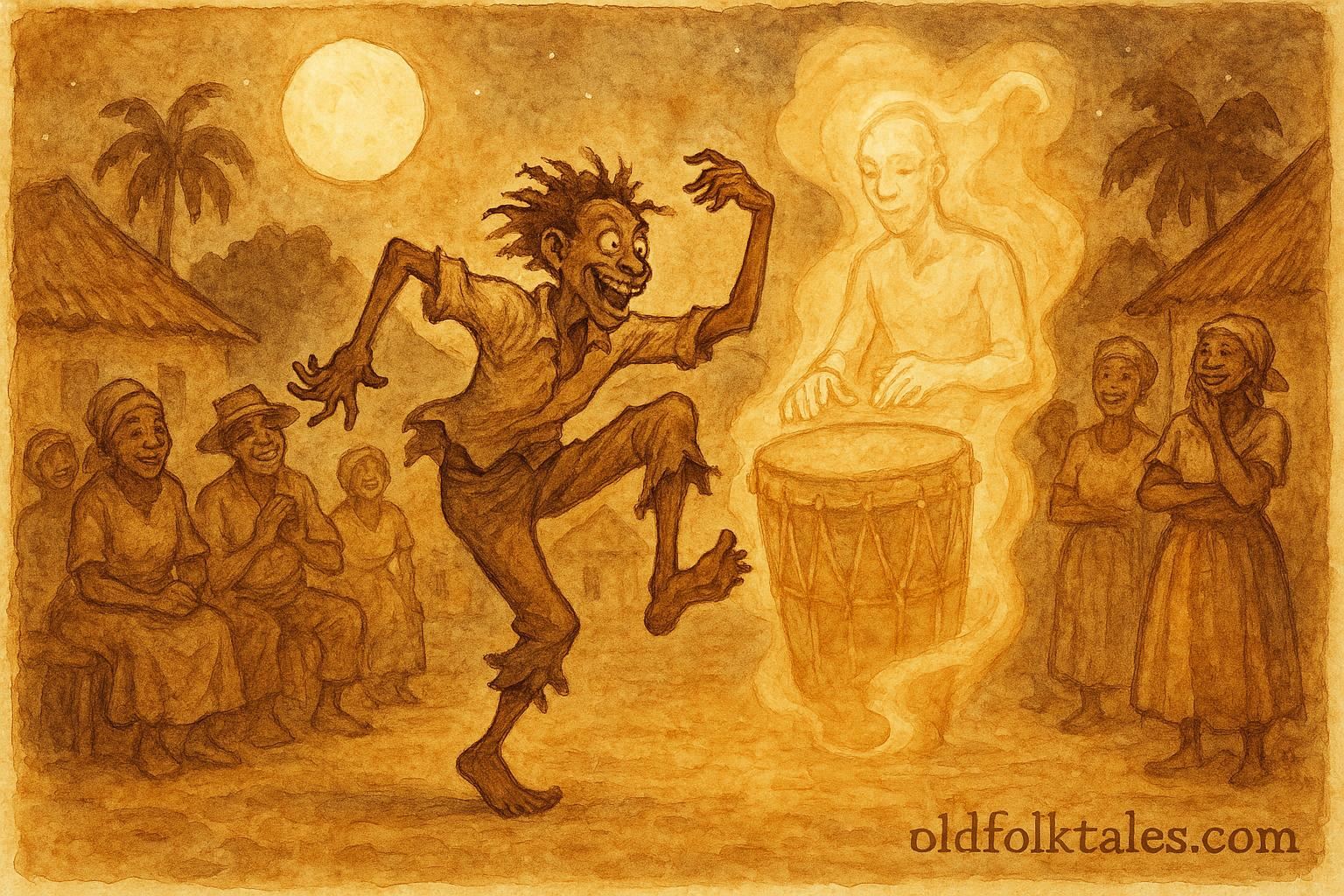
But before he could finish, the drum leapt into the air and thundered on its own. Malice’s feet jerked to life. He spun, twisted, and stomped wildly, unable to stop. “Help! Stop the drum!” he cried, but the rhythm only grew stronger.
As he danced, the truth poured from his mouth like water bursting from a spring. “I lied to my friends! I cheated the baker! I stole the drum!” he confessed, spinning in circles, his voice breaking with every beat.
The villagers woke to find Malice whirling through the square, drenched in sweat, confessing every wicked thing he’d ever done. The spirit stood nearby, calm and silent.
Finally, as dawn’s first light touched the hills, the drum fell quiet. Malice collapsed, gasping, his pride shattered but his spirit cleansed. The Spirit of the Drum looked down at him and said gently, “Truth dances in every lie, Brother Trickster. Remember that.”
The villagers forgave him, for his shame had turned to lesson. From that day, Malice played only the flute, for it made people smile, not confess.
Moral
Deceit may bring laughter for a moment, but truth will always rise to the rhythm of justice.
Knowledge Check
-
Who was Malice in the Haitian folktale “Brother Trickster and the Spirit Drum”?
Malice was a clever trickster known for deceit and mischief among his village. -
What power did the Spirit Drum possess?
The drum made everyone dance and confess their secrets when played. -
How did Malice misuse the Spirit Drum?
He used it to extort money from villagers instead of spreading joy. -
What happened when the spirit reclaimed the drum?
The drum forced Malice to dance and confess his own lies. -
What is the central moral of the story?
Deception may succeed briefly, but truth always reveals itself. -
What does the Spirit Drum symbolise in Haitian folklore?
It symbolises divine justice and the power of truth in the face of human deceit.
Source: Adapted from the Haitian folktale “Brother Trickster and the Spirit Drum” in When Night Falls, Kric! Krac! by Liliane Nerette Louis (1999), Libraries Unlimited.
Cultural Origin: Haiti (Creole oral tradition, Gonaïves region)