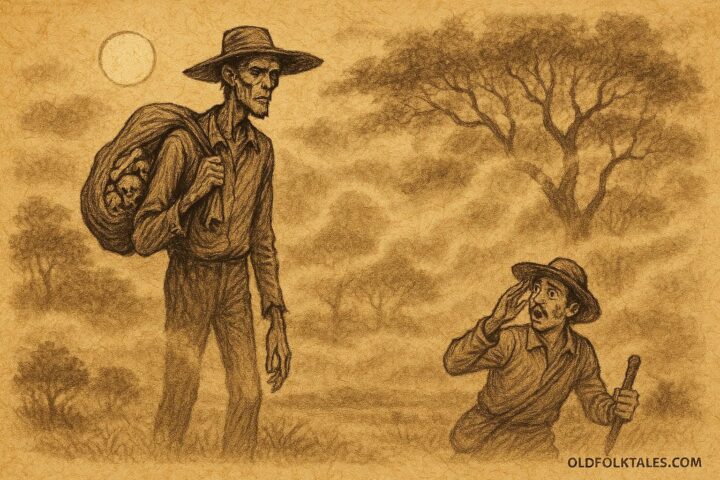
In the sun-drenched hills of Haiti, where the air hummed with cicadas and the scent of hot earth rose from the ground, there lived two men as different as night and day. Bouki was large, lumbering, and simple, with a heart led easily by his stomach. Malis, whose very name meant “cleverness,” was sharp-eyed, quick-witted, and slender as a blade of grass. They were partners of a sort, though their partnership mostly involved Malis thinking and Bouki doing.
One season, a prosperous farmer hired them both to tend his fields. The work was hard under the Caribbean sun, but the pay was fair, and the farmer’s wife was a renowned cook. Her pantry was a treasure trove, and its crowning jewel was a large, beautiful calabash gourd filled to the brim with rich, golden butter.
Day after day, Bouki’s gaze would drift from the furrows he hoed to the house, his mouth watering. “Oh, Malis,” he would moan, wiping his brow. “To taste just a spoonful of that cool, sweet butter!”
Malis, ever scheming, finally grinned. “Why just dream of it, brother? The farmer and his wife go to market tomorrow. We shall have our feast.”
And so, when the coast was clear, the two stole into the quiet, dark kitchen. Malis lifted the heavy calabash from its shelf, and they fell upon the butter like men starved. They ate until the gourd was scraped clean and their bellies were full and tight. A sudden panic then seized Bouki. “The farmer! He will see it is gone! We are ruined!”
Malis, never missing a beat, simply placed the empty calabash back on its shelf. “We will tell him the Butter Thief came,” he said, his voice smooth as oil. “A fearsome spirit who craves only the finest butter. It is a known thing.”
When the farmer returned, they acted out their lie with great drama. Bouki, wringing his hands, and Malis, clicking his tongue in false sympathy, told of a shadowy, insatiable creature who had devoured the butter in one gulp. The farmer listened, his face unreadable. He said nothing, but his eyes, sharp as a machete, looked from Bouki’s guilty shuffle to Malis’s too-innocent face.
The next day, the farmer called them before him. In his hands, he held a small, smooth piece of metal, blackened by fire. “The Butter Thief is a clever demon,” the farmer announced, his voice solemn. “But I know a trick to catch him. I have here a magic piece of iron. It is cool to the touch of an honest man, but it will burn the hand of the thief who lies.”
A cold dread settled in Bouki’s stomach. Malis, however, merely nodded with polite interest. The farmer heated the metal in the cooking fire until it glowed a faint, dangerous red. He then let it cool just enough to hold, though it was still searing hot.
“Now,” the farmer commanded, his gaze steady. “Each of you must take this metal and walk to that far fence and back. The guilty one will cry out.”
Bouki went first. The moment his fingers closed around the hot metal, a jolt of pain shot up his arm. But more powerful than the burn was the terrifying belief in the farmer’s magic. He clenched his jaw, tears springing to his eyes, and walked stiffly to the fence and back, handing the metal to Malis without a word, his palm already blistering.
Now it was Malis’s turn. He took the hot metal without flinch, for he understood the true test was not in the pain, but in the reaction. As he walked, he began to chatter, calling out cheerfully to imaginary passersby. “Good morning, neighbor! A fine day, is it not? Oh, hello there, little bird! Yes, yes, all is well!” He strolled to the fence and back, his hand burning in silent agony, and returned the metal with a gracious smile.
The farmer took the piece of iron and examined their hands. Bouki’s was a raw, angry red. Malis’s, though also burned, was held steady. The farmer’s eyes narrowed. “The magic iron has spoken,” he declared. “Bouki, your hand is burned because your conscience is guilty. You have stolen my butter.”
Bouki, overwhelmed by the pain and the exposure of his lie, broke down at once. “It is true!” he wailed, pointing a trembling finger at his partner. “But he made me do it! Malis ate the most!”
The farmer, having uncovered the truth, drove them both from his land without pay. As they trudged down the dusty road, Bouki nursed his sore hand and whimpered, “But how did the iron know, Malis? It was magic!”
Malis, sucking cool air on his own burned palm, shook his head at his foolish companion. “It knew nothing, Bouki. The metal was hot for us both. The test was not the burn, but the fear. You believed the lie, so the lie trapped you.”
And so, Bouki learned, though likely not for the last time, that the weight of a guilty conscience is far heavier than any burden, and its heat far more revealing than any fire.
The Moral Lesson:
This humorous tale teaches that guilt has a way of revealing itself. No external magic is needed to expose a liar; the fear of being caught and the burden of a dishonest heart will often lead a person to betray themselves.
Knowledge Check
Q1: What are the defining personality traits of Bouki and Malis in Haitian folklore?
A1: Bouki is the gullible, slow-witted fool who is driven by his appetites, while Malis (Ti Malis) is the clever, cunning trickster who devises the schemes.
Q2: What is the “magic” object the farmer uses to discover the thief, and what is its true purpose?
A2: He uses a piece of hot metal, claiming it will burn only the guilty. Its true purpose is a psychological test; the guilty party, believing the magic, will react with fear and pain, thereby revealing their dishonesty.
Q3: What common folkloric motif is demonstrated when the thieves blame a fictional “Butter Thief”?
A3: This is the “false culprit” or “scapegoat” motif, where a liar invents a supernatural or imaginary being to blame for their own misdeed.
Q4: How does Malis’s behavior during the test differ from Bouki’s, and why?
A4: Malis talks cheerfully to mask his pain because he understands the test is about controlling one’s reaction. Bouki, believing the magic is real, is paralyzed by guilt and fear, making his suffering obvious.
Q5: What is the cultural significance of the character names in Haiti?
A5: The names have become proverbs. To call someone a “Bouki” means they are foolish and easily duped, while a “Malis” is a sharp, cunning person.
Q6: What core human truth does this folktale ultimately explore?
A6: It explores the idea that guilt is a powerful, self-revealing force, and that a person’s own conscience and fear of exposure are often the greatest catalysts for confession.
Cultural Origin: Haitian Folktale, Haiti.
Source: Adapted from “Haitian Folktales” transcript by Laura Tanna (Tale #7).