Long ago, when animals spoke and the forest carried the memory of every boast and every lie, Tiger ruled as the strongest creature of the land. In the Trinidadian countryside, where bamboo thickets and riverbanks shaped both work and story, Tiger was known as the King of the Forest. His muscles were feared, his roar commanded silence, and his pride was as large as his shadow.
Tiger delighted in reminding others of his strength. Each day he boasted that no creature could match him. He strutted through the bush, scattering birds and smaller animals, certain that power alone decided worth. Many feared him, and none dared challenge him openly.
None, that is, except Anansi.
Anansi was small, a spider with thin legs and a quiet voice, often overlooked and easily dismissed. Yet beneath his modest appearance lived a sharp and restless mind. Anansi listened to Tiger’s boasting and grew weary of hearing strength praised as the only measure of greatness. He believed that cleverness, patience, and observation could undo even the strongest opponent.
One day, Anansi approached Tiger with respectful words and a playful tone. He told Tiger that although he was strong, strength alone did not make one supreme. Tiger laughed loudly, shaking leaves from the trees, and demanded proof of any claim that challenged his might.
Anansi smiled and said he had a brother, a relative far stronger than Tiger himself. Tiger scoffed, insisting no such creature existed. Anansi proposed a contest, not of claws or teeth, but of pulling strength. If Tiger won, Anansi would admit defeat and praise Tiger forever. If Tiger lost, he would concede that Anansi’s family held great power.
Confident in his strength, Tiger agreed.
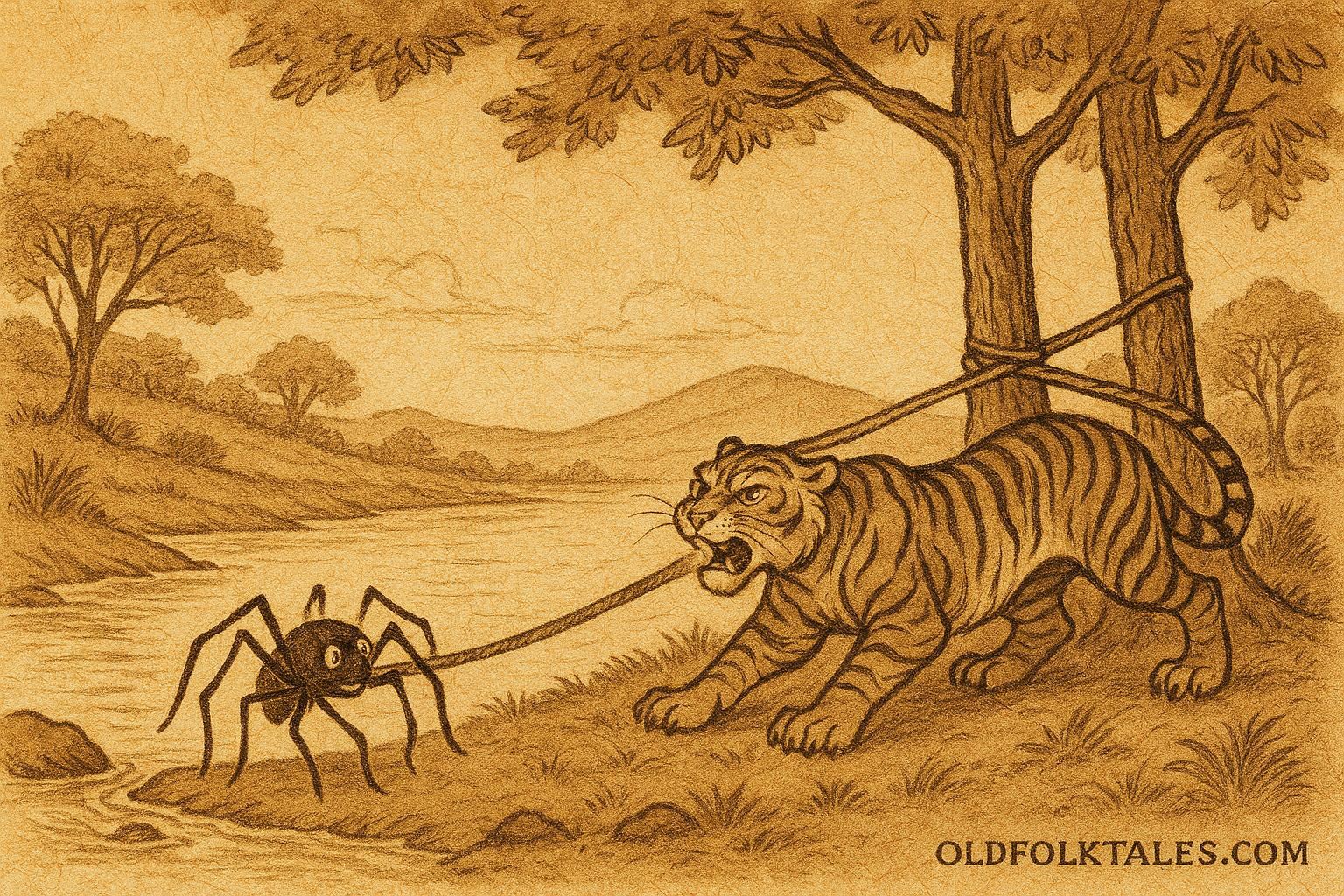
Anansi led Tiger to the edge of a river where thick vines grew tangled among the trees. He tied a long, sturdy vine around Tiger’s waist and instructed him to pull with all his strength when given the signal. Anansi then carried the other end of the vine deep into the bush.
There, unseen by Tiger, Anansi tied the vine securely around a massive tree whose roots gripped the earth like iron. The tree did not move in storms, nor did it bow to floods. Once the vine was fastened, Anansi hid behind the foliage.
He began to shake the vine and grunt loudly, imitating the effort of a powerful creature pulling back. Tiger heard the sounds and pulled with all his might. His paws dug into the soil, his muscles strained, and his breath came heavy. Yet the vine did not move an inch.
Thinking the unseen opponent was matching his strength, Tiger pulled harder. Again, Anansi shook the vine and growled softly. The contest continued until Tiger was exhausted. His pride faltered as his strength failed him. At last, he collapsed, unable to pull any further.
Anansi emerged from the bush calmly, brushing dirt from his legs. He told Tiger that his brother had grown tired of the contest and had gone away. Humbled and defeated, Tiger admitted that Anansi’s family must indeed possess great power.
From that day forward, Tiger’s boasting lessened. Though he remained strong, he learned that strength alone did not guarantee victory. Anansi, meanwhile, continued his quiet wanderings, leaving behind lessons disguised as laughter.
The people who told this story understood its deeper meaning. For those who lived under harsh authority, Anansi represented survival through wit. His tricks were not cruelty but clever resistance. In a world shaped by inequality, Anansi showed that intelligence could outmaneuver force.
Moral Lesson
This folktale teaches that intelligence and strategy can overcome brute strength, and that arrogance leaves even the powerful vulnerable.
Knowledge Check
-
Who are the main characters in Anansi and Tiger
Anansi the spider and Tiger the strong ruler -
What does Tiger represent
Pride and brute strength -
How does Anansi defeat Tiger
Through clever planning and deception -
What role does the tree play
It symbolizes immovable strength and trickery -
What cultural lesson does Anansi represent
Survival through intelligence under oppression -
Where does this folktale originate
Trinidad, rooted in Ashanti tradition
Source: Trinidadian Anansi folklore
Cultural Origin: Ashanti Akan tradition Creolized in Trinidad