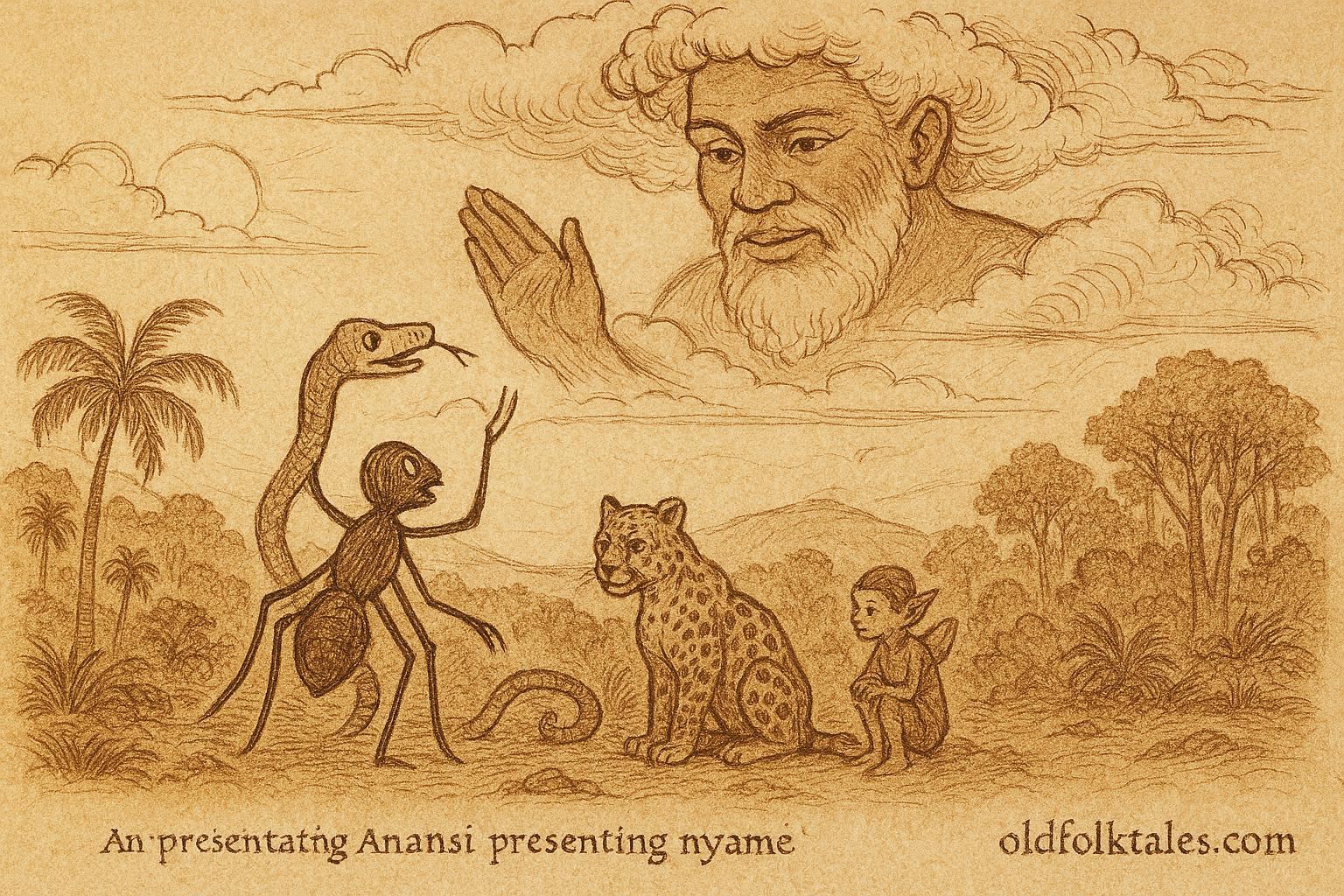
In the early days of the world, before stories traveled freely from village to village, all stories belonged to the Sky God, Nyame. He kept them close, high above the earth, guarding every tale of heroes, spirits, animals, and ancestors. Without stories, the people below lived quietly, without laughter, wisdom, or memory to guide them. Nights passed in silence, and lessons were easily forgotten.
Among those who longed for stories was Anansi, the small spider known not for strength, but for intelligence and determination. Anansi understood that stories were more than entertainment, they were the heart of culture, the threads that held people together. He believed that without stories, the world would lose its soul.
Explore French-Canadian legends and First Nations myths in our Canadian Folktales collection
Anansi climbed high into the sky and stood before Nyame. Bowing respectfully, he asked if the stories might be shared with the people of the earth. Nyame listened but refused. Stories, he said, were precious and powerful, and he did not give them away freely.
Still, Nyame admired Anansi’s courage and persistence. After a long pause, he set a challenge, believing it impossible for such a small creature to succeed. If Anansi could capture three dangerous beings, the stories would be his.
The first was Onini the python, feared for his great size and strength. The second was Osebo the leopard, swift, powerful, and deadly. The third was Mmoatia, a mysterious fairy known for vanishing into the forest without warning.
Anansi accepted the challenge without hesitation.
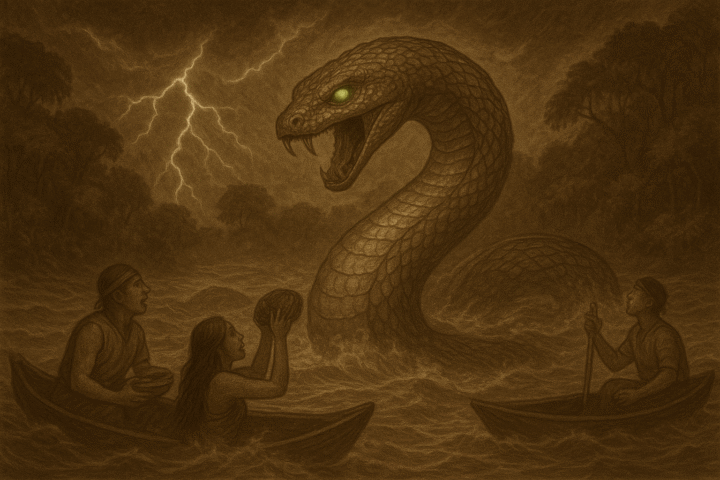
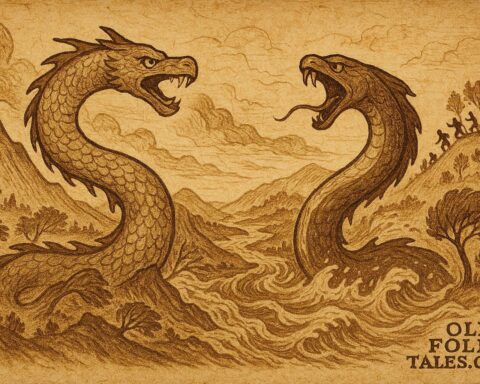
He began with Onini the python. Knowing he could not overpower such a creature, Anansi used words instead. He approached Onini and began an argument about who was longer, the python or a nearby tree branch. Curious and proud, Onini stretched himself alongside the branch so Anansi could measure him. While Onini lay still, Anansi quickly tied him up, securing the great snake without a single blow.
Next, Anansi turned his attention to Osebo the leopard. He dug a deep pit in the forest and covered it carefully with leaves and branches. When Osebo fell into the trap, Anansi approached cautiously, pretending to help. He offered to tie a rope around Osebo to pull him out. Trusting Anansi’s words, Osebo agreed, only to find himself bound and helpless.
The final task was the most difficult. Mmoatia the fairy was clever, quick, and magical. Anansi filled a calabash with sticky gum and placed it in the forest. When Mmoatia discovered it, curiosity overcame caution. As soon as the fairy touched the gum, she became stuck, and the more she struggled, the more trapped she became. Anansi captured her without force, using patience and planning.
With all three creatures captured, Anansi returned to Nyame. True to his word, the Sky God handed over the stories. From that day forward, stories belonged to Anansi, and through him, to the people.
That is why, across the Caribbean and beyond, stories are called Anansi stories, and why the clever spider is remembered as the keeper of tales.
Moral Lesson
This folktale teaches that persistence, intelligence, and determination can preserve culture and knowledge. Stories survive not through power, but through wisdom and effort.
Knowledge Check
1. Who is Nyame in Anansi folklore?
Nyame is the Sky God who originally owned all the world’s stories.
2. Why does Anansi want the stories?
He believes stories are essential for preserving wisdom and culture.
3. Which creatures must Anansi capture?
Onini the python, Osebo the leopard, and Mmoatia the fairy.
4. How does Anansi succeed without force?
He uses clever tricks, patience, and intelligence.
5. Why are stories called Anansi stories today?
Because Anansi earned the right to share them with the world.
6. What cultural meaning does this folktale hold?
It explains the survival of storytelling traditions in Afro-Caribbean culture.
Source: Akan myth, West Africa
Preserved in: Afro-Caribbean oral tradition
Cultural Origin: Akan (Ghana), Caribbean folklore