In the cane growing districts of Martinique and St. Lucia, where tall stalks whisper in the night wind and moonlight turns the fields silver, there lived a cane cutter known as much for his looks as for his arrogance. He was young, strong, and handsome, and he took great pride in the admiration he received. When older men spoke cautiously of spirits that wandered the roads after dark, he laughed openly at them. Most of all, he mocked those who feared La Diablesse, the devil woman said to roam the countryside disguised as beauty.
The elders warned that La Diablesse appeared as an elegant woman dressed in the fashions of an earlier time. Her gown flowed to the ground, hiding the cloven hoof that marked her true nature. Those who followed her charm, they said, never returned unchanged. But the cane cutter dismissed these stories as inventions meant to frighten children and restrain desire. He boasted that no woman, living or spirit, could deceive him.
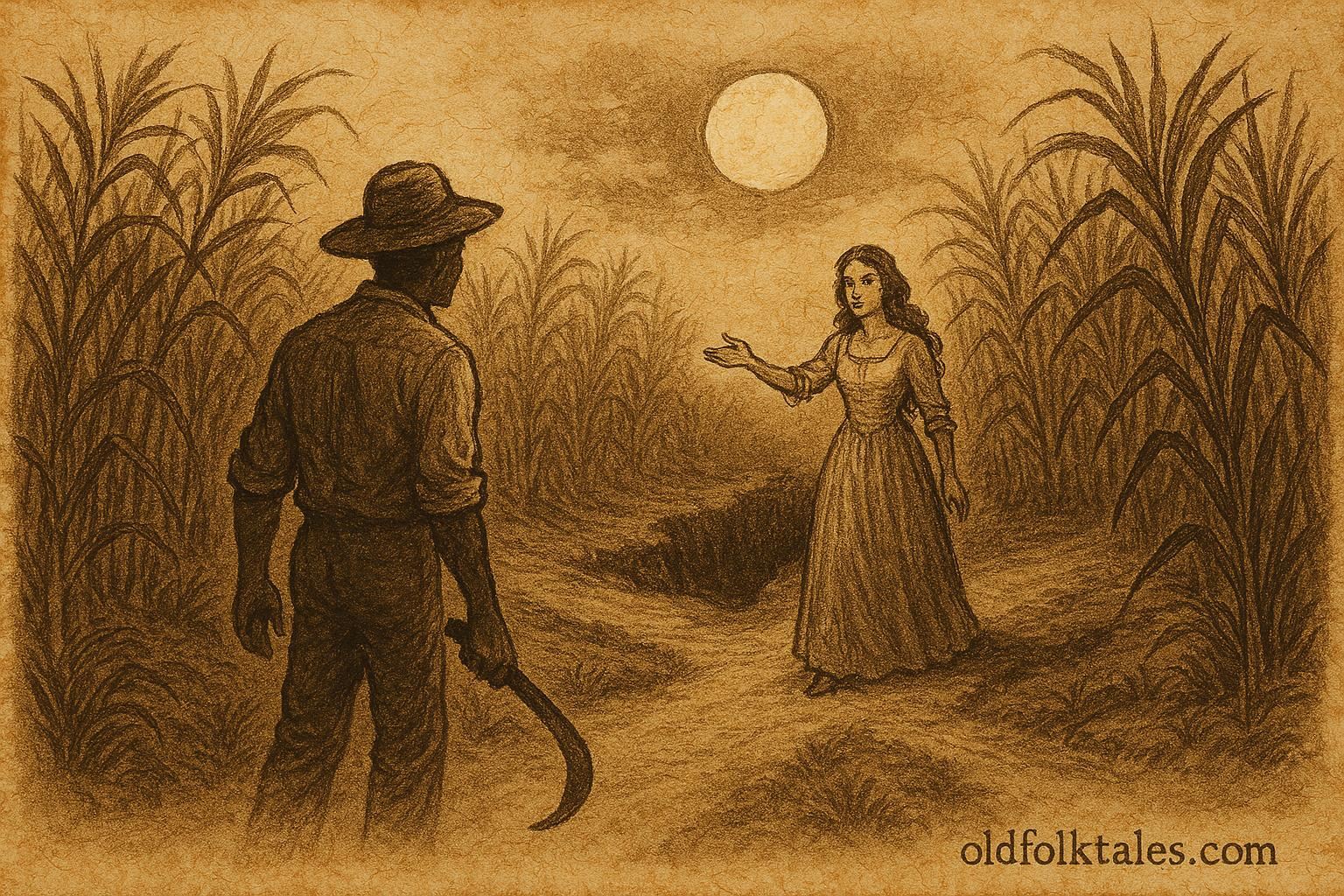
One night, after working late in the fields, the cane cutter set out alone along the narrow path that led home. The moon hung full and bright, lighting the crossroads where paths split toward the village, the hills, and the cane fields. As he approached, he noticed a woman standing quietly at the crossing.
She was strikingly beautiful. Her dress was rich and old fashioned, its fabric gleaming softly in the moonlight. A faint smile rested on her lips, and her posture was graceful and inviting. As the cane cutter slowed, she raised her hand and beckoned him forward. Her perfume drifted toward him, heavy and sweet, filling his senses and clouding his thoughts.
Flattered and intrigued, he stepped closer. He spoke confidently, as he always did, and she responded with gentle laughter. Without a word, she turned and began to walk away from the path, leading him toward the darker edge of the cane fields. Though he noticed the ground becoming uneven and the familiar road disappearing behind them, he followed without hesitation. His pride drowned out caution, and his desire drowned out memory.
Deeper they went, the cane rising tall and close around them. The scent of her perfume grew stronger, almost suffocating. The night air felt thick, and the sounds of insects faded into an uneasy silence. At last, she stopped.
She turned slowly to face him.
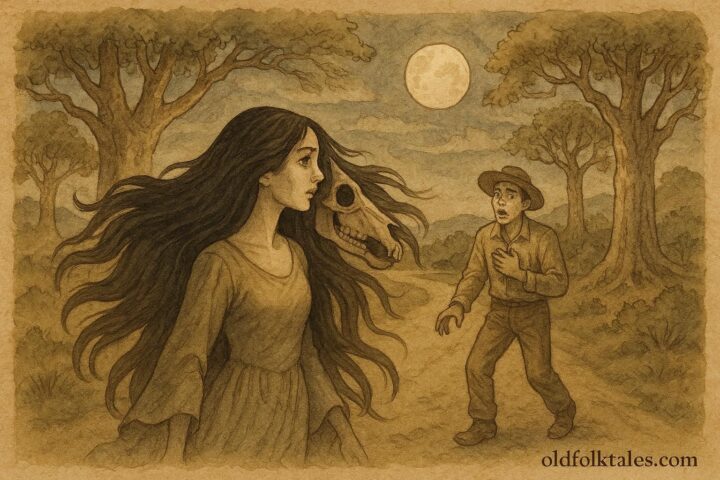
In an instant, the beauty vanished. Where her face had been, there was now only a skull, empty-eyed and grinning. Beneath her dress, one foot remained human, while the other ended in a cloven hoof. The truth struck the cane cutter with crushing force. This was La Diablesse, the very spirit he had mocked.
He cried out and staggered backward, terror breaking through his pride. As he stumbled, the ground vanished beneath his feet. La Diablesse had led him to the edge of a ravine concealed by shadow and cane. He fell, tumbling into darkness as her laughter echoed behind him.
At dawn, villagers found the cane cutter lying at the bottom of the ravine. His body lived, but his mind was shattered. He spoke endlessly of beauty that turned to rot, of sweet perfume that hid decay, and of a woman who smiled and destroyed. From that day on, he never mocked again, and neither did those who heard his story.
Moral Lesson
This folktale warns against pride, arrogance, and unchecked desire. It teaches that temptation often disguises danger and that mocking ancestral wisdom invites ruin rather than strength.
Knowledge Check
1. Who is La Diablesse in Caribbean folklore?
La Diablesse is a devil woman who appears as a beautiful lady while hiding her true monstrous form.
2. What flaw defines the cane cutter’s character?
He is boastful and dismissive of traditional warnings and spiritual beliefs.
3. How does La Diablesse lure her victims?
She uses beauty, charm, and perfume to lead them away from safe paths.
4. What reveals La Diablesse’s true identity?
Her skull face and cloven hoof.
5. What happens to the cane cutter after the encounter?
He survives but loses his sanity.
6. What cultural warning does the story reinforce?
It cautions against pride and carnal temptation.
Source and Cultural Origin
Source: Caribbean folktale, Martinique and St. Lucia
Adapted from Folklore Guadeloupéen and St. Lucia Antiqua, Vol. 3, compiled in dLOC.
Cultural Origin: Martinique and St. Lucia