In the dusty heartlands of New Spain, where moonlight turns the agave fields silver and the roads stretch lonely through hills and ravines, travelers still whisper of a figure who rides when the world sleeps, El Charro Negro, the Black Horseman.
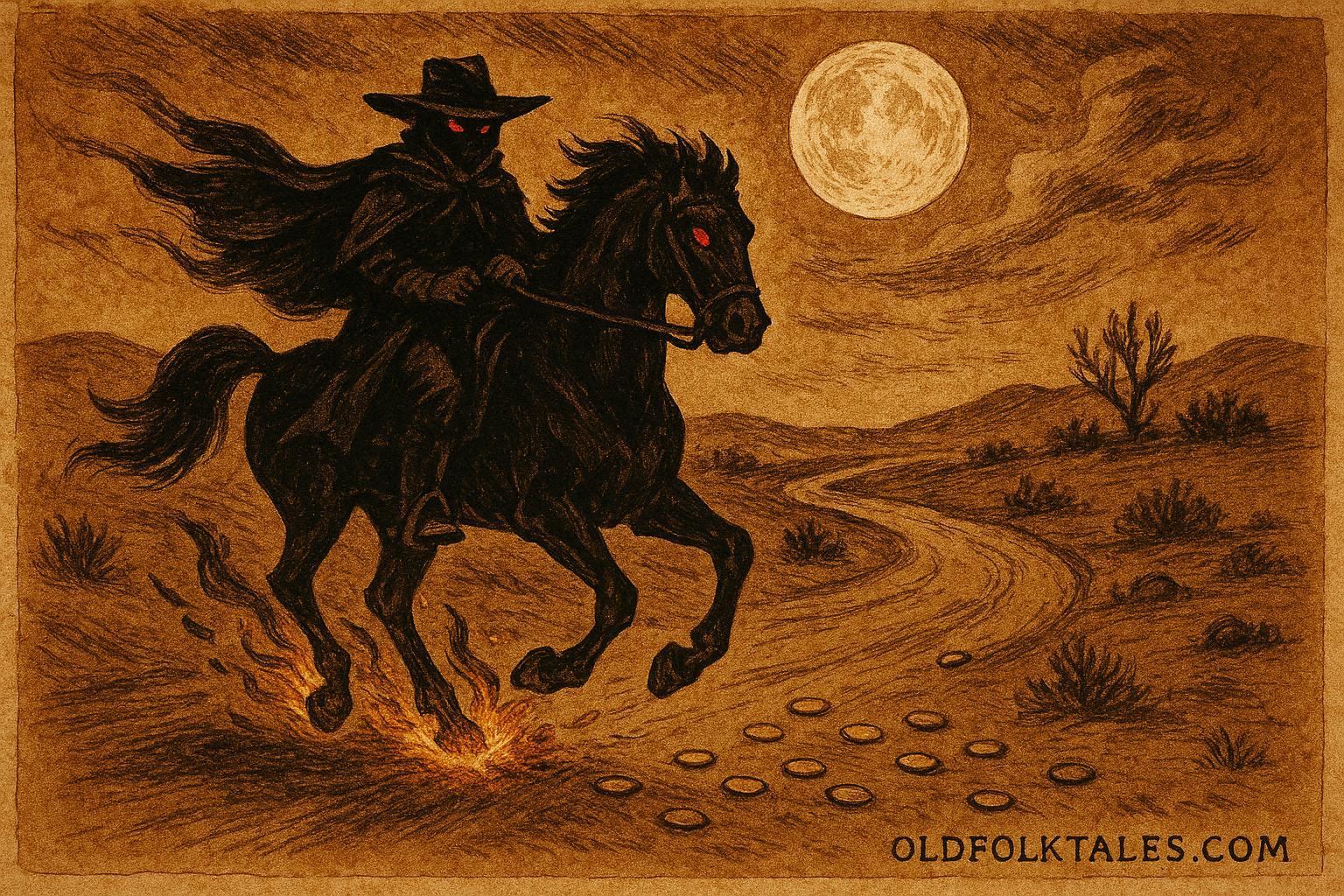
They say he appears at the edge of night, his stallion’s hooves striking sparks on the stones, his eyes burning red beneath the brim of a wide black hat. His coat is trimmed with silver, his boots gleam like mirrors, and gold coins jingle at his belt. Some swear they’ve seen him gallop through crossroads or emerge from the shadow of a mesquite tree when the wind is still and the dogs fall silent.
Discover the sacred tales of llamas, condors, and gods who guard the Andes
In the old colonial days, the people of Mexico feared him not as a man, but as a warning, for the Charro Negro was believed to be the Devil himself, riding the roads in human form to tempt the proud and punish the greedy.
The Midnight Encounter
One cool evening, a ranchero named Don Felipe rode home from market with a pouch of coins tied to his saddle. The moon was high, but the road through the ravine was dark as sin. His horse snorted and tossed its head, uneasy.
Then, from the shadows ahead, he heard the rhythm of hooves, slow, deliberate, drawing closer. Out of the darkness rode a figure dressed head to toe in black: silver buttons flashing, spurs jingling softly.
“Buenas noches, amigo,” the stranger said, tipping his hat. His voice was smooth as honey and cold as the grave. “A fine night to ride alone.”
Don Felipe nodded warily. “The road is long, señor. I aim to reach home before dawn.”
“Ah,” said the Charro, smiling. “Then allow me to ride with you. The night is safer with company, and I always repay good company with gold.”
As he spoke, he opened his hand, and golden coins glimmered like fireflies in the moonlight.
Felipe felt his heart quicken. The coins looked real, solid, heavy, shining. He thought of his debts, of the ranch he might improve, the fine horse he could buy.
But something in the rider’s gaze, that strange, glowing red, made him shiver. He muttered a prayer under his breath.
When he looked up again, the Charro was smiling wider, his teeth white as bone.
“Do you not trust me?” he asked. “Here, take one. For your trouble.”
Felipe shook his head. “I have no need of gifts, señor. I earn my silver with my hands.”
The Charro’s expression darkened. His horse pawed the ground, striking sparks from the stones. The air grew hot and still.
“So be it,” the stranger hissed. “But remember, not all who refuse my gold live to tell the tale.”
With a sound like thunder, the black stallion reared, and before Felipe could blink, the rider vanished, leaving behind only the smell of sulfur and a single scorched coin in the dust.
Those Who Took the Gold
Others were not so wise.
A greedy merchant once met the Charro on the road to Puebla. Tempted by the shining coins, he filled his pockets, and by morning, his fine garments had turned to rags, and the gold had become ashes. His body was found by the roadside, his eyes wide with terror.
A boastful landowner bragged that no devil could frighten him. He accepted the Charro’s offer, taking a bag of gold home to his hacienda. But at dawn, his house was found empty, only hoofprints scorched into the courtyard, leading straight to the gates of hell.
The wise learned their lesson: when the night grows too quiet and the wind carries the jingle of spurs, it is best to cross yourself and look away.
The Eternal Ride
Some say the Charro Negro is a cursed soul, once a proud man who sold his spirit to the Devil for wealth and power. When death came, there was no rest for him, condemned to ride forever, seeking others to share his fate.
Others say he is the Devil, roaming the earth to test men’s hearts, offering gold to those who will sell their souls too cheaply.
But whatever his origin, his warning remains the same: the road at midnight is a dangerous place for those who covet more than they need.
Even now, travelers claim to glimpse him in the glow of distant lightning, a dark horseman at the horizon, waiting for another soul lost to greed.
Explore the land of La Llorona, trickster coyotes, and magical realism in Mexican folklore
Moral Lesson
The Charro Negro reminds us that temptation often wears the guise of generosity. Greed blinds the heart, and ill-gotten wealth brings only ruin. The path of honesty and humility leads to safety, while the Devil’s road ends in eternal darkness.
Knowledge Check
- Who is El Charro Negro in Mexican folklore?
He is a mysterious black-clad horseman, often seen as the Devil in disguise, who tempts travelers with gold. - What happens to those who accept the Charro’s gold?
They become cursed or vanish, punished for their greed and moral weakness. - What moral lesson does this tale teach?
That greed and arrogance lead to destruction, while humility and faith protect the soul. - What cultural beliefs influence this legend?
It blends Spanish Catholic ideas of the Devil and sin with Indigenous Mexican respect for spiritual warnings. - Where does the story take place?
Along rural roads of colonial New Spain, especially in regions like Puebla and central Mexico. - What symbolizes temptation in the story?
The Charro’s gold coins,dazzling but deceptive,represent the lure of sin and false fortune.
Source: Tradiciones y Leyendas Mexicanas by Artemio del Valle Arizpe (1943) Cultural Origin: Colonial Mestizo (Spanish Catholic influence mixed with Indigenous moral traditions)