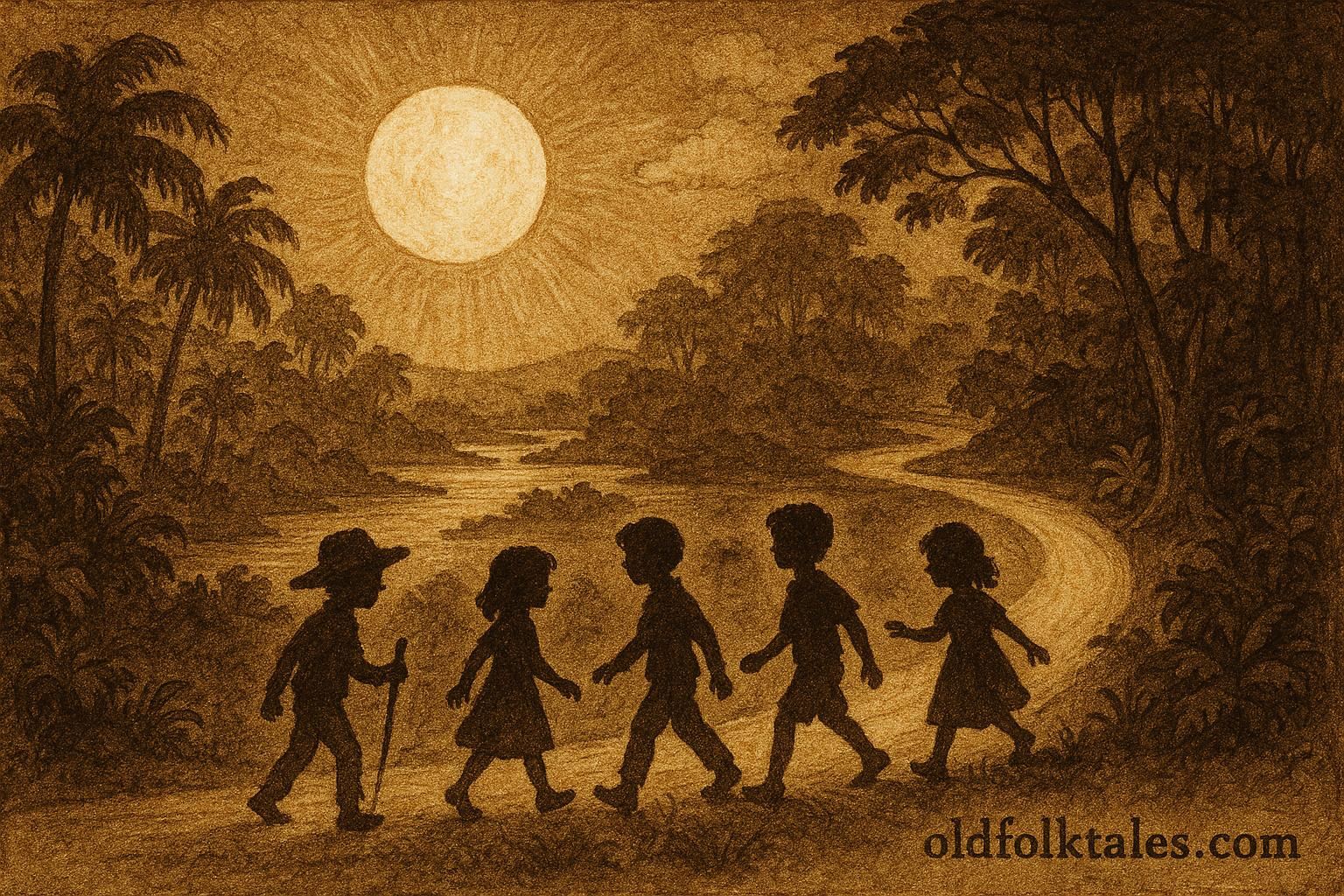
Long ago, in the lush lands of Suriname and Guyana, where rivers wove silver threads through dense forests and the wind carried the scent of tropical flowers, children often wondered about the world beyond their sight. One question, asked countless times, puzzled both young and old: why, when they walked at night, did the moon seem to follow them across the sky?
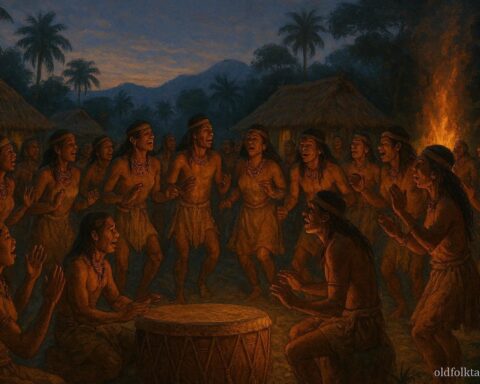
The elders, keepers of stories passed down from Africa, would gather children near the fire, where sparks danced like tiny stars against the dark canvas of the night. They spoke softly, weaving a tale older than memory itself.
Discover South America’s folktales filled with magic, transformation, and ancestral wisdom
“Long ago,” they said, “there was a spirit who loved the people dearly. He had watched humanity struggle through hardship and joy alike, observing from the heavens. In his care, he chose to remain close, to guide and protect when darkness came.”
The children listened, eyes wide in the flickering firelight. “But why does he follow us so closely?” one little girl asked, clutching a woven doll to her chest.
The elder smiled. “Because the spirit’s heart is tender. Wherever you go, he keeps watch, ensuring that no harm befalls you, that you may safely return to your homes.”
At first, some of the children thought it was mere trickery of the mind, that the moon’s movement was simply a trick of the eyes. But the elders explained that the moon itself was a gift, a manifestation of the spirit’s devotion. Every night, its silver glow cast a protective path along rivers, forests, and villages. Those who wandered under its light were never truly alone.
As the story unfolded, the children imagined the spirit soaring high above, unseen but ever-present, a guardian whose affection spanned both earth and sky. They understood that gratitude was due, not just for the moon’s gentle glow, but for all the unseen hands and hearts that worked to protect life in the darkness.
From that night forward, the children treated the moon with reverence. When they walked beneath its light, they whispered thanks and offered small gestures of respect: a song hummed softly, a flower laid at the riverbank, or a word of kindness to a neighbor. The elders nodded with pride, knowing that the love of a celestial spirit had inspired gratitude and humility among the people.
And so it is, even today, when people walk under the night sky, the moon follows gently above, not out of malice or mere coincidence, but because a spirit once chose to care for humanity, reminding all that even in the darkest hours, protection and love endure.
Moral Lesson
The tale teaches that unseen forces may watch over and protect us, and that gratitude and respect for life, seen and unseen, bring harmony and safety.
Knowledge Check
1. Who is the main character in the folktale?
A spirit who watches over humanity from the heavens.
2. What question do the children ask?
Why the moon seems to follow them wherever they go.
3. How does the spirit show care for the people?
By following them in the form of the moon, offering protection at night.
4. What cultural tradition does the story reflect?
African celestial myths preserved in Afro-Surinamese and Guyanese folklore.
5. What is the key symbol in the story?
The moon represents the spirit’s care, protection, and devotion to humanity.
6. What lesson does the folktale convey?
Gratitude and respect for unseen forces ensure guidance and protection.
Source: Afro-Surinamese/Guyanese folktale
Tradition: African celestial myths preserved in the Caribbean