In the long oral tradition of Haiti, few figures are as familiar as Bouki and Ti Malice. Bouki was strong, hardworking, and slow to question what he was told. Ti Malice, by contrast, was small, sharp-minded, and endlessly clever, always searching for advantage. Their stories were told at night, passed from mouth to mouth, warning listeners of the dangers of fear, greed, and blind belief.
One afternoon, as the sun lowered itself over the fields and the air grew heavy with heat, Bouki went fishing along a quiet stretch of water. After many hours of patient effort, he hauled in a magnificent fish, larger and finer than any he had ever caught. Its scales gleamed, and its flesh promised a feast that would satisfy him for days. Proud and joyful, Bouki slung the fish over his shoulder and began the walk home.
Click to read all South American Folktales — timeless stories from the Andes to the Amazon.
Before he could reach his house, he encountered Ti Malice sitting beneath a tree, watching the road with curious eyes. When Malice saw the fish, his hunger flared immediately, though his face remained calm. He circled Bouki, examining the catch with exaggerated caution.
“That is no ordinary fish,” Ti Malice said quietly. “Have you not heard the stories?”
Bouki froze. He had heard many stories, and most of them frightened him. Ti Malice leaned closer and whispered that the fish was a talking fish, cursed by powerful spirits. If Bouki cooked and ate it at home, Malice warned, disaster would fall upon him. His house would be ruined, his sleep haunted, and his life turned upside down.
Bouki trembled. He asked what could be done to escape such a fate.
Ti Malice, pretending reluctance, explained that there was only one safe way. The fish must be cooked and eaten at the crossroads at midnight. Bouki must stand on one foot while eating and obey every instruction exactly, or the spirits would be angered. The crossroads, known as the kafou, was a place of power, watched over by Papa Legba, the opener of gates between worlds.
Fear swallowed Bouki’s reason. He agreed to everything. Ti Malice nodded solemnly, warned him not to tell anyone, and walked away as if relieved to be rid of the matter.
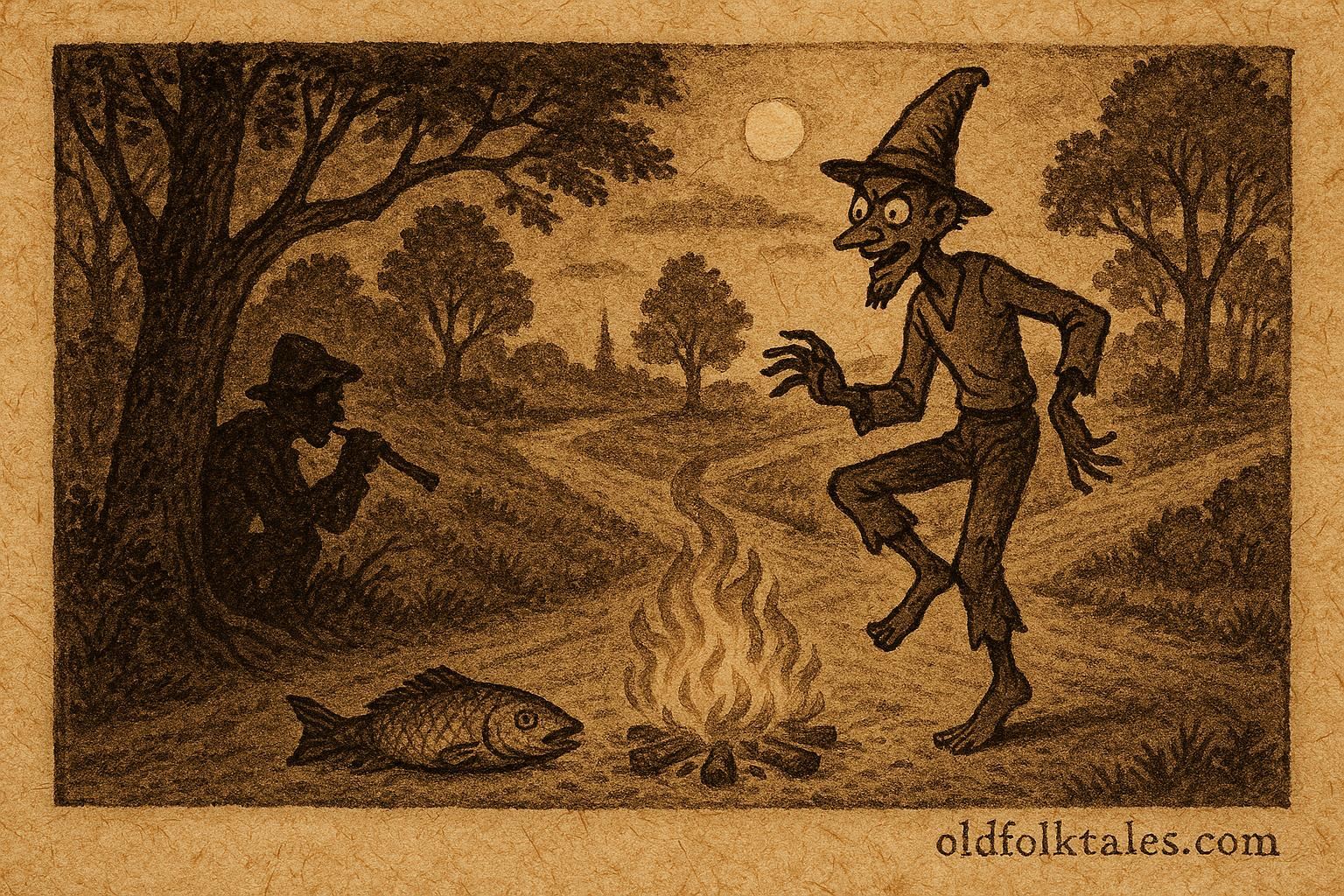
That night, Bouki carried the fish to the crossroads under a sky thick with stars. The place felt alive with unseen presence. Shadows stretched long across the earth, and the wind whispered through the trees. Bouki built a small fire and cooked the fish just as he had been told, his heart pounding with every sound.
Unbeknownst to him, Ti Malice had arrived earlier. He had disguised himself and hidden nearby, clutching a hollow reed he had prepared for this very moment. As Bouki stood on one foot, shaking with fear, Malice placed the reed to his lips.
From the darkness came a voice.
“Bouki,” the fish seemed to say, “you have done well to obey.”
Bouki screamed and nearly fell. The voice continued, commanding him to leave all the meat behind and take only the bones. If he disobeyed, the curse would follow him forever.
Terrified beyond thought, Bouki grabbed the bare bones and fled into the night, convinced he had escaped great danger. Ti Malice waited until the footsteps faded, then stepped into the firelight, laughing softly. He sat down and ate the fish in peace, savoring every bite.
The next day, Bouki told everyone how he had survived the cursed fish. Ti Malice listened silently, already planning his next trick.
Moral Lesson
This folktale teaches that blind fear and unexamined superstition make a person vulnerable to manipulation. Wisdom requires questioning those who profit from your fear.
Knowledge Check
1. Who are Bouki and Ti Malice in Haitian folklore?
They are traditional characters representing foolish strength and clever trickery.
2. Why does Ti Malice call the fish cursed?
To frighten Bouki and manipulate him into abandoning the meal.
3. What is the significance of the crossroads?
It is a sacred Vodou space associated with Papa Legba.
4. How does Ti Malice make the fish appear to talk?
He uses a hollow reed to project his voice.
5. Why does Bouki obey the strange ritual?
He fears spiritual punishment and takes Malice’s words literally.
6. What cultural lesson does the story convey?
That superstition without understanding invites exploitation.
Source & Cultural Origin
Source: Haitian folktale, Haiti
Adapted from the Bouki and Malice oral tradition.
Cultural Origin: Haiti (Haitian folklore, Vodou-influenced storytelling)