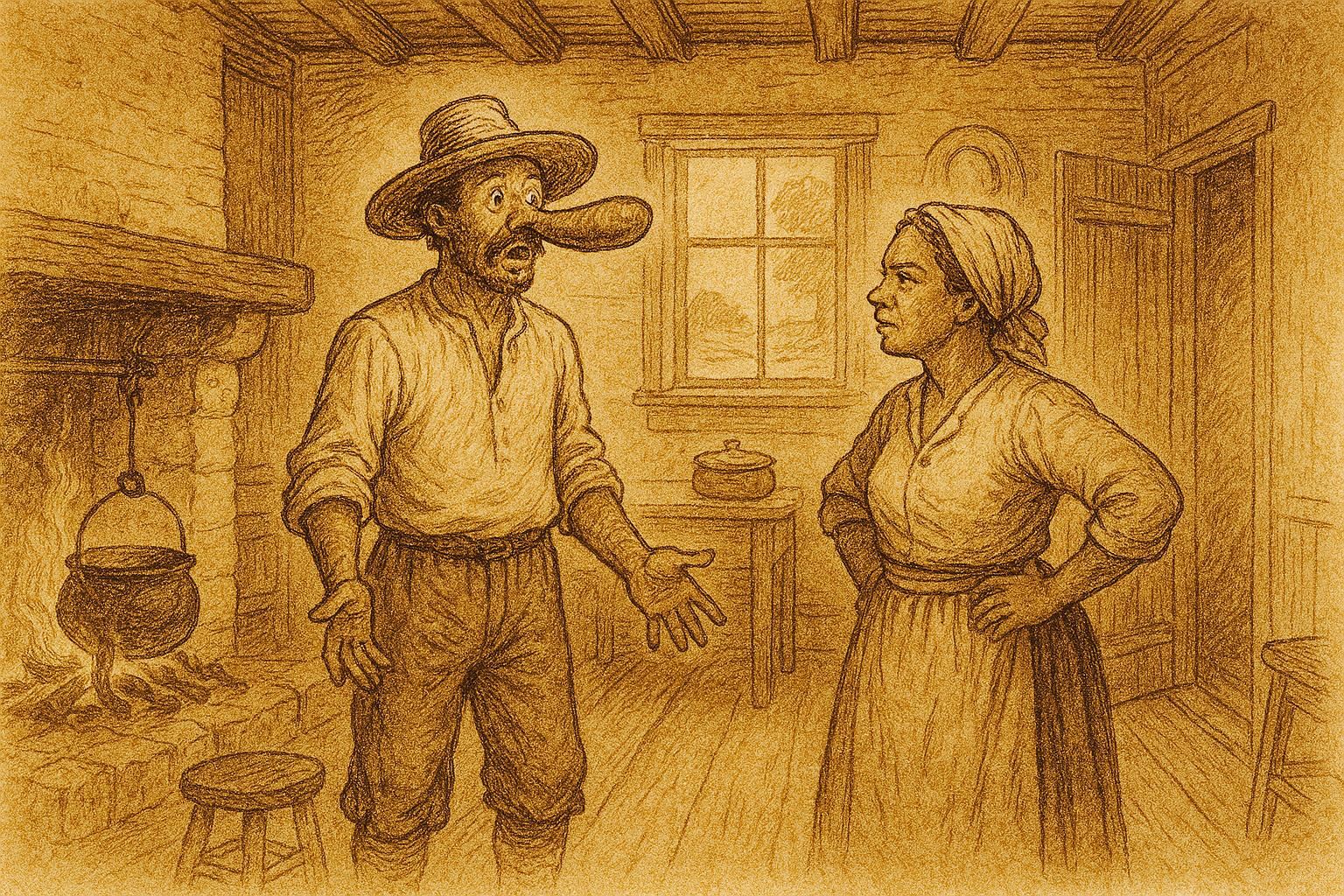
In the sunbaked hills of Haiti, where life was a daily bargain with the soil, there lived a farmer and his wife. Theirs was a life of honest toil and meager reward, where a full pot of beans was a blessing and a new pair of sandals a luxury. They were good people, but their world was small, bounded by the needs of the moment, the hunger in their bellies, the ache in their backs, the worry for the next rain.
One afternoon, as the farmer rested beneath the shade of a great mapou tree, he saw an old woman struggling along the dusty path. Her clothes were simple, her back bent, and her steps slow. Moved by kindness, the farmer rose, took the heavy bundle from her shoulders, and gently helped her on her way to the crossroads. When they arrived, the old woman straightened. Her eyes, which had seemed cloudy, now held a deep, knowing light. “You have a good heart,” she said, her voice no longer frail. “For your kindness, I grant you three wishes. Use them well.” Before the astonished farmer could utter a word, she vanished, leaving only a shimmer in the hot air. He knew then he had helped a lwa, a spirit, in disguise.
He ran home, his fatigue forgotten, bursting through the door of their small clay-and-wattle house. “Wife! Wife!” he cried. “A miracle! We have been granted three wishes!”
His wife stared, her hands covered in cornmeal. “Three wishes? Are you sure the sun hasn’t cooked your head?”
“I am sure!” he said, and he told her of the old woman at the crossroads. Joy exploded in their humble home. They danced a little jig, their minds racing with possibilities. A grand house! Fertile fields! A herd of cattle! Riches beyond measure! But as their excitement peaked, a practical problem intervened. In their celebration, they had forgotten to prepare the evening meal. The pot was empty, and their stomachs, reminded of their neglect, growled in unison.
The farmer smacked his lips, the grand visions fading before a more immediate, primal need. “Ah,” he sighed, leaning against the wall. “What I wouldn’t give right now for a long, juicy sausage to fill our bellies.”
No sooner had the words left his mouth than THUMP! A magnificent, steaming sausage, as long as your arm and glistening with fat, appeared on their rough wooden table.
The wife stared, first at the sausage, then at her husband. Her joy curdled into disbelief, then into hot anger. “You fool!” she shrieked. “You used one of our precious wishes… for a sausage? You imbecile! You could have wished for a feast! For a shop full of food! You waste a gift from the spirits on a single piece of meat?” Her rage grew, fueled by disappointment and hunger. “I wish that sausage were stuck to your foolish face!”
POP! The sausage flew from the table and slapped itself firmly across the farmer’s nose, clinging there as if glued.
Silence fell, heavy and dreadful. The farmer stood, cross-eyed, staring at the sausage now obscuring his face. The wife’s hands flew to her mouth, her anger extinguished by the chilling realization of what she had just done. Two wishes gone. One for a frivolous snack, the second for a moment of rage. The grand house, the fertile fields, the freedom from want, all vanished, replaced by the absurd, humiliating reality of a man with a sausage stuck to his face.
They looked at each other, the full weight of their folly settling upon them. There was nothing to do. No magic could fix this but their own remaining magic. With a sigh of profound resignation, the farmer mumbled through the meat, “I wish for this sausage to be gone.”
FWOOP. The sausage vanished. The air was clear. Their stomachs were still empty. Their house was still small. Their future was unchanged. They had been handed the keys to a dream, and in their hunger and haste, they had traded them for a momentary craving and a flash of temper. All they had to show for their divine gift was the memory of a full belly for one evening, and a lesson etched into their souls.
They sat down at their empty table, not speaking, the humor of their situation slowly dawning on them. A chuckle escaped the wife. The farmer shook his head, a grin spreading beneath his weary eyes. They had been foolish, yes, but they were together, and they were wiser. From that day on, whenever faced with a decision, they would remember the three wishes and say, “Let us not trade our fortune for a sausage.”
The Moral Lesson:
This folktale humorously teaches the dangers of impulsiveness and short-term thinking. It highlights how great opportunities can be squandered when we act on immediate desires or emotions without pausing to consider the long-term value and consequence of our choices.
Knowledge Check
Q1: What earns the farmer three wishes in the Haitian folktale?
A1: He earns the wishes by showing kindness to an old woman, who is revealed to be a magical being or lwa in disguise.
Q2: What is the couple’s first impulsive wish?
A2: In a moment of hunger, the farmer wishes for a long, juicy sausage to eat.
Q3: How does the wife react, and what is the second wish?
A3: She becomes furious at the waste and, in her anger, wishes the sausage were stuck to her husband’s face, which it immediately does.
Q4: What must the final wish be used for?
A4: The third and final wish must be used to remove the sausage from the farmer’s face, leaving them with nothing of lasting value.
Q5: What does the sausage symbolize in the story?
A5: It symbolizes an immediate, trivial desire that overrides wiser, long-term planning, showing how poverty can focus the mind on momentary needs.
Q6: What is the core lesson of this Three Wishes tale?
A6: The core lesson is the danger of acting on impulse without foresight, warning that poor judgment can waste great opportunities on trivial gains.
Source: Adapted from common Haitian oral tradition, with European parallels.
Cultural Origin: Haiti (Haitian folklore).