In a small farming village in Veracruz, nestled between green hills and wide sugarcane fields, there once lived a boy known by all as Juanito. He was clever, but terribly lazy. While his friends helped their parents in the fields from sunrise, Juanito would sleep until noon, only waking when the village bell tolled for lunch. His poor mother pleaded with him each morning, “Mijo, get up! The land won’t feed those who sleep!” But Juanito only turned over and grumbled, “The land can wait.”
Every day, his mother worked under the hot sun, hoeing the soil, tending to the oxen, and planting maize. The villagers whispered about her misfortune, for in a farming community, a lazy child was a burden to the whole family. Yet she never gave up on Juanito, praying that one day he would understand the dignity of work.
Click to read all South American Folktales — timeless stories from the Andes to the Amazon.
One sweltering afternoon, when the air shimmered like fire over the dry fields, Juanito went wandering toward the edge of the village. He stopped beneath a great ceiba tree, the tree of life, as the elders called it, and stretched himself in its shade. Its thick roots spread across the earth like the veins of a sleeping giant. Birds sang from its branches, and the breeze carried the scent of ripe fruit and freshly cut cane.
Juanito lay there, half-asleep, when a strange murmur reached his ears. It wasn’t the wind, nor the rustling of leaves, it was the low rumble of voices. He blinked, sat up, and looked around. The sound came from the nearby corral, where two oxen stood tethered to a wooden post. To his amazement, the animals were talking.
The older ox, gray with age and scars from years of labor, said mournfully, “Tomorrow, they will sell me to the butcher. My strength is gone, and my time is over.”
The younger ox shook its head. “You’ve worked so hard for them. It’s not fair.”
“That is how life goes,” sighed the old ox. “But still, I wish someone would warn the farmer. I’ve plowed his fields faithfully for years.”
Juanito’s heart jumped. He could hardly believe what he had heard. “Talking oxen?” he whispered to himself. “I must be dreaming!” But the oxen continued their quiet conversation, and the boy knew it was real.
He ran straight to the farmer, still panting. “Señor! Don’t sell your old ox! He knows things, he told the other one that you’ll sell him tomorrow!”
The farmer frowned. “Juanito, are you making up tales again?”
“No, I swear by the ceiba tree!” cried the boy. “He spoke with his own mouth.”
The farmer laughed but decided to check anyway. He looked into the old ox’s eyes and saw something calm and wise there, something that gave him pause. “Very well,” he said. “I won’t sell him.”
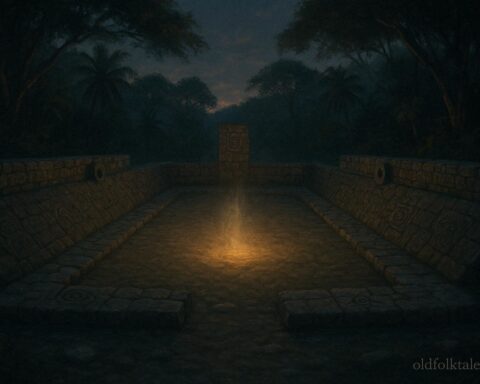
That night, as the moon rose over the fields, Juanito returned to the ceiba tree. He felt something calling him there. The same ox spoke again, its voice low and steady like a drumbeat. “You saved my life, boy, and for that I thank you. Listen well: beneath the roots of this ceiba lies a treasure buried long ago, before the Spaniards came. Dig there tonight, and what you find will be your reward.”
Juanito’s eyes widened. “A treasure?”
“Yes,” said the ox, “but remember, gold shines only for those who learn to honor the land.”
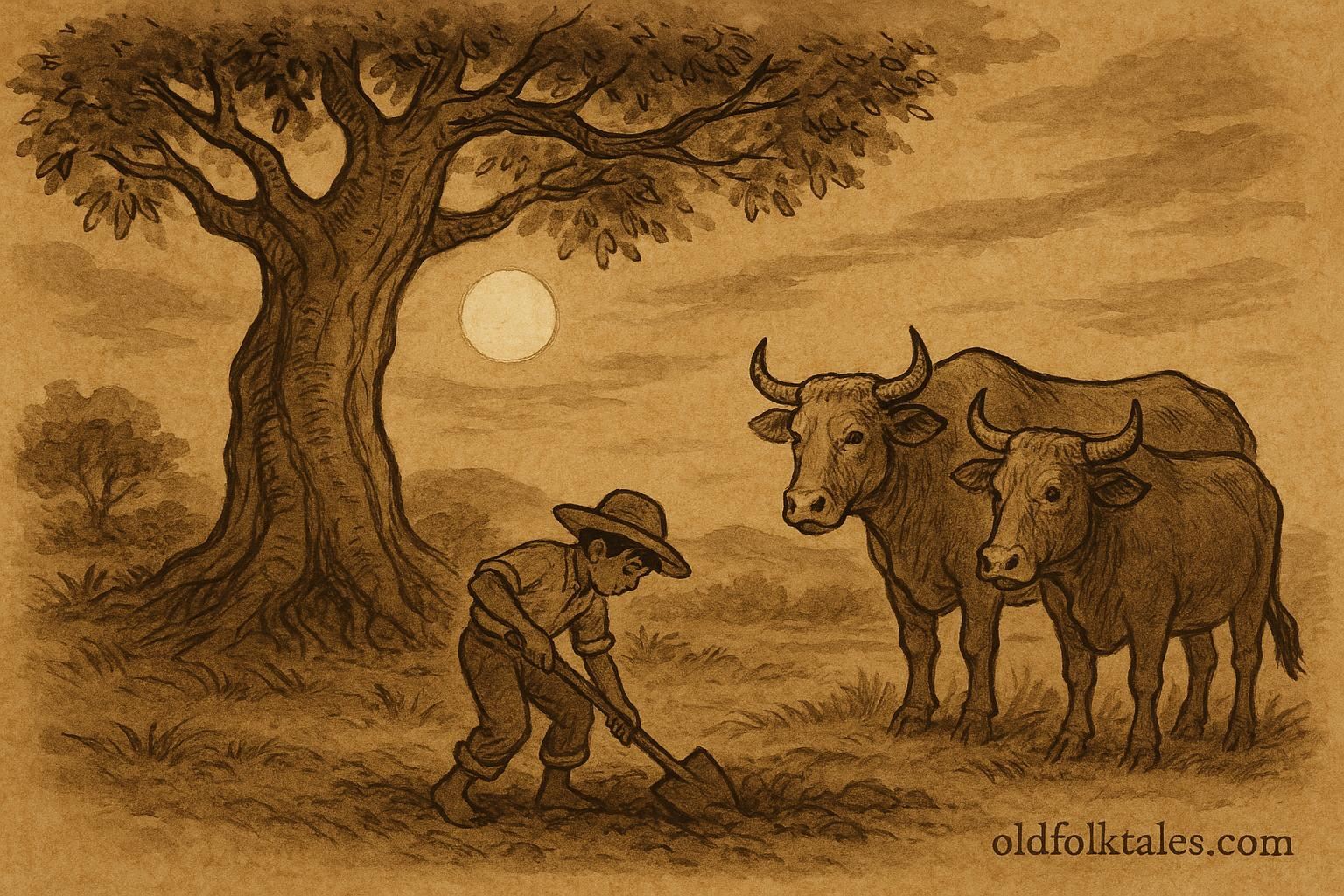
When the ox fell silent, Juanito grabbed a shovel and began to dig. The earth was hard and sweat poured down his face. For the first time in his life, he worked through the night without stopping. The ceiba’s roots twisted around his hands like guiding arms, and soon the shovel struck something solid. He dug faster until he unearthed a clay pot filled with gold coins that glittered like sunlight.
He gasped, his heart racing. Never had he imagined so much wealth. Yet as he stood there under the moonlight, something inside him changed. The sound of the rustling leaves, the smell of the earth, the glow of the ceiba, all reminded him of the ox’s words: “Gold shines only for those who honor the land.”
The next morning, the villagers awoke to see Juanito carrying baskets of food to every doorstep. He gave away most of the treasure, keeping only enough to repair his mother’s house and buy two strong oxen for their fields. From that day forward, he rose at dawn and worked until sunset, guiding his plow with pride.
Whenever anyone asked him what had changed, he smiled and said, “The land talks to those who listen.”
And when the ceiba tree bloomed again, the villagers often saw him resting under its shade, no longer lazy, but thoughtful and grateful. The whisper of its leaves seemed to hum a quiet blessing, as if the spirit of the ox was still watching over him.
Moral Lesson
This story teaches lessons on gratitude, respect for nature, and the value of honest work. True wealth is found not in gold, but in harmony with the land.
Knowledge Check
- What lesson did the talking ox teach Juanito?
That wisdom and reward come from respecting the land and hard work. - Why did Juanito warn the farmer?
Because he overheard the ox saying it would be sold to the butcher. - What symbol does the ceiba tree represent in the story?
It represents life, nature’s spirit, and ancestral wisdom in Totonac culture. - What did Juanito find beneath the ceiba’s roots?
A buried treasure of gold coins. - How did Juanito change after discovering the treasure?
He became diligent, generous, and respectful toward the land. - What cultural values are reflected in the story?
Indigenous animism, rural Catholic morality, and the harmony between humans and nature.
Source: Adapted from Folktales of Mexico by Neil Philip (1992, p. 44); variants in Américo Paredes’ Mexican Folk Tales.
Cultural Origin: Veracruz, Mexico (Totonac and mestizo farming communities)