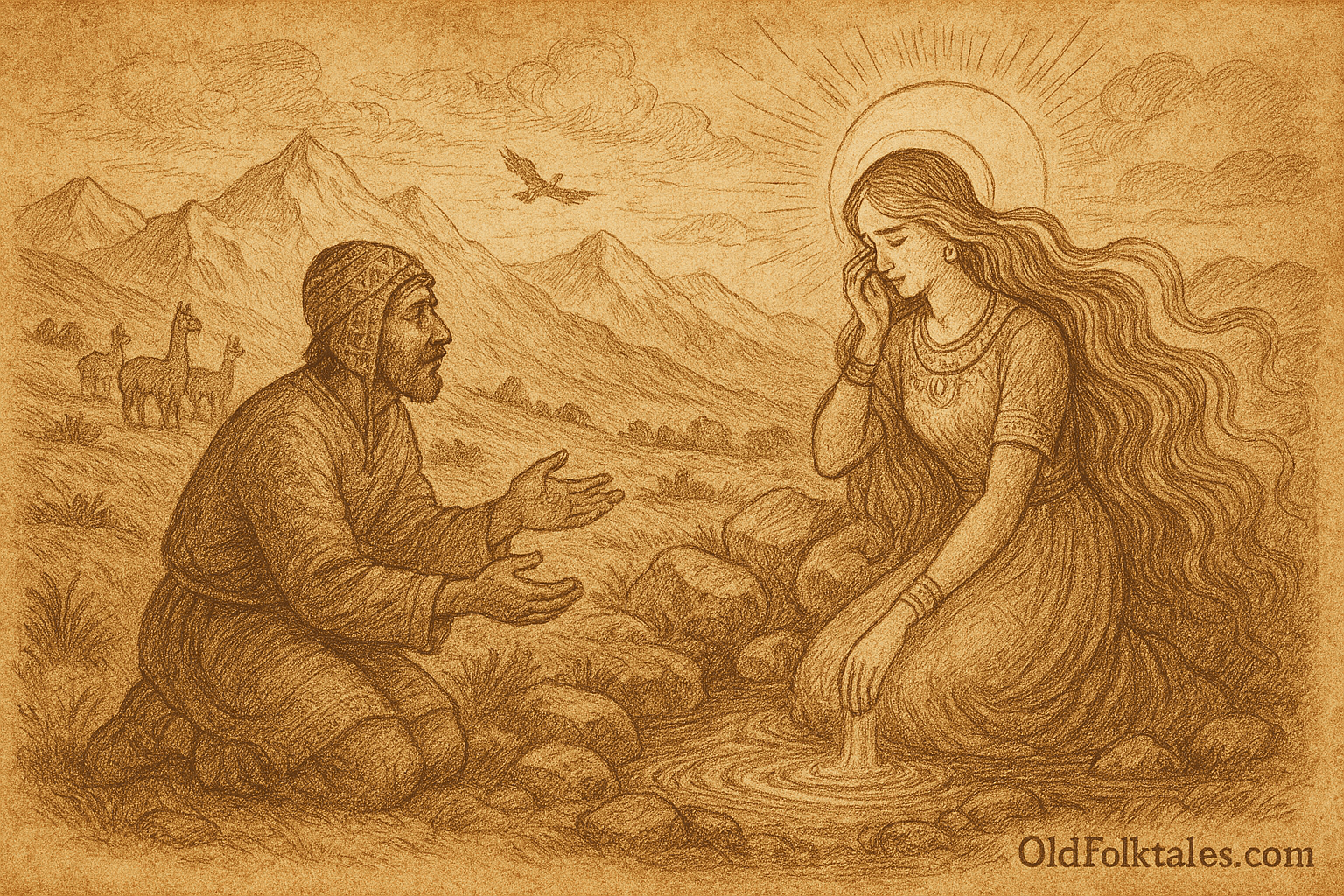
Long ago, when the world was younger and the boundary between heaven and earth was thinner than morning mist, there lived a shepherd named Acachi in the high valleys of the Andes. His name meant “salt” in the Quechua tongue, for his family had come from the sacred salt mines of Maras, where white terraces cascade down the mountainside like frozen waterfalls. Acachi was neither rich nor important, merely a humble keeper of llamas and alpacas who spent his days in the company of clouds and condors, watching his flock graze on the tough grasses that clung to the slopes.
Every morning, Acachi would rise before dawn and climb to the highest pasture, a place so elevated that he could see the sun god Inti rising from behind the eastern peaks in all his blazing glory. The shepherd would remove his chullo hat respectfully and whisper prayers of gratitude for the warmth that would keep his animals alive through another day. He was a faithful man, observant of all the proper rituals, making his offerings of coca leaves and chicha at the stone shrines scattered throughout his territory.
Click to read all South American Folktales — timeless stories from the Andes to the Amazon.
One morning, as the first rays of sunlight painted the snow-covered peaks in shades of gold and rose, Acachi saw something that made his heart stop. Descending from the sky on a beam of pure light was a maiden of such extraordinary beauty that she seemed woven from sunlight itself. Her hair flowed behind her like liquid gold, cascading past her waist in waves that shimmered with every movement. Her skin glowed with an inner radiance, and her eyes held the warm amber of dawn. She wore a dress of the finest cloth Acachi had ever seen, woven with threads that changed color from red to orange to yellow as she moved, and around her neck hung ornaments of pure gold that caught and reflected Inti’s light.
The celestial maiden descended to a crystalline spring that bubbled up from the rocks near where Acachi’s llamas grazed. She knelt by the water and began to weep, her tears falling like drops of molten gold into the pool. The shepherd, his curiosity overcoming his fear, approached slowly and spoke with great respect.
“Beautiful lady, why do you weep? What sorrow could touch one as radiant as you?”
The maiden looked up, startled, her eyes wide with surprise and something that looked like hope. “You can see me? You are not blinded by my father’s light?”
“I see you clearly,” Acachi replied, his voice gentle. “And I see that you are in distress. How can a simple shepherd help one who descends from the sky?”
The maiden’s story poured forth like water from a broken dam. She was Chaska Quyllur, daughter of Inti himself, the great sun god who ruled the day sky. Her father had promised her in marriage to Illapa, the fierce thunder god who shook the heavens with his rage. But Chaska Quyllur did not love Illapa. She feared his violence and his temper, the way he struck the earth with lightning and split mountains with his fury.
“I fled from my father’s palace in the sky,” she confessed, her voice trembling. “I descended to this world hoping to find refuge, but I know Illapa will search for me. His jealousy is as vast as the storm clouds, and his anger knows no mercy. When he finds me, he will drag me back to the heavens and bind me to him forever.”
Acachi felt something stir in his chest, a feeling he had never experienced before. Despite the impossibility of their circumstances, despite the vast gulf between a celestial being and a mortal shepherd, he found himself saying words that came from his deepest soul.
“Then stay here with me. I will protect you. My home is humble, but it is hidden in a valley where few people venture. My flock and I will be your guardians.”
Chaska Quyllur looked into the shepherd’s eyes and saw something there that she had never seen in the cold halls of heaven: genuine kindness without expectation of reward, love offered freely without demands or conditions. She placed her glowing hand in his weathered one, and in that moment, a bond was forged that even the gods would struggle to break.
For many months, they lived together in Acachi’s simple stone dwelling, perched on a mountainside where eagles nested and the wind sang ancient songs. Chaska Quyllur learned to help with the llamas, though her divine nature made the animals nervous at first. She wove cloth on Acachi’s loom, and though she tried to make simple patterns like the village women, her work always came out glowing with celestial light. She learned to cook quinoa and potatoes over the fire, and to make offerings at the local shrines.
Acachi had never known such happiness. Each day with Chaska Quyllur felt like a gift he had done nothing to deserve. They would sit together watching the sunset, her head resting on his shoulder, speaking of dreams and possibilities. She told him stories of the sky realm, of palaces built from starlight and gardens where flowers never wilted. He told her of the earth, of how seeds became plants, of the way baby llamas wobbled on their legs, of the quiet satisfaction of honest work.
But happiness, like morning dew, cannot last forever when it is built on hiding and fear.
One day, villagers from the valley below came seeking a lost sheep. They saw smoke from Acachi’s dwelling and climbed up to investigate. When they entered his home and saw Chaska Quyllur, they fell to their knees in terror and awe. Her divine nature was unmistakable, the way light seemed to bend around her, the way her presence made their hearts race with a mixture of reverence and fear.
“The shepherd harbors a goddess!” they cried. “He has stolen a daughter of heaven! This blasphemy will bring the wrath of the gods upon us all!”
The villagers ran back down the mountain, spreading word of what they had discovered. Within days, the entire region was in turmoil. Priests came to demand that Chaska Quyllur be returned to the sky. Old women wailed that crops would fail and animals would die because of Acachi’s presumption. Young men, jealous of the shepherd’s impossible fortune, spoke of forcing the divine maiden to leave.
But the worst was yet to come.
The sky darkened though it was midday. Black clouds gathered with unnatural speed, boiling and churning with barely contained rage. Thunder rolled across the heavens like war drums, and lightning split the air with violence that made the very mountains tremble. Illapa had found his bride.
The thunder god appeared in a blaze of electricity and fury, his form terrible and magnificent. His voice, when he spoke, shook loose stones from the peaks and sent Acachi’s llamas fleeing in terror.
“Mortal fool! You dare to steal what belongs to the gods? You dare to touch the daughter of Inti with your earthbound hands? For this offense, I will tear you apart with lightning and scatter your ashes across these worthless mountains!”
But Chaska Quyllur stepped between them, her own light flaring to match Illapa’s fury. “No! I chose to stay with him. He did not steal me; I gave myself freely. This mortal man has shown me more love and kindness in these few months than you ever could in eternity. I will not return with you, Illapa. I will not be your bride.”
The thunder god’s rage reached a fever pitch. The sky turned black as night, and lightning struck the ground all around them, leaving smoking craters in the earth. But even in his fury, Illapa could not strike Chaska Quyllur directly, for she was protected by her father’s light.
Then, from the east, came a voice that made even Illapa pause: Inti himself, the sun god, appeared on the horizon in blazing glory.
“Enough,” Inti commanded, and his voice carried the weight of ages. “My daughter has made her choice. But mortal and immortal cannot truly be together. Their natures are too different, their destinies too divergent. Yet I see the love between them is genuine, and I am not so cruel as to destroy what is true.”
Inti’s light grew brighter, encompassing both Acachi and Chaska Quyllur. The shepherd felt a strange sensation spreading through his body, a heaviness and coldness unlike anything he had experienced. Beside him, Chaska Quyllur gasped as the same transformation overtook her.
“I give you eternity together,” Inti said, his voice filled with a sadness that spoke of understanding the pain of letting go. “But it will be an eternity of stillness. You will become stone, monuments to your love, standing forever on this sacred peak where all can see that even the gods cannot prevent true hearts from finding each other.”
The transformation was swift but not painful. Acachi felt his skin hardening, his bones becoming granite, his blood turning to solid stone. But he also felt Chaska Quyllur’s hand in his, felt their fingers intertwining as they both turned to stone together. Their last mortal sensation was of looking into each other’s eyes, seeing love reflected there, knowing that even in this strange eternal sleep, they would be together.
The villagers who climbed to the high peak the next day found two stone figures standing side by side, their hands clasped, their faces turned toward each other in eternal regard. The female figure still seemed to glow faintly in the sunlight, as if some remnant of her celestial nature had been preserved in the stone. The male figure stood protective and gentle, his expression peaceful despite the tragic circumstances of his transformation.
To this day, on certain peaks in the Andes, there stand stone formations that the Quechua people call the Shepherd and the Daughter of the Sun. When morning light first touches these stones, they seem to glow with an inner warmth, and locals say it is Chaska Quyllur’s divine nature still expressing itself. And when storms roll through the mountains, some say they can still hear Illapa’s jealous thunder, forever denied the bride he could never have won through force or fury.
The tale is told to young people as a reminder that true love recognizes no boundaries, that kindness matters more than status or power, and that some loves are so powerful that not even the gods themselves can truly destroy them. Though Acachi and Chaska Quyllur could not remain mortal and living, they achieved something perhaps even greater: an eternity together, immortalized in stone, their love story literally carved into the mountains for all generations to see and remember.
Click to read all Andean Highland Folktales — echoing from the mountain peaks of Peru, Bolivia, and Ecuador.
The Moral of the Story
This legend teaches us that genuine love transcends all boundaries of status, origin, and even the divide between mortal and divine. It shows that true love is given freely, without expectation of reward, and that kindness and respect are more valuable than power or position. The story also reminds us that defying social expectations and hierarchies for the sake of authentic connection requires courage and comes with consequences, yet those consequences may be transformed into something eternal and meaningful. Most profoundly, it illustrates that love which is true cannot be destroyed, only transformed, and that choosing love over duty or expectation, while it may lead to sacrifice, creates something that endures beyond individual lifetimes.
Knowledge Check
Q1: Who is Chaska Quyllur, and why did she flee from the sky realm?
Chaska Quyllur is the daughter of Inti, the sun god in Quechua mythology. She fled from her father’s celestial palace because she was promised in marriage to Illapa, the violent thunder god, whom she feared and did not love. Rather than accept a forced marriage to a deity known for his rage and storms, she chose to descend to the mortal world seeking refuge and freedom, demonstrating her courage and desire for self-determination.
Q2: What makes Acachi’s love for Chaska Quyllur significant in the context of Andean culture?
Acachi’s love is significant because it crosses the fundamental boundary between mortal and divine, yet it is characterized by humility, genuine kindness, and selfless protection rather than possession or expectation. Despite being a simple shepherd with nothing to offer materially, he provides what Chaska Quyllur never found in the heavens: unconditional love and respect. His willingness to protect her despite the impossibility of their union and the inevitable divine retribution demonstrates the Andean value of love based on character rather than status.
Q3: Why does Illapa react with such fury when he discovers Chaska Quyllur with the shepherd?
Illapa’s rage represents both his jealousy and his wounded pride. As a powerful thunder god promised a divine bride, he is humiliated that she chose a mortal shepherd over him. His violent reaction reflects his nature as a storm deity associated with destructive power, but also reveals that his claim to Chaska Quyllur is based on entitlement and possession rather than love. His fury demonstrates that power and divine status do not guarantee love or loyalty, and that forced relationships breed resentment rather than affection.
Q4: What does the transformation into stone symbolize in this legend?
The transformation into stone symbolizes several profound concepts: the permanence and immortality of true love, the way sacrifice transforms into eternal monument, and the idea that some bonds transcend even death. By becoming stone together, Acachi and Chaska Quyllur achieve what they could not have as mortal and immortal: true unity and eternal presence together. The stone figures also serve as physical reminders to future generations, turning their love story into a literal landmark that teaches and inspires, demonstrating how personal sacrifice can become collective cultural memory.
Q5: How does Inti’s decision to turn the lovers to stone reflect Andean concepts of divine justice?
Inti’s decision represents a form of divine justice that balances multiple concerns: respecting his daughter’s genuine love while acknowledging the impossibility of mortal-immortal union, punishing the breach of cosmic order while recognizing authentic emotion, and providing a resolution that honors truth over convention. Rather than simply destroying or separating the lovers, he transforms their situation into something eternal, showing wisdom and compassion alongside authority. This reflects Andean understanding of balance and reciprocity, where even punishment can contain blessing.
Q6: What cultural values about love and social barriers does this story teach?
The story teaches that authentic love based on character and kindness transcends social hierarchies and arbitrary boundaries. It challenges the idea that marriages should be arranged based on status or power rather than genuine affection and mutual respect. The tale validates choosing personal happiness over social expectation, while honestly acknowledging that such choices come with consequences. It also emphasizes that what society or even gods deem impossible may still be worth pursuing, and that love which requires courage and sacrifice often achieves a form of immortality through story and remembrance, inspiring others to value authentic connection over convenient convention.
Source: Adapted from traditional Quechua oral narratives and creation tales from Andean folklore collections, as documented in ethnographic compilations of Peruvian highland mythology, including regional variations of celestial maiden stories preserved in Quechua language folklore traditions.
Cultural Origin: Quechua communities, Andean highlands of Peru (traditional oral narratives with regional variations)