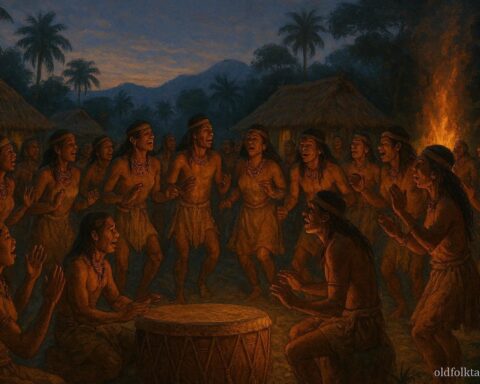
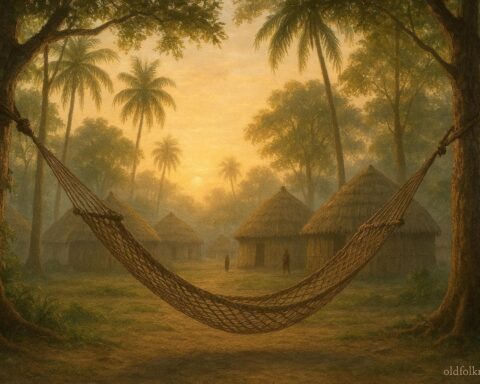
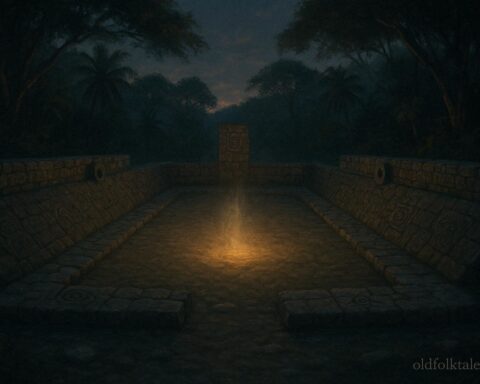
In a valley surrounded by volcanic hills and wide fields of maize, there lay a great stone unlike any other. It rested at the edge of an old settlement, smooth on one side and rough on the other, as though shaped by both time and intention. The people knew the stone had always been there. No one remembered seeing it arrive, and no one could recall a time when it had not belonged to the land.
The elders said the stone was placed by the ancestors during the earliest days, when people learned that survival depended not on individual power, but on shared effort. Yet as generations passed, that lesson grew quieter.
When a new ceremonial center was planned, the leaders decided the stone should be moved to the central plaza. It was large, but not impossibly so. Strong men believed they could carry it with ropes and poles. They gathered at dawn, confident and eager to prove their strength.
They pulled.
Discover the diverse storytelling traditions of Canada — from the icy North to the Maritimes
The ropes tightened. Muscles strained. Feet dug into the soil. But the stone did not move. Not even the slightest shift disturbed the dust beneath it.
Frustrated, they rested and tried again. This time they shouted, urging one another on. Still, the stone remained fixed, as if it had grown roots deep into the earth.
Word spread quickly through the settlement. Some laughed and claimed the men were weak. Others insisted the stone was cursed. A few argued that better tools were needed. So they returned with thicker ropes, stronger poles, and sharper commands.
Again, they failed.
One man stepped forward, proud and impatient. “Stand aside,” he said. “I will move it alone.” He wrapped a rope around his shoulders and pulled until his breath burned. The stone did not respond.
Anger rose among the people. They argued over who should lead, who was strongest, and who had failed. Some accused others of laziness. Others blamed the elders for clinging to old beliefs.
At last, an elder woman who had been watching silently approached the stone. She did not touch it. She placed her palm on the ground beside it and closed her eyes.
“This stone does not resist strength,” she said calmly. “It resists intention.”
The people quieted.
“The stone does not belong to any one person,” she continued. “It will not move for pride, command, or display. It moves only when carried for the good of all.”
The words unsettled many. They had come to prove themselves, not to listen.
Still, curiosity replaced anger. The elder suggested they try again, but differently.
This time, the children were invited to join. So were the elders, the farmers, the builders, and those who usually stood aside during heavy labor. No one was placed above another. No commands were shouted. Instead, they spoke together about why the stone should be moved.
They agreed it would stand in the plaza not as a monument to power, but as a reminder of shared responsibility. It would be used during gatherings, placed at the center during decisions that affected the whole community.
Only then did they take hold of the ropes.
They lifted together, slowly, carefully.
The stone shifted.
A gasp moved through the crowd. Encouraged, they continued, adjusting their pace so no one was strained or left behind. Step by step, the stone rose and moved forward. It did not feel lighter, but it felt willing.
When they reached the plaza, they lowered it gently. The stone settled into place as if it had always intended to be there.
From that day on, the stone became more than a marker. When disputes arose, people gathered around it. When decisions were needed, hands rested upon its surface. The elders reminded the people of the day it refused to move.
And the stone never moved again, not because it could not, but because it had already taught its lesson.
Explore the ancestral legends of Canada, Mesoamerica, and South America’s Indigenous tribes.
Moral Lesson
True strength is not found in individual power or loud authority, but in humility and cooperation. When people act with shared purpose and respect, even the heaviest burdens can be carried.
Knowledge Check
1. Why did the stone refuse to move at first?
Because it was approached with pride, competition, and individual ambition rather than shared purpose.
2. What changed when the community tried again?
They included everyone and agreed on a communal reason for moving the stone.
3. Who understood the stone’s nature first?
An elder woman who recognized that intention mattered more than strength.
4. What does the stone symbolize in the story?
Communal responsibility, humility, and unity.
5. Why did the stone move only once?
Because its purpose was to teach a lesson, not to be used repeatedly.
6. How does the story guide leadership and decision-making?
It teaches that leadership must serve the community, not individual pride.
Source
Adapted from Toltec folklore summaries and Central Mexican oral history traditions documented in academic Mesoamerican studies.
Cultural Origin
Toltec-influenced Nahua traditions, Central Mexico.