In the deep night of Jamaica, when the day’s heat has fled and the only light comes from a sliver of moon, the lonely roads belong to the duppies. And of all the island’s ghosts, none strikes a deeper chill in the heart than the Rolling Calf.
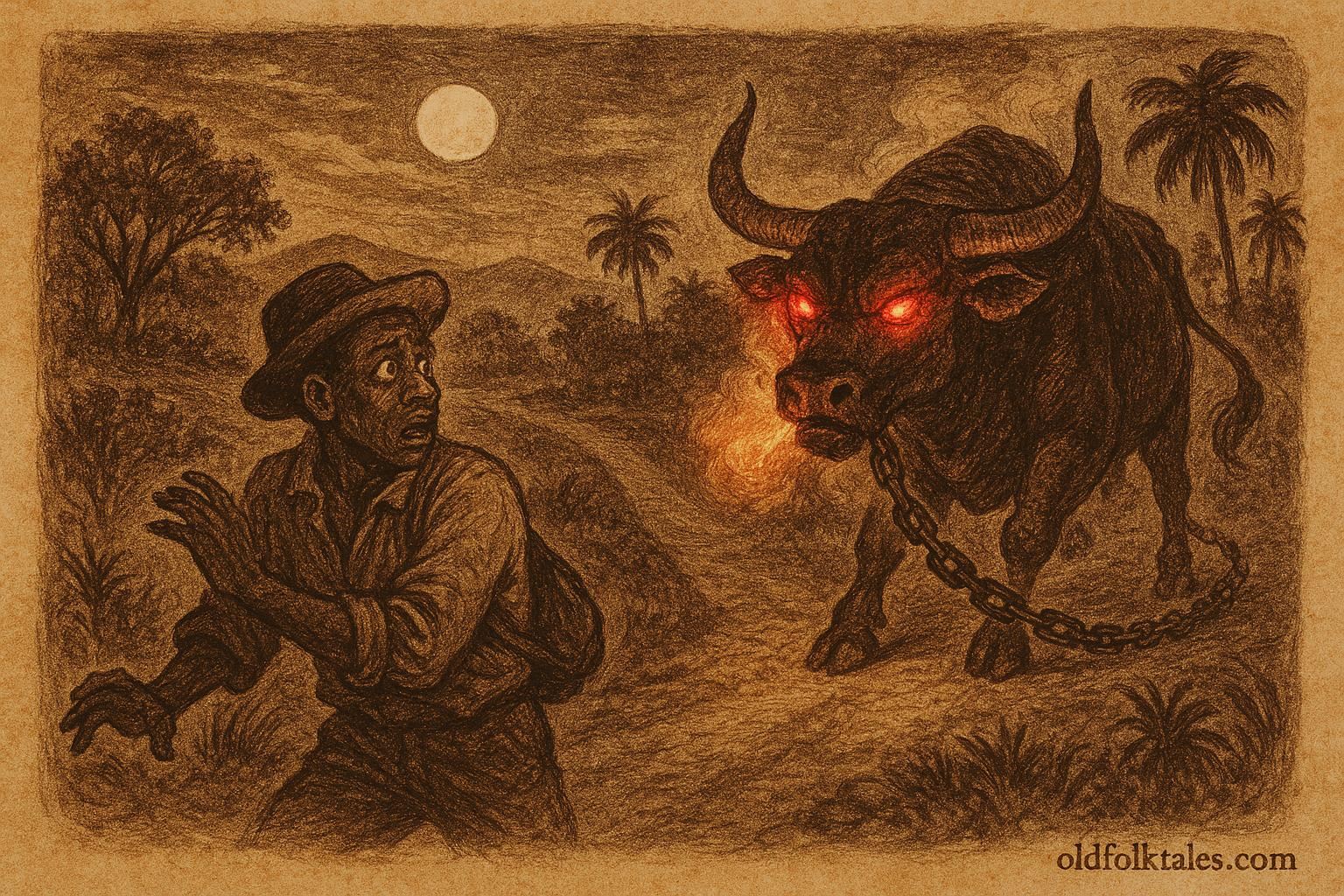
It does not haunt houses or graves, but the in-between places: the long, dark stretches of road between villages, the lonely bridle paths through the cane fields, and most of all, the crossroads where choices are made. To see it is to know true fear. It appears as a massive, jet-black bull, but one born of nightmare. Its eyes are not eyes, but two burning coals of hellfire that cut through the darkness. From its flared nostrils, sulfurous smoke puffs into the cool air. And the worst sound of all, the dreadful, clanking, grinding rattle of a heavy chain it drags behind it, a sound that chills the blood long before the beast comes into view.
The old people say the Rolling Calf is no ordinary animal spirit. It is the restless duppy of a wicked person forced to walk the earth in a form that reflects their sins. Most often, it is said to be the ghost of a cruel butcher who took pleasure in the suffering of the beasts he slaughtered. Sometimes, it is the spirit of a heartless plantation owner or overseer from the old days, a man whose life was measured in the crack of the whip and the clank of the slave chain. In death, their brutality is made manifest: the bull’s fury, the chain’s reminder, the fire of a tormented conscience.
The story is not just a fright; it is a warning whispered from generation to generation: Live a wicked life, and your spirit may not find peace. It may become a terror on the roads, chasing the living as you are chased by your own deeds.
But like all things in Jamaican lore, where there is a powerful evil, there is also a knowable defense. The knowledge of how to escape the Rolling Calf is passed down as carefully as the tale itself. If you are walking alone at night and hear the heavy, clanking chain drawing near, do not run in a blind panic. It will chase you, and it is faster.
You must be clever and calm. First, get off the road itself. The Rolling Calf is bound to the path. Fling yourself into a gully or a ditch and lie perfectly flat, face down, making yourself small in the earth’s embrace.
If you have a penknife, use it quickly to scratch a cross into the soil beside you. The holy symbol can turn away the unholy beast.
The most clever trick is one of misdirection. If you have time, strip off your shirt or your hat. Throw your garment in one direction, while you crawl or roll quietly away in another. The Rolling Calf, they say, will follow the scent on your clothes, giving you precious moments to escape.
Some carry the folk protections: a sprig of vervain, the sacred herb, tucked in a pocket, or a bit of pearl ash. These substances are believed to form a barrier the fiery spirit cannot cross.
The Rolling Calf, for all its terror, is a ghost that can be outwitted. That is the heart of the story. It is a force of chaos and past cruelty, but with knowledge, ritual, and a clear head, the living can survive its chase. It transforms the tools of historical oppression, the bullwhip’s terror, the chain’s bondage, into a specter that can be understood, avoided, and defeated by the very people who once suffered under them.
So, the story serves its purpose. It keeps children from wandering too far after dark. It encourages moral living. And it provides a profound, symbolic comfort: that the chains of the past, however loud they clank in the night, can be slipped with wisdom and courage.
The Moral Lesson:
The legend of the Rolling Calf serves as a powerful societal caution. It teaches that wickedness and cruelty in life have consequences that may endure beyond death, transforming the perpetrator into a monstrous, restless spirit. Simultaneously, it empowers the living with practical knowledge and ritual, emphasizing that even the most terrifying manifestations of past evils can be survived and outwitted.
Knowledge Check
Q1: What is the Rolling Calf in Jamaican folklore?
A1: It is a terrifying type of duppy (ghost) that manifests as a monstrous, fiery-eyed bull dragging a clanking chain, which haunts lonely roads and crossroads at night.
Q2: What is the believed origin of a Rolling Calf spirit?
A2: It is said to be the restless ghost of a particularly wicked person, most commonly a cruel butcher or a brutal plantation owner/overseer, whose sins in life transform them into this beastly form.
Q3: What are some traditional methods to escape a Rolling Calf?
A3: Methods include lying flat in a ditch off the road, scratching a cross in the earth, throwing one’s clothes in a different direction as a decoy, or using protective substances like vervain or pearl ash.
Q4: Why is the sound of a chain integral to the Rolling Calf legend?
A4: The clanking chain evokes the brutal history of slavery and oppression, transforming the literal chains of that era into a supernatural symbol of guilt and haunting that can now be heard and potentially escaped.
Q5: What specific locations are most associated with a Rolling Calf haunting?
A5: They are most associated with lonely roads, pathways through old fields, and especially crossroads, which are traditionally liminal, spiritual spaces in many cultures.
Q6: What are the two main social functions of this legend?
A6: It acts as a moral caution (warning against wickedness) and a practical empowerment (providing rituals to survive the haunt), while also serving as a form of cultural commentary on Jamaica’s history.
Cultural Origin: Jamaican Folklore (Duppy Legend), Jamaica.
Source: Collected from Jamaican oral tradition, as reflected in publications like The Gleaner and the fieldwork of folklorists like Laura Tanna.