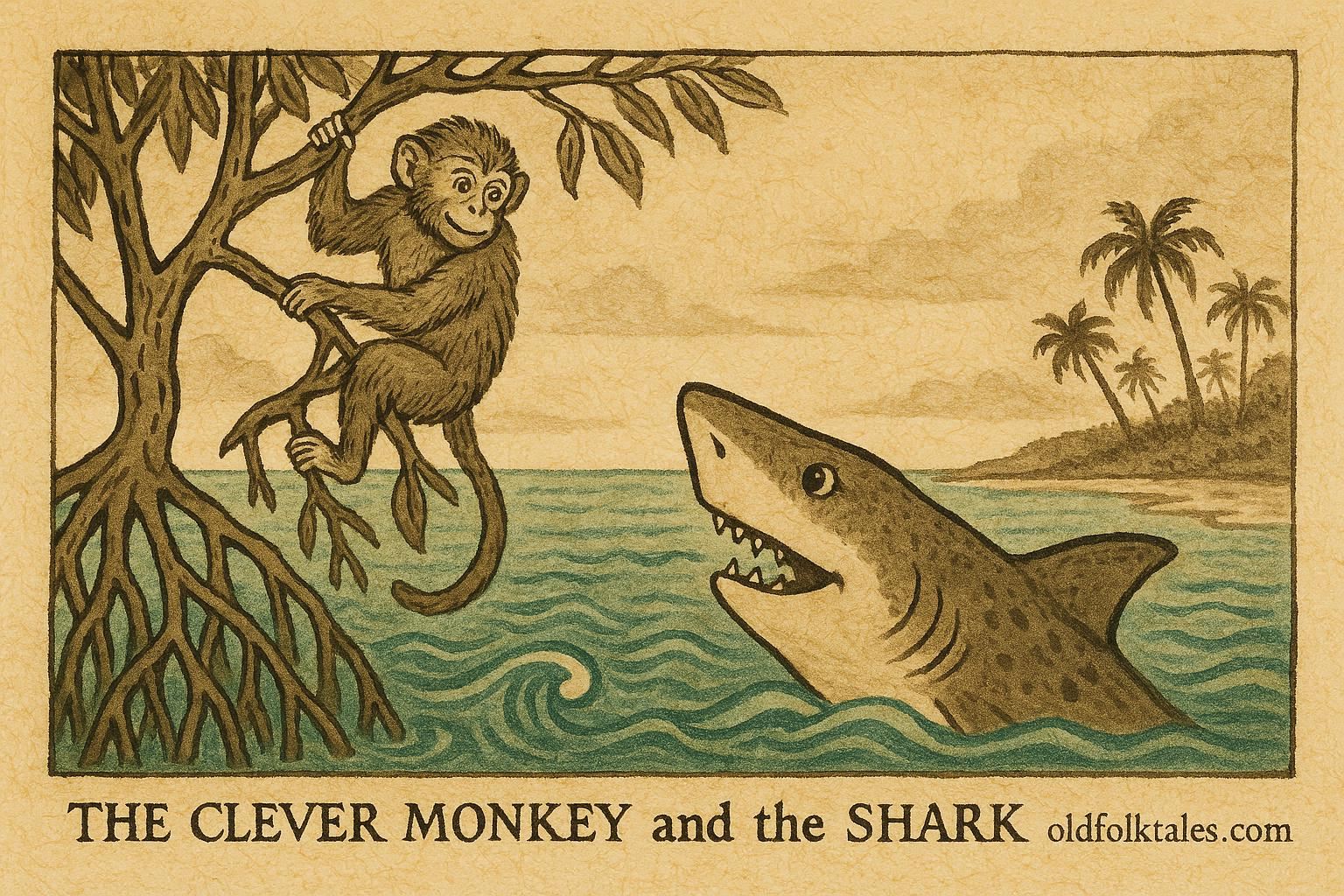
Along the warm coast of Cuba, where mangroves dip their roots into the turquoise sea and the air hums with the rhythm of waves, there lived a quick-witted monkey. He spent his days swinging among the tangled branches that grew close to the shore, feasting on ripe fruit and chattering cheerfully to the birds and crabs below. From his high perch, he could see the glimmering water stretch far into the horizon, and he often wondered what kind of creatures lived beneath its rippling surface.
One day, while the monkey sat on a branch dangling low over the water, he noticed a gray shape gliding smoothly below. It was a shark, large and sleek, with eyes like polished stones. The shark stopped and called up to him, “Good morning, Monkey! What a fine spot you have there. You must live like a king among the trees.”
The monkey grinned, always pleased by flattery. “It’s not a bad life,” he said, “as long as there are bananas to eat and the sun to warm my fur.”
The shark’s voice was smooth as the tide. “You know, I’ve been watching you for some time. You seem a fine fellow, and I’d like to be your friend. We sharks don’t have much company out here. Why don’t you come visit me in the sea? I could show you the wonders below, coral gardens, pearl shells, and fish that sparkle like stars.”
The monkey laughed. “Me, swim? My friend, I’d sink like a stone! I belong to the trees, not the sea.”
But the shark insisted. “You have nothing to fear. Climb onto my back, and I’ll carry you safely. You’ll see things no monkey has ever seen.”
The monkey hesitated. He was curious, and a little vain. The idea of being the first monkey to explore the sea tickled his pride. After a moment’s thought, he agreed. “Very well, Shark. I’ll trust you.” He leapt lightly from the branch and landed on the shark’s slippery back.
Together, they glided out into deeper waters. The monkey clung tightly, watching the sunlight shimmer through the surface and fish dart past like living jewels. For a while, it was thrilling. But soon the water grew darker and colder. The shore was far behind them now.
Then the shark spoke again, his voice lower and more serious. “My friend,” he said, “there’s something I must tell you. Our king, the great Shark King, is gravely ill. The healers say only the heart of a monkey can cure him. I’m sorry, but I brought you here so your heart could save our king’s life.”
The monkey’s fur stood on end. His heart thudded faster than ever. “You, you mean to take my heart?” he stammered.
“I wish it weren’t so,” said the shark, “but the king’s command cannot be refused.”
For a moment, the monkey said nothing. Then his clever mind began to turn. “Oh,” he said, pretending calm, “why didn’t you say so sooner, my friend? I’d have been happy to help your king. But there’s one small problem.”
The shark blinked. “Problem?”
“Yes,” said the monkey. “You see, I never travel with my heart. I always hang it on the tree branch when I go out, so it doesn’t get wet or tired. If you take me back to shore, I’ll fetch it for you.”
The shark’s eyes widened. “You left your heart behind?”
“Of course,” the monkey said matter-of-factly. “Don’t you ever take yours out?”
The shark frowned, puzzled but convinced. “No, we sharks keep ours inside. But if that’s what you need, I’ll take you back.”
He turned and swam swiftly toward the shore. As soon as they neared the mangroves, the monkey leapt from the shark’s back and scrambled up the nearest tree. From the safety of the high branches, he looked down at the shark, who waited expectantly below.
“Well?” called the shark. “Where’s your heart?”
The monkey laughed so hard the leaves shook. “My poor, foolish friend! Did you really believe I could live without my heart? If you want it so badly, you’ll have to come up here and get it!”
The shark’s face darkened with anger. “You tricked me!” he roared.
The monkey only grinned. “And you tried to trick me first. Perhaps now you’ll remember—there’s more than one kind of wisdom in this world.”
The shark thrashed in the water, furious, but he knew he had been beaten. The monkey stayed safe among the trees, laughing until the shark finally swam away. From that day forward, the monkey never trusted smooth words from strangers, and the shark never again tried to outwit a creature of the land.
And so, on that bright Caribbean shore, the tale of The Monkey and the Shark became a favorite among storytellers, told by grandmothers at night, reminding children that quick thinking and courage can outsmart even the strongest foe.
Immerse yourself in Latin America’s stories of passion, transformation, and spirit.
Moral Lesson
This Afro-Cuban folktale teaches lessons on wisdom, trust, and survival. The clever monkey reminds us that intelligence and self-control are greater tools than strength or flattery. Those who use their minds wisely can overcome deceit and danger.
Knowledge Check
1. Who are the main characters in “The Monkey and the Shark”?
The story features a clever monkey and a deceitful shark who tries to trick him.
2. What motivates the shark to lure the monkey into the sea?
The shark claims his king needs the monkey’s heart to cure an illness.
3. How does the monkey escape from danger?
He pretends to have left his heart hanging on a tree, tricking the shark into returning him to shore.
4. What key theme from West African storytelling appears in this folktale?
The triumph of intelligence and trickery over brute strength, a hallmark of Yoruba and Akan folktales.
5. What lesson does the story teach about trust?
It warns against blind trust in flattering or deceitful people and praises quick thinking in the face of betrayal.
6. How does this tale reflect Afro-Cuban culture?
It blends Yoruba trickster traditions with Cuban coastal imagery, preserving African moral wisdom within Caribbean storytelling.
Source: Afro-Cuban retelling of a West African (Yoruba/Akan) folktale recorded in Cuban oral tradition; appears in Latin American Folktales: Stories from Hispanic and Indian Traditions, ed. John Bierhorst (Pantheon, 2002).
Cultural Origin: Afro-Cuban / Yoruba-Diasporic Folklore