In a small village in Haiti, there lived a gentle girl named Cendrine. Her world was one of simple joys, shaded by the broad leaves of mango and breadfruit trees, until her beloved mother fell gravely ill. On her deathbed, Cendrine’s mother placed a single, unassuming orange seed into her daughter’s small palm. “Keep this close to your heart,” she whispered, her voice a faint rustle. “It holds my love for you. Plant it with your tears, and you will never be alone.”
After her mother’s passing, Cendrine’s father remarried a woman with a daughter of her own. Where Cendrine was quiet and kind, the stepmother was sharp-tongued and jealous, and her daughter was spiteful. They forced Cendrine into servitude, making her scrub, cook, and haul water until her arms ached. Her only solace was the tiny orange seed, which she wore in a little pouch around her neck.
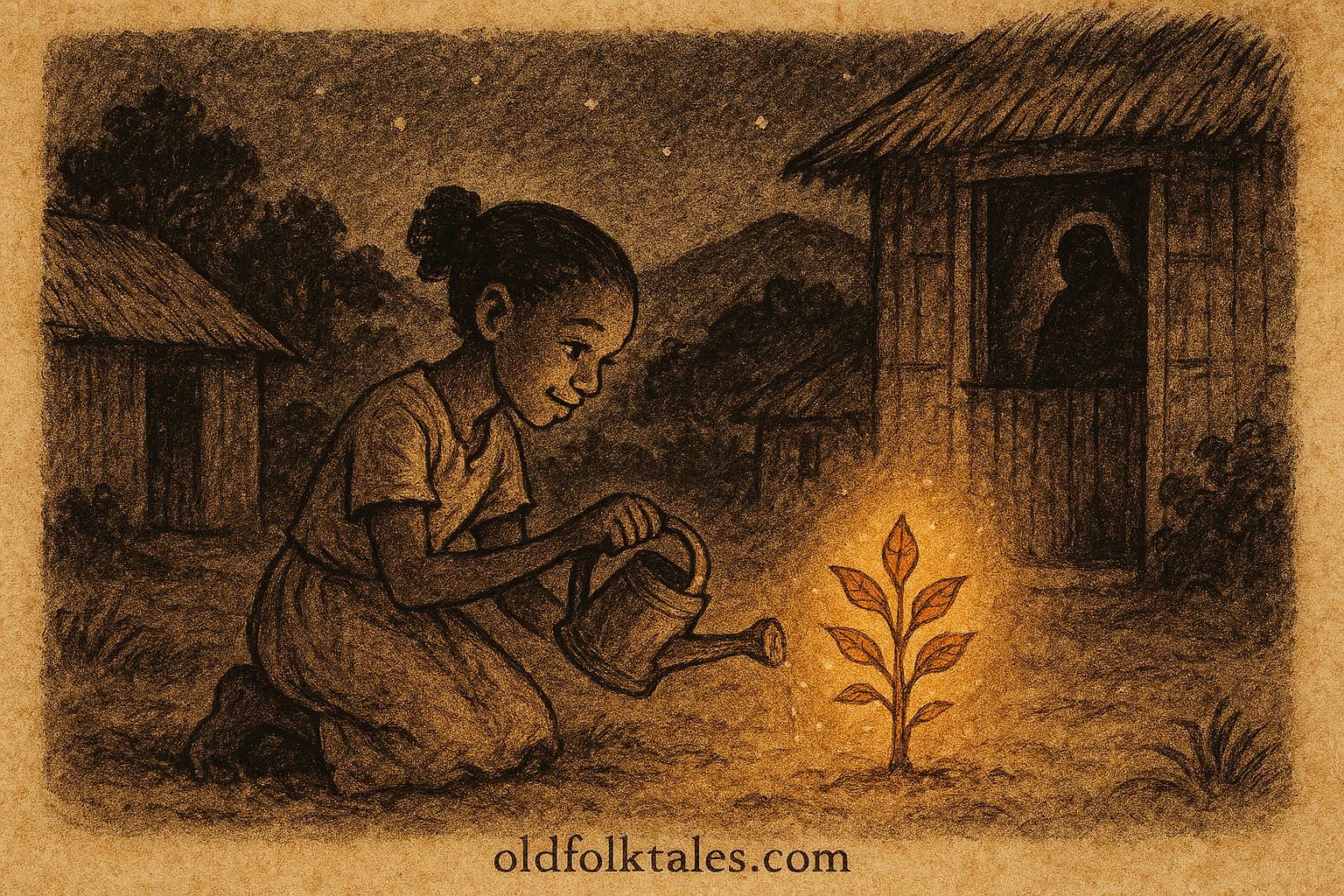
One evening, after being denied supper, Cendrine crept into the dusty yard. Thinking of her mother, her tears fell freely onto the dry earth. Remembering the instruction, she dug a small hole and planted the seed. She watered it with what little she could save from her own drinking ration. Overnight, a miracle occurred. A vibrant sapling sprang from the ground, and within days, it grew into a magnificent orange tree, the most beautiful anyone had ever seen. Its leaves were a deeper green than the sea, and its blossoms smelled sweeter than honey. But its true magic was for Cendrine alone. When she sang to it, the tree would rustle its leaves in a harmonious reply. When she was hungry, it would lower a branch heavy with succulent, sun-warmed oranges just for her.
The stepmother and stepsister watched in venomous envy. The tree offered them nothing—its branches rose high out of reach, and its fruit turned bitter if they tried to seize it. Fury consumed the stepmother. One afternoon, while Cendrine was fetching water from the distant river, the woman took a sharp machete and hacked the magic tree down, reducing its splendor to a pile of lifeless wood and scattered leaves.
Heartbroken, Cendrine returned to the devastation. She wept among the shattered branches until, exhausted, she fell asleep. In a dream, her mother’s voice comforted her: “Do not despair, my child. From this wood, create anew.” Inspired, Cendrine carefully gathered the finest piece of the trunk. With patience and love, she carved the wood into a small, graceful doll. She placed it in the remnants of the tree’s roots.
The next morning, the doll was alive. It was not large, but its eyes sparkled with familiar warmth. “I am here to help you,” it said in a voice like rustling leaves. From that day, the magical doll became Cendrine’s secret guardian. It completed her most arduous chores in the blink of an eye, drew cool water from the well, and even prepared exquisite meals. The stepmother grew suspicious of Cendrine’s newfound peace.
Determined to uncover the secret, the stepmother pretended to fall ill, demanding a special broth that required herbs from deep in the forest. She sent Cendrine to fetch them, knowing the journey would take all day. As soon as Cendrine was gone, the woman and her daughter began to search the hut. They found the wooden doll, sitting serenely near the hearth. Sneering, the stepsister snatched it up. But the doll, infused with a mother’s protective love, began to grow. It grew taller than the roof, its wooden form becoming mighty and strong. It stared down at the two cruel women, who dropped to their knees in terrified apology, begging for mercy.
The doll did not harm them but commanded them to leave and never return. Cowed and frightened, the stepmother and stepsister fled the village. When Cendrine returned, the doll had returned to its small, sweet form. “Your home is your own again,” it said. Cendrine’s father, finally seeing the truth, embraced his daughter. The magical doll stayed as a companion and guide, and Cendrine lived a life of kindness and contentment, the enduring love of her mother forever watching over her.
The Moral Lesson:
This tale teaches that true love and purity of heart are resilient forces that cannot be destroyed by malice. Like the magic orange seed, goodness, when nurtured through hardship, will always find a way to grow, transform, and ultimately triumph, providing protection and guiding us toward a just and happy life.
Knowledge Check
Q1: What does the magic orange seed symbolize in the Haitian folktale?
A1: The seed symbolizes the enduring, protective love of Cendrine’s mother, which takes root and grows even after her death, becoming a source of magic and resilience for her daughter.
Q2: How is the stepmother’s cruelty defeated in the story?
A2: Her cruelty is defeated by the magical wooden doll, which transforms into a powerful giant, confronting the stepmother and stepsister and forcing them to flee in fear and repentance.
Q3: What is unique about the Haitian Cinderella’s magic helper compared to other versions?
A3: Unlike a fairy godmother, the helper originates directly from nature (the orange tree) and maternal love. It evolves from a seed to a tree to a hand-carved doll, reflecting a deeply rooted connection to the land and ancestry.
Q4: Why does the orange tree only bear fruit for Cendrine?
A4: The tree responds to Cendrine’s pure heart and her nurturing tears. It is a manifestation of her mother’s bond with her, rejecting the cruelty and envy of the stepfamily.
Q5: What is the cultural significance of using an orange tree in this folktale?
A5: The orange tree is a common and valued fruit tree in Haiti, making the magic relatable and rooted in the local environment. It represents sustenance, life, and beauty emerging from the Caribbean landscape.
Q6: What common folkloric motif is present in The Magic Orange Tree?
A6: The story features the “magic helper” motif, where a persecuted protagonist receives aid from a supernatural being or object, which is a central element in Cinderella-type tales worldwide.
Cultural Origin: Haitian Folktale, Haiti.
Source: Adapted from The Magic Orange Tree and Other Haitian Folktales by Diane Wolkstein, collected from Haitian storyteller Maurice Sixto.