In the quiet folds of Bald Eagle Valley, where the morning mist hangs low over the ridges and farm fields stretch between streams, there lived a simple family whose story the valley has never forgotten. Their home sat close to the mountain road, framed by oak trees and a patchwork of corn and barley fields. Life was measured in chores, seasons, and Sunday bells, until one fateful day when loss crept in and settled among them.
The father was a hardworking farmer, known for his patience and steady hand. His wife, gentle but strong, held the household together with the warmth of her songs, soft melodies passed down through her Pennsylvania-German family. They had three children: two daughters who helped with the spinning and a son, their pride and joy, full of restless energy and curiosity.
Click to read all South American Folktales — timeless stories from the Andes to the Amazon.
One summer morning, when the fields shimmered under the heat and the air buzzed with insects, the boy disappeared. Some said he followed the creek downstream and lost his way. Others whispered he might have been taken in the confusion of soldiers passing through, one of the small tragedies of uncertain times. Whatever the cause, the boy never came home that day.
At first, the family searched every path, calling his name until their voices broke. The father and neighbors combed the woods, carrying lanterns through the dark, while the mother waited by the gate, singing the tune she always sang to her children, a lullaby about the stars finding their way back to the sky. But days turned to weeks, and weeks to years. The boy was gone, and only hope remained.
Seasons rolled through the valley. The daughters grew up and married, the father’s hair turned white, and the mother grew quiet, her voice softer now, though she still hummed the old song in the evenings. Around the firesides of Bald Eagle Valley, people still spoke kindly of them, saying, “That poor woman still waits for her boy.”
Then, one cold autumn many years later, when frost silvered the fields and the smell of wood smoke filled the air, rumors began to stir. A stranger had been seen living in the hills above the valley, a man who kept to himself, wearing rough clothes and carrying old trinkets that looked handmade. Some hunters claimed he muttered names no one recognized and hummed tunes as he walked along the ridges.
At first, no one thought much of it. The mountains had always been home to wanderers, hermits, trappers, and veterans who never returned fully from war. But one evening, when the church bell tolled and people gathered for the midweek prayer, a young farmhand spoke.
“I saw that man near the hollow by the old fence line,” he said. “He was humming something, an old tune. Sounded like the one Mrs. Brenner used to sing when we were children.”
The room went silent. The mother, now old, her hair white as the frost outside, lifted her head.
“My song?” she asked quietly. “You are certain it was my song?”
The farmhand nodded. “Clear as church bells, ma’am.”
Without hesitation, the family and neighbors prepared to search the hills once again. They carried lanterns, ropes, and bread, guided by the memory of the boy’s favorite paths. The old landmarks came back to them as they walked, the split oak tree, the mossy stone wall, the flat rock where he used to watch the clouds. Each one was a marker of memory, a path carved not in earth but in the heart.
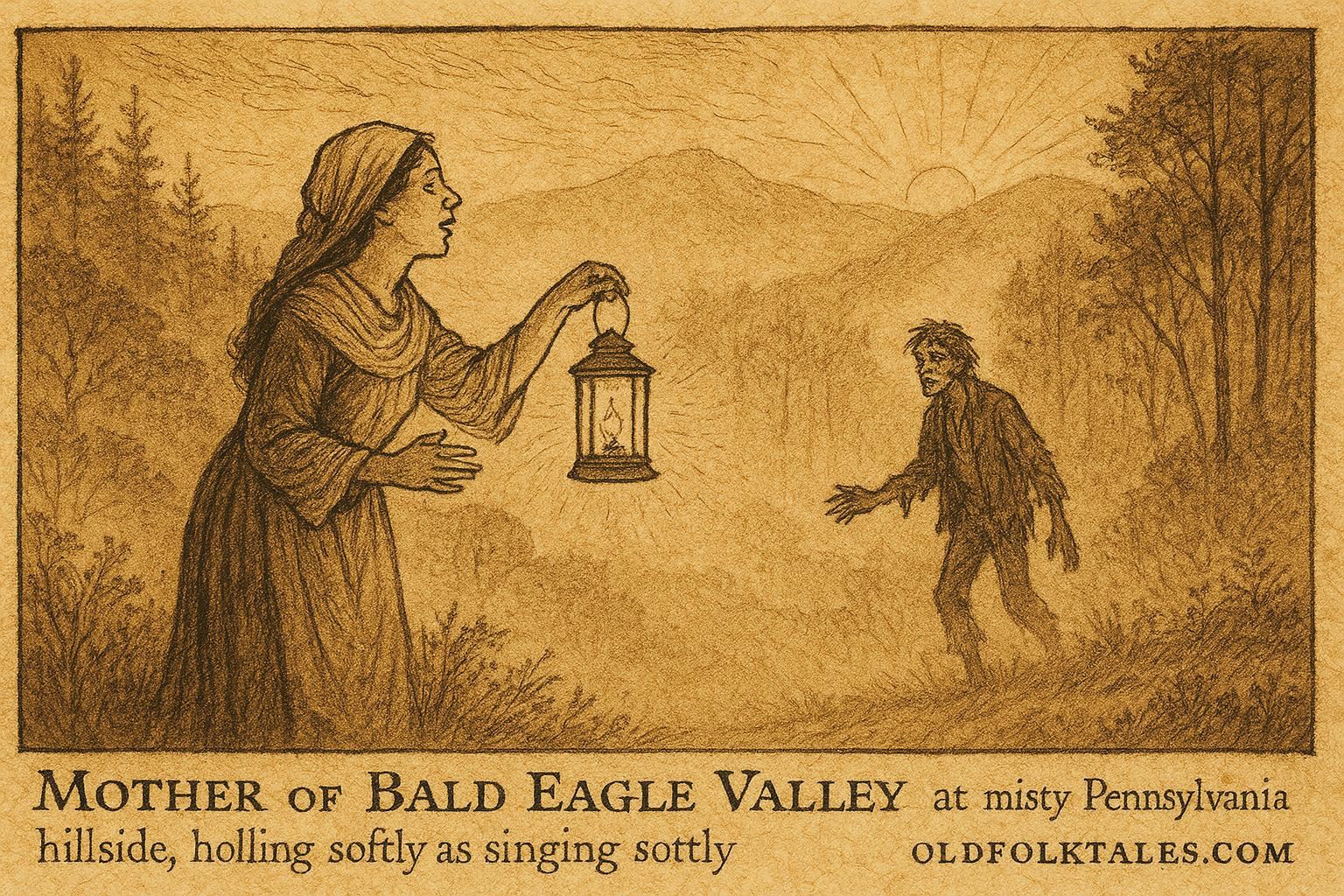
As they neared the clearing by the ridge, the dogs began to bark. There, by a fallen log, they saw the figure: a thin man with long, tangled hair, his coat patched with old cloth. He looked up with startled eyes as the lantern light touched his face. In his hand hung a small wooden button, carved with the initials “B.E.”, the very same his father had carved for the boy’s jacket long ago.
The mother stepped forward, trembling. “My son,” she whispered.
The man’s eyes filled with confusion, then recognition. From his lips came a faint hum, the same lullaby she had sung by the fireside so many years ago.
The valley grew silent except for that tune. Slowly, the mother reached for him, and he took her hand. Though years of wandering had changed him, the song had stayed, the thread that bound him to his past.
The neighbors carried the news home that night. Bells rang in the little church of Bald Eagle Valley, and people came to see for themselves. They spoke softly, not to frighten him, but to honor the miracle that had returned to their midst.
Some said the man never fully remembered where he had been or what had happened. Others believed he had lost his way in both body and mind. But none of that mattered to his mother, who at last could rest knowing her song had guided him home.
In time, the story spread beyond the valley. Parents told it to their children on long winter nights, as a reminder never to wander too far and to cherish the ties that keep families together. Even today, if you walk through the ridges at dusk, you might hear the faint hum of a lullaby echoing between the hills, a mother’s song calling her child home.
Immerse yourself in Latin America’s stories of passion, transformation, and spirit.
Moral Lesson
The Lost Brother of Bald Eagle Valley teaches that family love and memory can transcend time and loss. Even when years pass and paths grow cold, the heart remembers what the mind forgets. Love, like a song, can guide us back home.
Knowledge Check
1. Where does “The Lost Brother of Bald Eagle Valley” take place?
It is set in rural Pennsylvania, within the mountain farming communities of Bald Eagle Valley.
2. What causes the family’s sorrow in the story?
Their young son disappears one summer and is lost for many years before being rediscovered.
3. How does the mother recognize her lost son?
Through a familiar song, the lullaby she used to sing when he was a child, and a carved button with his initials.
4. What is the symbolic role of the mother’s song?
The song represents memory, love, and the unbreakable bond between family members.
5. What cultural values does the story reflect?
The folktale reflects Pennsylvania-German rural values of faith, family, perseverance, and community support.
6. What is the main moral lesson of the story?
The story teaches that love and memory can guide even the lost back home and that family bonds never fade.
Source: Adapted from The Lost Brother of Bald Eagle Valley in Pennsylvania Fireside Tales by Jeffrey R. Frazier.
Cultural Origin: Pennsylvania–German / Mountain Farm Folklore, United States.