In the highlands of Puebla, where the clouds drift low and the slopes shimmer with green after the summer rains, the people still whisper of El Señor del Cerro The Lord of the Hill.
He is said to dwell within the heart of the mountains, watching over the hidden veins of silver and the roots of the pines. No one knows his true age, for he has been there since before the first Spanish horse set foot upon the land. Some say he is an ancient nahual, a guardian spirit bound to the hills. Others believe he is one of the old gods who stayed behind when the new faith came, protecting the balance of nature in silence.
Immerse yourself in Latin America’s stories of passion, transformation, and spirit.
To the villagers, the cerros, the hills, are alive. They breathe with the wind, they bleed through their streams, and they guard treasures meant only for those who show humility. The people say that each hill has its own heart, and to wound it without permission is to awaken its anger.
The Miner Who Listened to the Hills
Long ago, during the silver rush of New Spain, a young miner named Mateo Hernández came from the valley to the mountains of Puebla. He was not a rich man, nor was he blessed with luck, but he had a patient heart and strong hands.
Mateo worked for a mining company that had built wooden shafts into the hillside. The foremen drove the men hard, promising riches that never came. While others cursed the earth when their picks struck empty rock, Mateo would pause to listen. “The hill will tell us where to dig,” he used to say, half in jest, half in faith.
The other miners laughed. “The only thing that hill will tell you is that you’re poor,” one of them sneered. But Mateo did not answer. He only smiled and carried on.
Each evening, when his shift ended, Mateo would sit at the edge of the ravine, eating his small meal of beans, maize, and tortillas while watching the clouds turn red over the mountains. He spoke to the earth as if it were an old friend. “I take only what I need,” he said quietly. “If I ever find silver, I’ll share it with those who are hungry.”
The Stranger on the Path
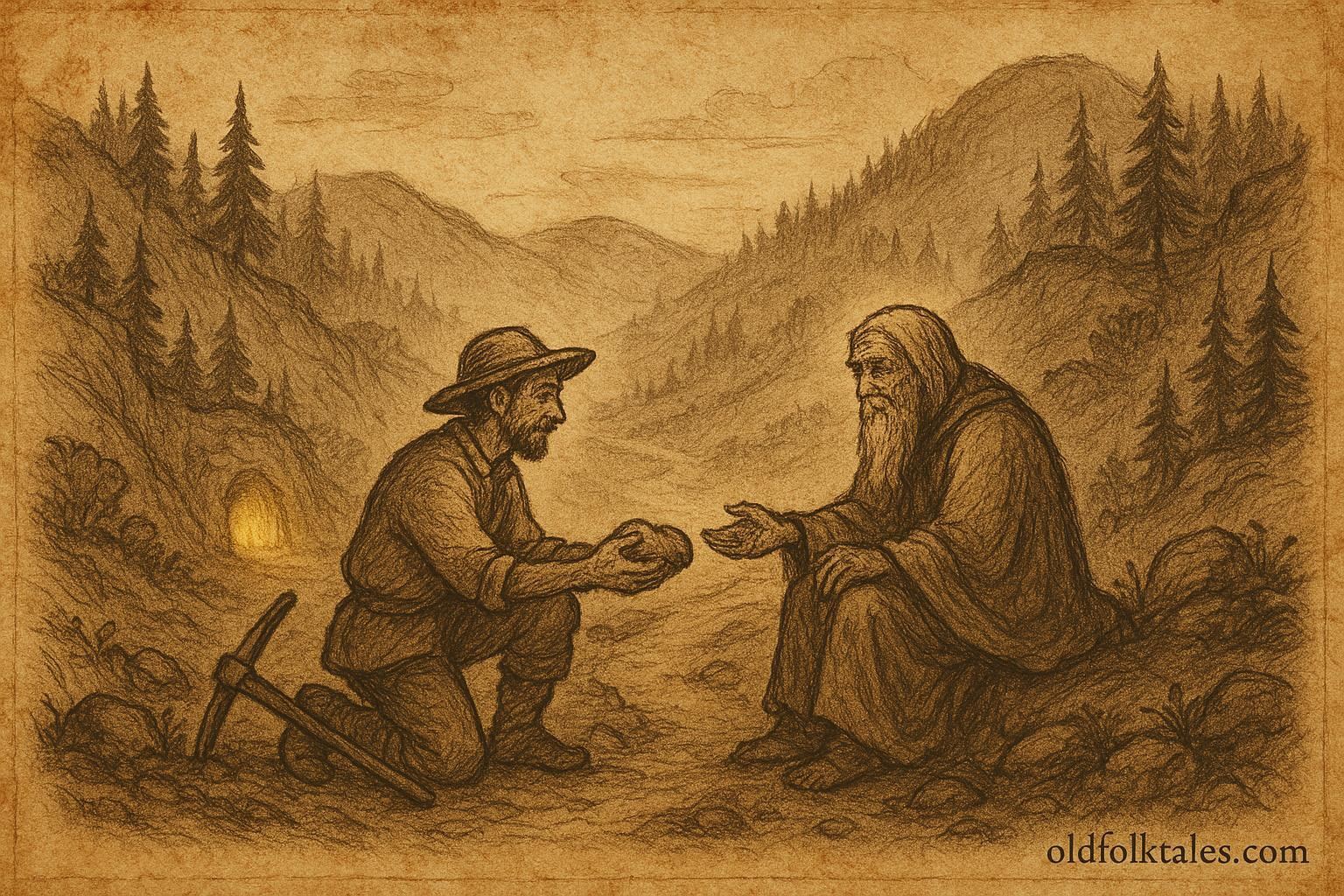
One afternoon, as a storm gathered over the hills, Mateo started down the path toward his hut. The wind was heavy with the scent of rain and pine sap. Ahead, a figure appeared, an old man, stooped but steady, walking with a gnarled wooden staff. His tunic was patched, and his wide-brimmed hat hid most of his face.
“Buenas tardes, hijo,” the old man greeted him. “You’ve worked hard today.”
Mateo nodded, surprised. “Yes, abuelo. But the earth has given me little. The hill keeps its treasure close.”
The old man smiled faintly. “And yet you still greet it with kindness. That is rare.”
He looked down at Mateo’s satchel. “What have you to eat?”
“Only tortillas and beans, señor,” Mateo said. “It’s not much, but you’re welcome to share.”
The two sat on a stone, breaking bread beneath the scent of wet earth. As lightning flickered across the sky, the old man ate slowly, his eyes gleaming like polished obsidian.
When they finished, he rose. “You have shared your food,” he said softly, “and the hill has seen your heart. Tomorrow, dig where the water seeps through the stone, where the mountain weeps. There you will find its gift.”
Before Mateo could speak, the old man was gone. No footsteps, no trail, only the sound of rain beginning to fall.
The Hill’s Reward
The next morning, the miners returned to their work. The rain had left the earth slick and heavy. Remembering the old man’s words, Mateo searched for the place “where the mountain weeps.” He found a small trickle of water running down a wall of stone inside the mine, glimmering faintly in the dim light.
He raised his pick and struck once, and the sound rang clear as a church bell. Beneath the damp rock, a vein of pure silver gleamed, brighter than moonlight.
“¡Milagro!” shouted the miners, running to see. Soon the news spread through the camp, Mateo had found the richest vein in the region.
The foreman wanted to claim the discovery, but the village elders stepped forward. “It was Mateo’s faith that brought the blessing,” they said. “The hill gives only to those it trusts.”
Mateo used his share of the silver not for luxury but for good. He repaired the chapel roof, gave tools to the poorer miners, and brought food to widows and orphans. Near the mine entrance, he built a small stone shrine with candles and maize offerings, a place where the villagers could give thanks to the spirit of the hill.
They called it El Cerro del Señor, “The Lord’s Hill.”
The Price of Greed
Years passed, and the mine changed hands. Outsiders from the city arrived, greedy for the mountain’s riches. They laughed at the old shrine, calling it superstition. They poured wine on the earth and dug recklessly, widening the tunnels, blasting stone with fire.
At first, the mine yielded much, but soon the luck turned. The tunnels grew unstable. Strange winds howled through the shafts even on still days. Miners claimed to see a shadowy old man walking deep within, tapping his staff on the walls.
Then, one night, a thunderous collapse buried an entire gallery. When rescuers entered days later, they found the tools warped and melted as if touched by heat, but no bodies.
Frightened, the men fled the camp. The overseers abandoned the site, declaring it cursed. Only the locals stayed behind, tending to the small shrine and whispering prayers to the Lord of the Hill.
The Spirit’s Vigil
Even today, the villagers of Puebla leave offerings at the mountain’s base, candles, flowers, tamales, or a bit of pulque. They say that when the fog rolls down the slopes at dusk, the spirit of El Señor del Cerro still walks, watching over those who remember to give thanks.
Some nights, miners hear the faint sound of a staff tapping stone or catch a glimpse of an old man standing on the ridge against the rising moon. He guards the land that fed them, stern but just.
The hill remains rich in minerals, yet untouched by greed. And so, the people have learned that the earth’s blessings are not won by force or cunning, but by respect, generosity, and balance.
Moral Lesson
The Lord of the Hill teaches that the earth is sacred, not a treasure to be plundered, but a living being to be honored. Those who give in gratitude receive abundance; those who take in arrogance invite ruin. The story reminds us that true wealth comes not from what we extract from the world, but from what we give back.
Knowledge Check
- Who is El Señor del Cerro in Mexican folklore?
He is the guardian spirit of the mountains and mines, a protector of nature’s sacred balance in Nahuatl belief. - What lesson does the miner Mateo learn from the spirit?
That generosity and humility toward the earth bring prosperity, while greed leads to disaster. - How did Mateo discover the vein of silver?
After sharing food with a mysterious old man, the spirit in disguise, who guided him to the hill’s “weeping stone.” - What happened to the outsiders who disrespected the mountain?
Their greed caused the mine to collapse mysteriously, and the Lord of the Hill reclaimed what was his. - What does the story symbolize in Nahuatl culture?
It reflects the belief that nature is alive, and spiritual harmony depends on reciprocity between humans and the earth. - What is the modern moral relevance of the tale?
It reminds us to practice environmental respect and gratitude, protecting natural resources instead of exploiting them.
Source: Cuentos del México Rural, Alfredo López Austin (1965)
Cultural Origin: Nahuatl-speaking communities of Puebla, Mexico.