In the heart of ancient Mexico, when the Aztec empire flourished under the golden light of the Sun God Tonatiuh, there lived a young couple whose love was as radiant as the dawn itself. The maiden, Xóchitl, whose name meant “flower,” was known throughout her village for her kindness and grace. Her beloved, Huitzilin, whose name meant “hummingbird,” was a brave and loyal young warrior.
Each morning, as the sun rose above the mountains, Xóchitl and Huitzilin would climb a sacred hill to offer bright flowers to Tonatiuh. They believed that their love, like the blossoms they laid before the god, would bloom forever under his light. There, amid the songs of birds and the whisper of the wind, they promised to love one another for all eternity, a love watched over by the golden sun.
The War That Changed Everything
But peace does not last forever. One season, word spread across the Aztec lands that war had come. The emperor called upon his strongest and bravest to defend their people. Huitzilin, bound by duty and honor, answered the call. Xóchitl wept, clutching his hands, knowing that the world without him would lose its color.
“Wait for me,” Huitzilin said softly. “When the sun touches this hill each morning, think of me. Its light will be my promise to return.”
Days turned into weeks, and weeks into moons. Xóchitl climbed the hill daily, carrying flowers to the god, praying for her warrior’s safety. But one fateful afternoon, a messenger arrived bearing terrible news, Huitzilin had fallen in battle.
The sky seemed to dim that day. The wind grew still. Xóchitl’s heart shattered like pottery in the sun. For days she wandered in sorrow, her eyes searching the horizon for a shadow that would never return.
The Girl Who Spoke to the Sun
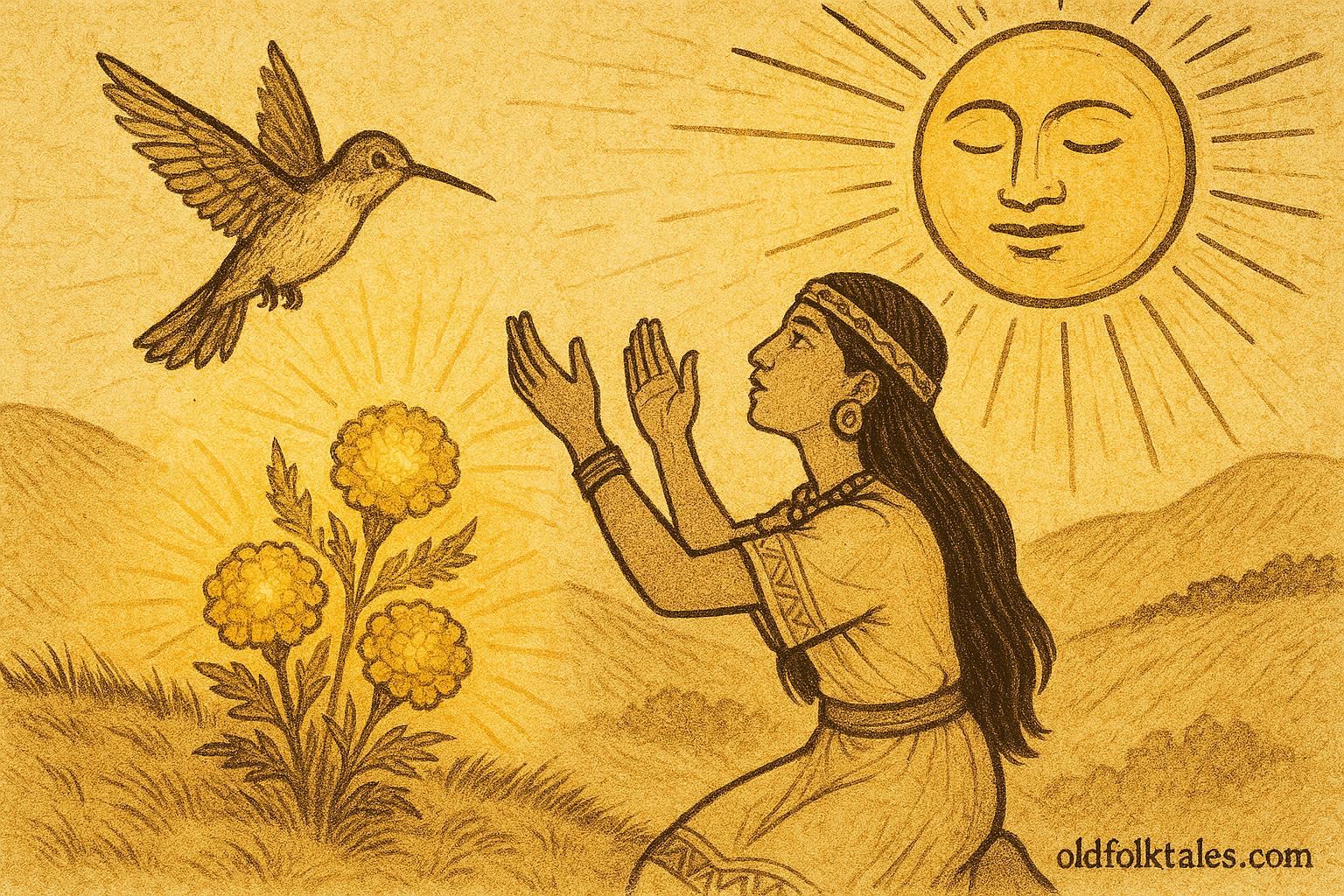
One morning, she climbed once more to the sacred hill, clutching the last flowers she could find. faded blossoms, their petals trembling in the wind. Standing at the summit, she lifted her arms to the heavens and cried out, “Tonatiuh, great Sun Lord! You watched over our love. Take pity on me now. Let me be with him again, if not in this life, then in another.”
The sun, glowing bright above the valley, heard her plea. Its light shimmered down upon her as if in answer. The warmth grew until it surrounded her completely. Those who watched from below said that her figure seemed to dissolve into golden light, and when the brilliance faded, a single marigold bloomed where she had stood.
Its petals burned with the color of the sun, deep orange and gold, and its fragrance drifted through the air like a prayer.
The Hummingbird Returns
Not long after, a hummingbird appeared, darting through the air in a flash of green and blue. Drawn by the scent of the marigold, it hovered close, touching its tiny beak to the flower’s heart. The villagers who saw it whispered that the bird was Huitzilin’s spirit, returned to find his beloved once more.
From that moment, the two were never parted, she as the flower, he as the hummingbird, bound together by love and by the light of the sun.
And so Tonatiuh, moved by their devotion, declared that every year, when the souls of the dead return to visit the living, the cempasúchil would bloom again. Its bright petals would guide spirits home, lighting their way from the world beyond.
The Legacy of the Marigold
Even now, during the Día de los Muertos (Day of the Dead), families across Mexico lay trails of marigold petals from their doorsteps to their altars. They believe that the scent and color of the cempasúchil help loved ones find their way back to the world of the living, just as Huitzilin found his way back to Xóchitl.
Every blossom tells their story, a tale of love so strong that not even death could break it.
Moral Lesson
The Legend of the Flower of the Dead teaches that love and devotion transcend death. Through faith, sacrifice, and remembrance, even the deepest sorrow can give rise to new life. The marigold reminds us that love is eternal, glowing like the sun, guiding the souls of those we cherish.
Knowledge Check
1. Who are the main characters in The Legend of the Flower of the Dead?
Xóchitl, a kind Aztec maiden, and Huitzilin, a brave warrior, are the central figures of this Aztec love legend.
2. What does the marigold symbolize in Aztec and Mexican tradition?
The marigold, or cempasúchil, symbolizes eternal love, remembrance, and the link between life and death.
3. Which Aztec god answers Xóchitl’s prayer?
The Sun God, Tonatiuh, responds to her plea, transforming her into a golden marigold flower.
4. Why is the hummingbird important in the story?
The hummingbird represents Huitzilin’s returning spirit, showing that love continues beyond the grave.
5. What cultural event keeps this legend alive today?
The story is honored each year during Mexico’s Día de los Muertos (Day of the Dead) celebrations.
6. What moral lesson does the tale teach?
True love and remembrance can conquer even death, turning grief into beauty and memory into light.
Source: Adapted from Aztec Legends & Lore (Aztecnm.com) and Native-Languages.org – Aztec Myths.
Cultural Origin: Aztec / Nahua (Mexico)