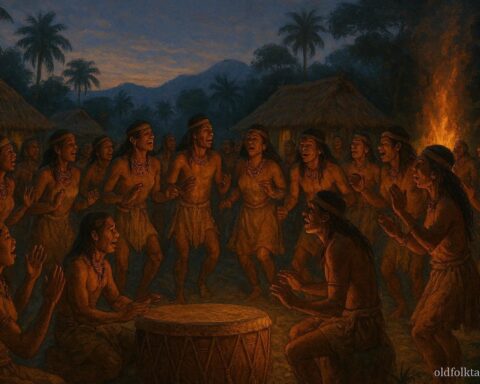
In the heart of the lush tropical forest, where rivers gleamed like glass beneath the Caribbean moon, there once lived a young Arawak maiden whose spirit was as light as a songbird’s and whose eyes held the calm of a still lagoon. Her people said that when she sang, even the leaves trembled to listen, and when she laughed, the stars seemed to shimmer a little brighter above the treetops.
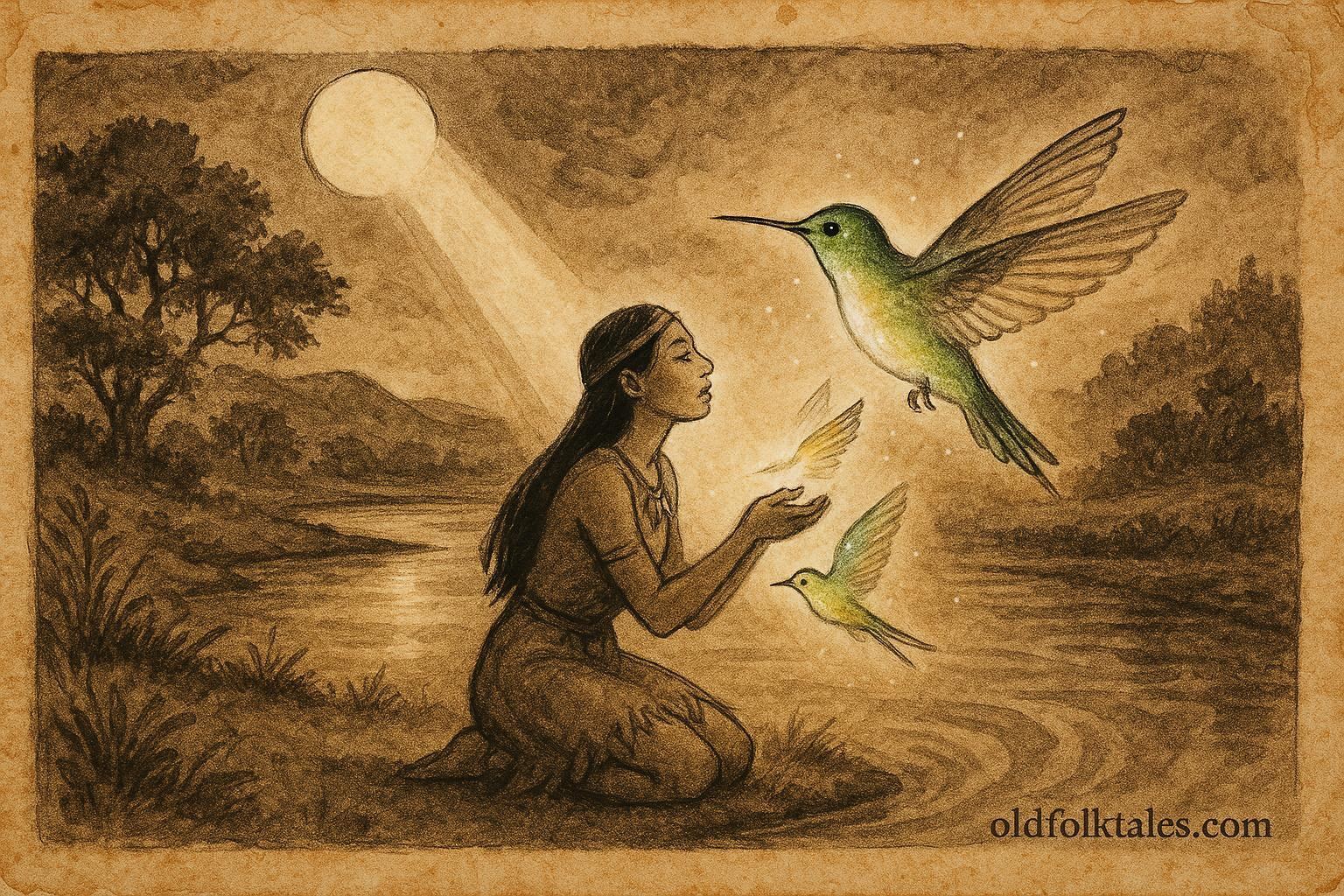
Every evening, after the village fires had quieted and the crickets began their chorus, the girl would sit alone beside the riverbank, gazing up at the silver moon that glowed over the forest canopy. She would whisper her thoughts to it, words of wonder, longing, and dreams. The others teased her gently, saying she was in love with the sky. But she only smiled, for in her heart she felt a presence watching her from above.
Each night, as she drifted into sleep, her dreams were visited by a radiant being, the Moon Spirit. He came clothed in silver light, his face both kind and sorrowful, his eyes deep as the heavens themselves. In the dream world, he spoke to her softly, telling stories of the stars and the paths they wandered, of the sea tides that followed his call, and of the great silence of the sky.
Over time, the girl’s love for the Moon Spirit grew. She waited eagerly for nightfall, when his glow would spill across the forest and his voice would echo in her dreams. She sang to him in the language of her people, songs of longing that drifted up with the mist, carried by the wind until they reached the heavens.
But love between the sky and the earth is a fragile thing. The Moon Spirit, though he loved her deeply, could never remain long. His place was above, watching over all the world. Yet each time he descended to touch her dreams, he grew weaker, his light dimming across the night.
When the girl saw the moon waning one night, she wept by the river, calling out to him through her tears. “Why do you fade, my beloved one? Have I done wrong to love you?”
The Moon Spirit’s voice drifted to her, tender and sorrowful:
“Child of the earth, my love for you burns as bright as the sun’s reflection upon your rivers, but I cannot remain. My light belongs to all. Yet know this, our love will not be lost to the world.”
At dawn, her family awoke to find her gone. They searched the forest, the riverside, and the mountain paths, but there was no sign of her. Only a single shimmering feather lay in the grass where she had last sat, tiny and bright, glistening with the colors of dawn: emerald, gold, and sapphire.
When the sun touched it, a faint hum filled the air. From that light sprang a small, radiant creature, the first hummingbird. It darted upward, wings a blur, flashing like living sunlight. The people watched in awe as it hovered beside the flowers, sipping from their nectar, then rose toward the sky, as if carrying a message beyond the clouds.
And when night returned, the tiny bird could be seen dancing beneath the moonlight, circling upward in joyous spirals, as though greeting a beloved it could no longer touch. The villagers understood then: their lost maiden had not vanished. She had been transformed. Her spirit had become the hummingbird, the eternal messenger between sky and earth.
From that day, the Lokono people said that whenever a hummingbird hovers by a flower, it is singing a love song to the moon. And when moonlight gleams upon the river, it is the Moon Spirit answering her, reminding the people that love, even when separated by worlds, never truly fades.
The hummingbird became sacred among the Arawak. They saw in its fragile wings the strength of devotion, and in its shimmering feathers, the beauty of longing fulfilled. To this day, when the night grows still and the moon reflects upon the forest waters, the Lokono remember the maiden who loved the sky, and how her love became eternal flight.
Discover ancient tales passed down by the Indigenous peoples of the Americas.
Moral Lesson
The story of The Hummingbird and the Moon teaches that true love knows no boundaries between worlds. Though longing and separation may bring sorrow, beauty and connection can be born from the heart’s deepest devotion. Love, when pure, transforms and endures forever.
Knowledge Check
- Who is the main character in this Lokono (Arawak) folktale?
A young Arawak maiden who falls in love with the Moon Spirit. - What happens to the maiden at the end of the story?
She disappears and is transformed into the first hummingbird. - What does the hummingbird symbolize in the legend?
It symbolizes eternal love, transformation, and harmony between the sky and the earth. - Why does the Moon Spirit leave the maiden?
He must return to his place in the sky, as his light belongs to the world. - What natural element is explained through this myth?
The origin of the hummingbird and its spiritual connection to the moon. - What is the key moral message of this Arawak folktale?
That love and beauty can transcend distance and become eternal through devotion and transformation.
Source: Collected by Walter E. Roth, An Inquiry into the Animism and Folklore of the Guiana Indians (1915).
Cultural Origin: Lokono (Arawak – Guyana, Suriname, and Caribbean Coasts).