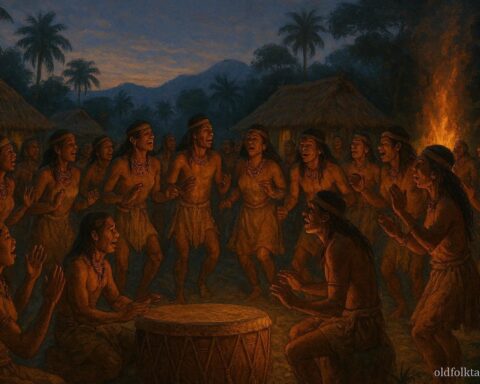
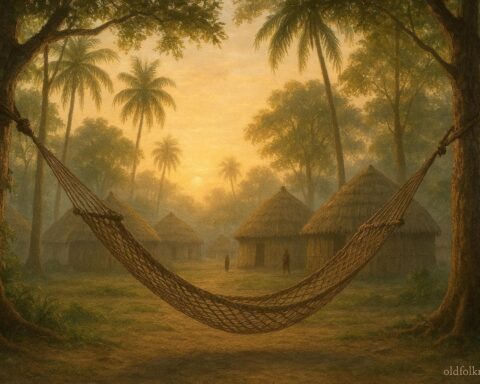
In the hills and forest edges of old Jamaica, where the boundary between the living and the spirits was never fixed, there lived a young woman whose beauty was spoken of in whispers. People said her face carried quiet light and her voice softened even hardened hearts. Yet it was not her beauty alone that shaped her fate, but the mysterious love that came to her after sunset.
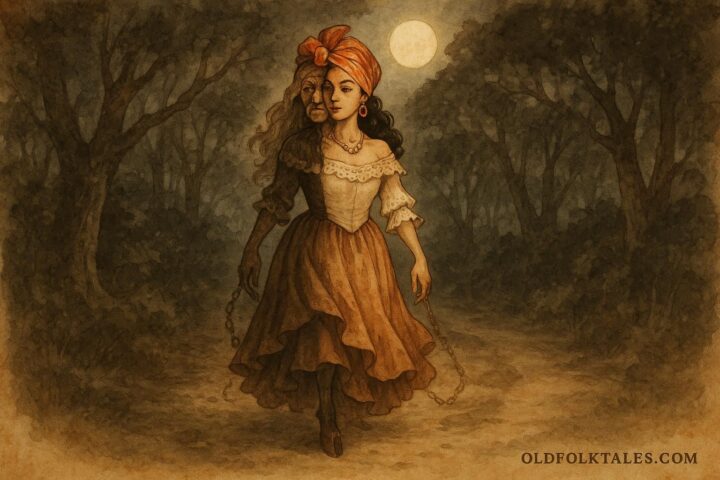
Each night, as the moon climbed over the trees, a handsome stranger arrived at her door. He was tall, well-spoken, and dressed more finely than any man from the nearby villages. He brought gifts of cloth, beads, and food, always generous, always kind. He never stayed past the crowing of the morning birds, and he never came by daylight. The girl asked him once where he lived, but he only smiled and said the night was his home.
The girl fell deeply in love. To her, his secrecy mattered little. But her mother, a woman seasoned by age and old knowledge, watched with growing unease. She had heard too many stories of spirits who borrowed human form. She noticed how no one had ever seen the stranger enter or leave the village road.
One evening, before the stranger returned, the mother scattered crushed cassava and dried peas across the floor of the hut. She said nothing to her daughter and went to sleep. By morning, when the first light crept through the doorway, the floor told its story. There, pressed clearly into the powder, were bird tracks, sharp and unmistakable.
The mother’s fears were confirmed. She begged her daughter to end the visits. She warned her of jumbies, spirits who walked between worlds and whose love could carry a heavy price. But the girl would not listen. Her heart was already bound, and she trusted the stranger more than fear.
Not long after, the girl followed him as he left one night. She kept to the shadows as he moved beyond the village, into the forest where moonlight broke through the leaves. At the edge of a clearing, she watched as he stopped, lifted his arms, and changed. His human form fell away, and before her stood a magnificent bird, a great John Crow with wide black wings, shining eyes, and feathers that caught the moonlight like polished stone. In some tellings, he becomes a radiant parrot, blazing with color. In all, he was no ordinary creature.
The bird spoke to her, his voice gentle and unchanged. He told her the truth. He was a Jumbie Bird, a spirit of the air, ancient and powerful. He had chosen her because her spirit was strong enough to walk between worlds. He warned her that loving him meant standing apart from ordinary human life.
The girl did not flee. She told him she loved him as he was. Moved by her devotion, the Jumbie Bird gave her a single feather. “If you are ever in danger,” he said, “burn this, and I will come.”
Time passed, and life returned to its quiet rhythm. Then one season, danger came. Raiders descended on the village, burning huts and driving people into the hills. As fear spread, the girl remembered the feather. With shaking hands, she placed it in the fire.
The smoke rose, and the sky darkened with wings. A vast flock of birds descended, screaming and circling, driving the attackers away. The village was saved, but the girl knew her choice was clear. She could remain among humans, or she could cross fully into the spirit world.
At dawn, she stepped into the clearing and transformed, her body lifting into feathers and wings. Together, she and the Jumbie Bird flew beyond the mountains, leaving behind a story that would be told for generations.
Moral Lesson
This folktale teaches that love requires choice and courage, and that power often exists beyond what appears familiar. It also reminds listeners that the spirit world and human world are deeply connected, and respect for that boundary brings protection rather than harm.
Knowledge Check
1. Who is the mysterious nightly visitor in the story?
He is a Jumbie Bird, a spirit who can take human form.
2. How does the mother discover his true nature?
By scattering cassava or peas on the floor and finding bird tracks.
3. What does the John Crow symbolize in the story?
A powerful spirit protector hidden behind an unclean reputation.
4. What object allows the girl to summon help?
A single feather given by the Jumbie Bird.
5. Why does the girl choose to leave the human world?
She accepts her bond with the spirit and chooses love and protection.
6. What cultural belief does the story reinforce?
That humans and spirits share a fluid boundary and mutual obligations.
Source & Cultural Origin
Source: Old Maroon or Windward folktale
Cultural Origin: Jamaica and the wider Afro-Caribbean tradition