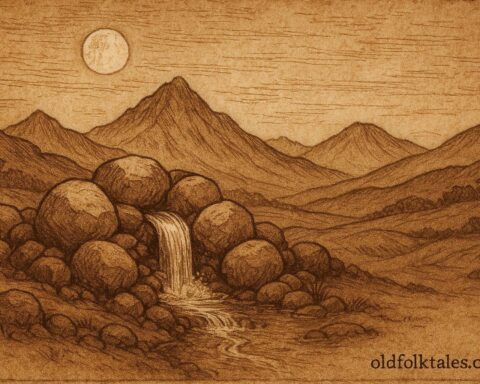
In the high Andean plateau where the air is thin, and the sky stretches endlessly and blue, there lived an Aymara community that had honored the mountains for countless generations. These were not ordinary peaks, they were the Apus, the sacred mountain spirits who watched over the people, controlled the weather, brought the rains, and protected the crops. Every family in the village knew that the Apus demanded respect, and so they performed rituals with reverence, leaving offerings of coca leaves, chicha, and prayers carried on the wind.
Among the villagers was a young girl named Sisa, bright and curious, with eyes that sparkled with intelligence and a tongue quick with questions. Unlike the other children who listened intently when the elders spoke of the old ways, Sisa found herself doubting. She watched as her grandmother knelt before small stone altars, murmuring prayers in Aymara and Quechua. She observed the elaborate ceremonies where the community gathered to make offerings to Pachamama, the Earth Mother, and to the Apus who loomed on every horizon. And increasingly, she wondered if it was all just superstition stories told by people who didn’t understand the natural world.
Click to read all Andean Highland Folktales — echoing from the mountain peaks of Peru, Bolivia, and Ecuador.
“Why do we waste good food and drink on rocks?” she would ask, her voice carrying an edge of mockery. “Mountains are just stone and ice. They cannot hear us. They cannot help or harm us.”
Her grandmother’s face would darken with worry. “Child, do not speak such words. The Apus have been here since before memory. They are ancient and powerful. To dishonor them is to invite disaster.”
But Sisa only laughed, her young voice ringing out across the fields. “I’ve climbed those mountains. I’ve touched their slopes. They’re nothing but cold stone. All these rituals the offerings, the prayers, the days when we’re forbidden to climb it’s all foolishness for people who are afraid of their own shadows.”
The other young people began to whisper about her disrespect. The elders shook their heads gravely, exchanging concerned glances. Her parents tried to reason with her, to explain that the ways of their ancestors had kept the community safe and prosperous for generations. But Sisa was stubborn, convinced that education and reason had freed her from what she saw as outdated beliefs.
The breaking point came during the festival of the Apus, a sacred time when no one was permitted to climb the mountains. For three days, the peaks were left undisturbed while the community performed ceremonies at their bases, asking for protection and abundance in the coming year. It was a time of prayer, of offerings, of respect for the forces that sustained their lives in this harsh, beautiful land.
On the second day of the festival, Sisa announced her intentions boldly and publicly. “I will climb Illimani tomorrow,” she declared, naming one of the most sacred peaks. “I will prove that these mountains are just mountains, nothing more. When I return unharmed, perhaps people will stop living in fear of rocks.”
Gasps rippled through the gathering. Her grandmother clutched her chest, her weathered face pale with shock. The village yatiri the traditional healer and spiritual guide stepped forward, his ancient eyes fierce with warning. “Girl, you must not do this. The Apus do not tolerate mockery, especially during their sacred days. They are patient with ignorance, but deliberate disrespect brings consequences. The mountains will teach you what your elders cannot.”
Sisa lifted her chin defiantly. “I am not afraid of superstitions.”
Before dawn the next morning, while the village still slept, Sisa gathered supplies and began her climb. The path up Illimani was familiar to her she had walked it many times during permitted seasons. The morning was clear and beautiful, the sun painting the snow-capped peaks in shades of gold and pink. As she climbed higher, breathing hard in the thin air, she felt vindicated. Nothing supernatural barred her way. No angry spirits appeared to stop her. It was just a mountain, just as she had always believed.
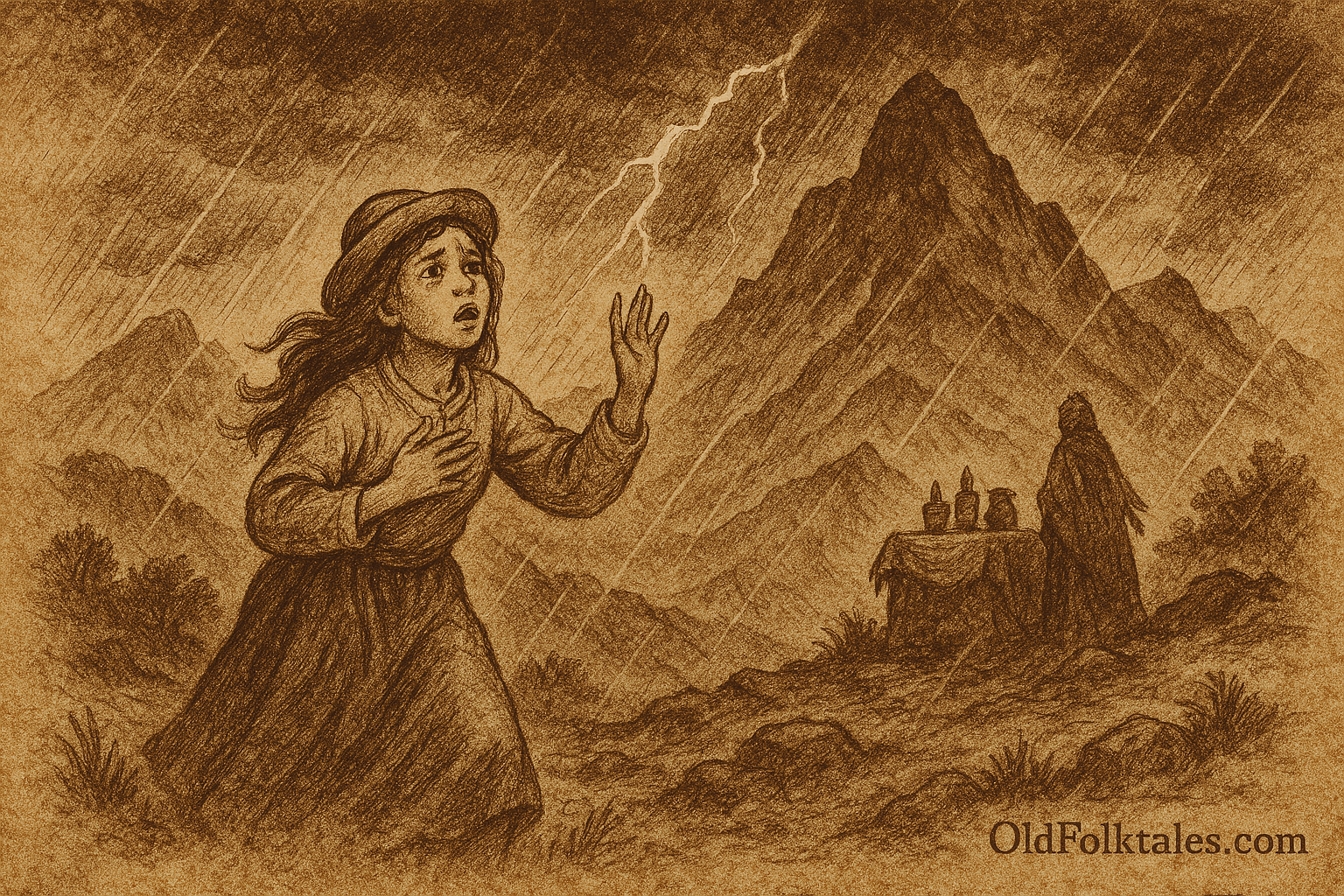
But as she reached the higher elevations, something changed. Clouds that had seemed distant suddenly rushed in with unnatural speed, boiling up from the valleys below and descending from the peaks above. Within moments, the clear morning transformed into a maelstrom of wind and snow. The temperature plummeted. Visibility shrank to mere feet. The wind howled with a voice that seemed almost human angry, ancient, and immense.
Sisa tried to descend, but the trail had vanished beneath the sudden snowfall. Every direction looked the same, a swirling white chaos that disoriented and confused her. The cold bit through her clothes with savage teeth. Her hands grew numb, her feet stumbled over rocks she couldn’t see. Fear, real and primal, gripped her heart for the first time.
She found a small outcropping of rocks that offered minimal shelter and huddled there, wrapping her arms around herself as the storm raged. Hours passed. The cold seeped deeper. She realized with mounting terror that she might not survive the night. No one knew exactly where she had gone. The storm showed no signs of abating. She was alone on the sacred mountain she had mocked, and for the first time, she understood how small and fragile she was against forces she had dismissed as myth.
As darkness fell and her body began to shake uncontrollably, something shifted in Sisa’s heart. Pride crumbled before the reality of her situation. In that moment of extremity, faced with her own mortality, she did something she had sworn she would never do she prayed.
“Taita Illimani,” she whispered through chattering teeth, using the respectful term for the mountain spirit. “Forgive me. I was arrogant and foolish. I disrespected you and the ways of my ancestors. I understand now that there are forces greater than my understanding. Please, if you grant me my life, I will honor you always. I will learn the old ways. I will teach others to respect what I had scorned.”
Her voice was carried away by the wind, but she continued praying, in Aymara and Spanish, pouring out her remorse and fear and newfound humility. She begged forgiveness from Pachamama, from the Apus, from the spirits her grandmother had always honored. Tears froze on her cheeks as she promised to dedicate her life to preserving the traditions she had ridiculed.
Gradually so gradually she almost didn’t notice the wind began to calm. The snow lightened. By the time dawn broke, weak and gray, the storm had passed. Exhausted, hypothermic, but alive, Sisa found she could see the trail again. She descended slowly, her body trembling with cold and weakness, her mind forever changed by the long night on the mountain.
When she stumbled into the village, her family surrounded her with cries of relief and tears. But Sisa went immediately to her grandmother and the yatiri, falling to her knees before them. “Forgive me,” she said simply. “I understand now. I wish to learn.”
From that day forward, Sisa became the most devoted student of the traditional ways. She learned the prayers, the ceremonies, the proper methods of making offerings. She learned to read the signs in nature, to understand the language of the land. Years later, she became a ritual keeper herself, teaching the next generation to honor the Apus and Pachamama with the respect they deserved. And whenever young people grew skeptical or mocking, she would tell them her story not to frighten them, but to share the wisdom she had learned at such cost that some truths cannot be taught, only experienced, and that humility before the mysteries of the world is not weakness but wisdom.
Click to read all South American Folktales — timeless stories from the Andes to the Amazon.
The Moral Lesson
This Aymara tale teaches that disrespect for nature and ancient wisdom, especially when rooted in arrogance rather than genuine questioning, invites genuine danger. Sisa’s mockery of the Apus was not simply a difference of opinion, it represented a dangerous disconnection from the environment and traditions that had sustained her community for generations. The mountains’ response to her deliberate disrespect during sacred time demonstrated that nature’s power is real, whether we choose to acknowledge it or not. Her survival and transformation came only through genuine humility and the willingness to admit her error. The story reminds us of that indigenous traditions often encode deep ecological and spiritual knowledge, and that dismissing such wisdom without understanding its roots can have serious consequences. True wisdom lies not in rejecting tradition, but in approaching both old knowledge and new understanding with respect and humility.
Knowledge Check
Q1: Who are the Apus in Aymara culture and why are they important?
A1: In Aymara culture of the Andean Highlands, the Apus are sacred mountain spirits that have been revered since ancient times. They are believed to watch over communities, control weather patterns, bring rain for crops, and protect the people. The Apus are not simply geographical features but powerful spiritual beings that require respect and offerings. They represent the deep connection between Aymara people and their mountainous environment, embodying the belief that nature possesses consciousness and power.
Q2: What was Sisa’s main offense against Aymara tradition?
A2: Sisa’s offense was twofold: she openly mocked the traditional rituals and beliefs about the Apus, dismissing them as superstition, and she deliberately climbed sacred Illimani during the festival of the Apus, a time when the mountains were meant to be left undisturbed out of respect. Her actions were not mere skepticism but active disrespect during a sacred period, which made her transgression particularly serious in the eyes of both the community and, according to the story, the mountain spirits themselves.
Q3: What happened when Sisa climbed the mountain during the sacred festival?
A3: When Sisa climbed Illimani during the sacred festival, a sudden and violent storm appeared with unnatural speed, transforming a clear morning into a whiteout blizzard. She became lost, unable to find the trail, and was stranded overnight in freezing conditions that threatened her life. The storm’s timing and intensity suggested it was a response from the Apus to her deliberate disrespect, teaching her through direct experience the power she had denied existed.
Q4: How did Sisa survive her night on the mountain?
A4: Sisa survived by finding shelter among rocks and, critically, by undergoing a spiritual transformation. Faced with death, she abandoned her pride and prayed to Taita Illimani (Father Illimani) and the other spirits she had mocked, asking forgiveness and promising to honor the traditional ways if granted her life. Only after this genuine expression of humility and remorse did the storm begin to calm, allowing her to descend safely at dawn.
Q5: What role does the yatiri play in Aymara spiritual traditions?
A5: The yatiri in Aymara tradition is a spiritual guide, healer, and keeper of traditional knowledge who serves as an intermediary between the community and the spiritual world. In this story, the yatiri warns Sisa about the consequences of disrespecting the Apus, demonstrating the role of these practitioners as protectors of sacred knowledge and communal spiritual health. The yatiri understands the proper relationship between humans and nature spirits that younger, more skeptical generations might question.
Q6: What transformation did Sisa undergo after her experience on the mountain?
A6: After her harrowing experience, Sisa transformed from a skeptical mocker of tradition into its most devoted student and eventually a ritual keeper herself. She dedicated herself to learning the prayers, ceremonies, and traditional practices she had once scorned. Her transformation was complete and genuine—she didn’t simply comply outwardly but developed a deep understanding of and respect for Aymara spiritual traditions, eventually teaching the next generation and using her own story as a teaching tool about humility and respect.
Source: Adapted from Aymara oral tradition documented in regional Andean folklore collections, with ethnographic context referenced by Xavier Albó.
Cultural Origin: Aymara people, Andean Highlands of Bolivia