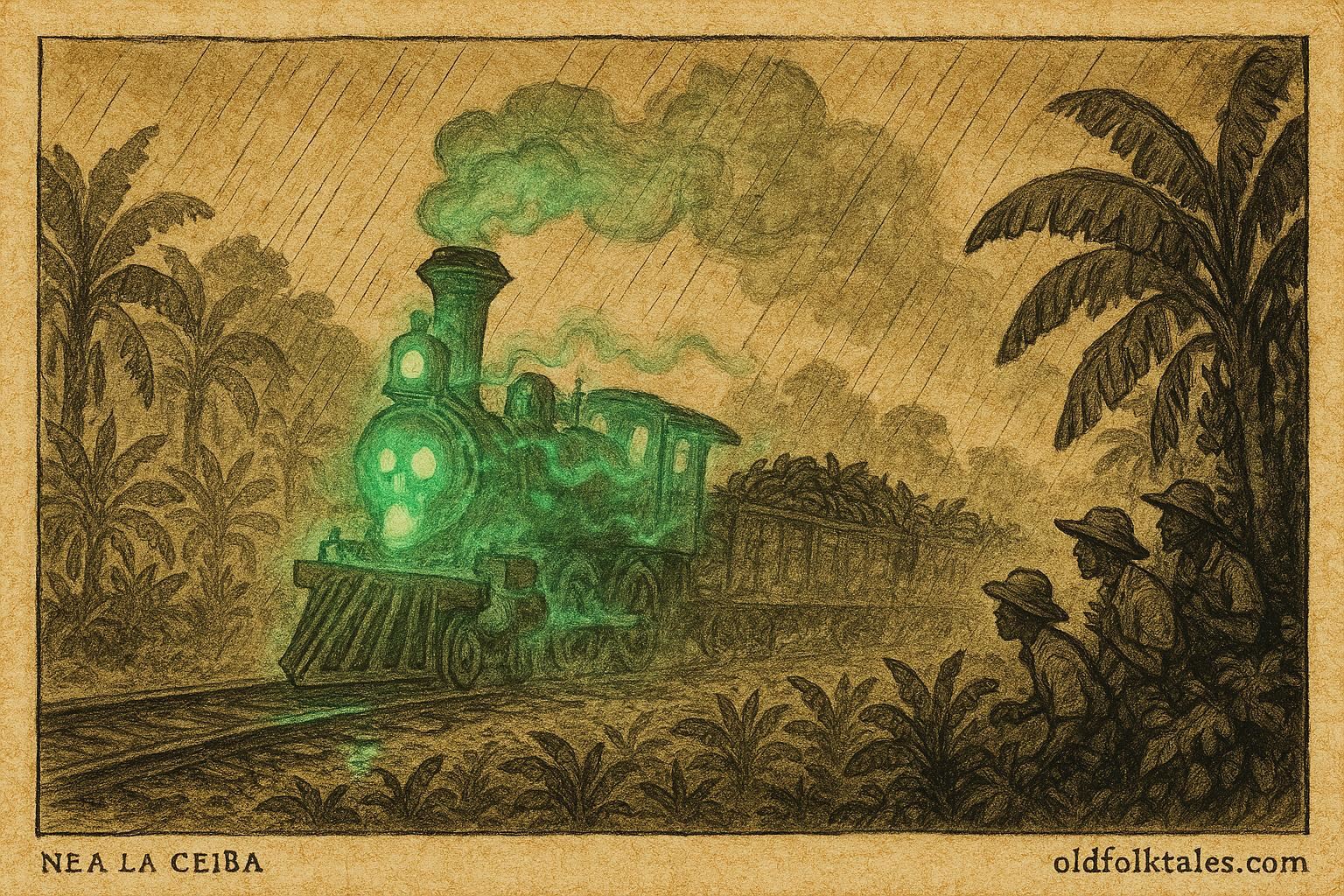
The train once ruled the northern coast of Honduras, its iron tracks cutting through banana plantations like veins carrying the lifeblood of an empire. In the early twentieth century, steam locomotive Number 47 belonged to the Standard Fruit Company, hauling endless loads of green banana stems from the lowland fields to the ports of La Ceiba. Its whistle marked the rhythm of labor, dawn to dusk, rain or sun.
In 1929, during a season of relentless storms, the rains came harder than usual. Rivers swelled, the ground softened, and the wooden trestles that carried the tracks across flooded land groaned beneath the weight of passing cars. On a night thick with rain and wind, Number 47 made its final run. The locomotive entered a flooded trestle, its wheels slipping on soaked rails. With a violent shudder, the structure gave way. The train plunged into the darkness below, killing its Honduran crew and several American foremen instantly. The jungle swallowed the wreckage, and the company moved on.
But the land remembered.
Years later, long after the tracks had rusted and disappeared beneath weeds and modern roads, workers near the old plantation routes began to hear sounds that did not belong to the present. On nights when the rain fell heavily, echoing the storms of the past, a distant whistle could be heard. Low at first, then growing louder. A steady chug followed, slow and rhythmic, as if a steam engine were approaching.
Those who listened carefully felt the ground vibrate beneath their feet.
Then the Ghost Train appeared.
It emerged from the rain glowing with a sickly green phosphorescence, its iron body half-light, half-shadow. The engine moved at full speed, yet made no sparks and threw no steam. Its wheels followed tracks that no longer existed, passing through fences, warehouses, and newly built homes without resistance. The cars behind it overflowed with bananas, swollen and blackened, their stench heavy in the air. These were not living fruit but spectral remains, endlessly rotting yet never disappearing.
The Train did not stop.
Witnesses stood frozen as it passed, feeling the cold wind of its movement brush against their skin. Faces were sometimes seen in the cab and between the cars, silent and expressionless, bound to their final journey. The whistle sounded once more, long and mournful, before the Train vanished into the rain.
Among the banana workers of La Ceiba, it was known that seeing the Ghost Train carried meaning. It was not a random haunting but an omen. When it appeared, layoffs soon followed, or unrest stirred in the plantations. Strikes broke out. Wages were cut. Accidents increased. The Train ran not only on steel and memory, but on warning.
There was also a rule, passed quietly from worker to worker. If you saw the Ghost Train, you must act. You were to take a piece of ripe fruit and throw it onto the tracks where the Train had passed. It did not matter if the rails were invisible. The offering acknowledged the dead and honored the labor that once fed the land.
Those who ignored this custom paid a price. The smell of rotting bananas followed them home. It seeped into walls, clothing, and bedding. No amount of cleaning removed it. Weeks could pass before the odor faded, and during that time sleep was restless, filled with dreams of rushing wheels and flooded ground.
The elders said the Ghost Train was not a curse but a memory that refused to fade. It was the echo of an industry built on danger, speed, and disregard for the lives that kept it running. Number 47 continued its doomed route because the work had never truly ended. As long as the land remembered the crash, the Train would return.
On heavy nights, when rain drums on tin roofs and the air smells of earth and fruit, people still listen. And when the whistle comes, no one doubts what it means.
Moral Lesson
The story teaches that collective memory endures beyond progress, and that ignoring the sacrifices of labor invites consequences that cannot be erased.
Knowledge Check
Q1: What was locomotive Number 47 used for?
A1: Transporting banana stems for the Standard Fruit Company.
Q2: When did the original train crash occur?
A2: In 1929 during heavy flooding.
Q3: What does the Ghost Train carry?
A3: Spectral, rotting bananas.
Q4: What does seeing the Ghost Train symbolize?
A4: Impending layoffs, strikes, or unrest.
Q5: What offering must witnesses make?
A5: Throwing a piece of ripe fruit onto the tracks.
Q6: What cultural message does the legend convey?
A6: The lasting cost of industrial exploitation.
Cultural Origin and Source
Source: Afro-Antillean Honduran Creole legend, La Ceiba
Documented in oral histories of banana workers archived at the National Autonomous University of Honduras (UNAH).