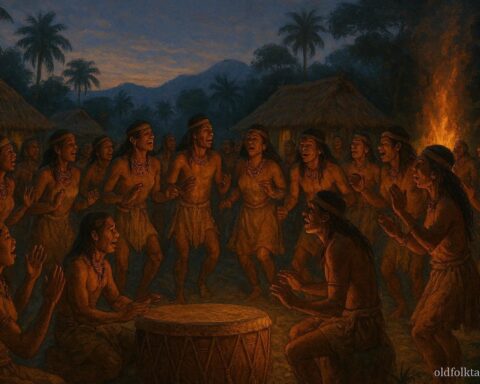
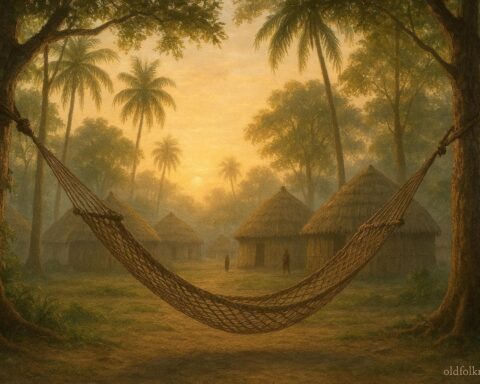
In the earliest days of the Upper Amazon, before healing songs were known and before sacred rituals guided human hands, illness and misfortune moved freely through the villages. Pain arrived without warning, and fear followed close behind. The forest stood vast and watchful, filled with plants whose powers were not yet understood and rivers whose voices were heard but not interpreted. In that uncertain time, the people believed that knowledge existed, but it had not yet found a keeper.
Among the villagers lived a young hunter, quiet in speech and observant in nature. He walked the forest paths with respect, never taking more than he needed, never striking without offering thanks. Animals did not flee at his approach, and elders noticed that the wind often stilled when he listened. Though untrained in ritual, the hunter sensed that the forest was alive with meaning.
Click to read all South American Folktales — timeless stories from the Andes to the Amazon.
One night, while resting beside the river, he dreamed.
In the dream, the forest spoke, not in words, but in feeling. Leaves shimmered with instruction. Roots pulsed with memory. Animals watched him with knowing eyes. A voice, neither male nor female, told him that knowledge was not a gift to be claimed, but a burden to be carried. If he wished to learn, he must endure trials of patience, humility, and restraint.
When he awoke, the forest felt changed.
The hunter began to wander deeper into the jungle, guided by intuition rather than path. He learned to listen, to the warning cry of birds, to the silence before storms, to the subtle differences between healing plants and harmful ones. Some days he fasted. Some nights he dreamed visions that left him shaken and unsure. The spirits tested him constantly, showing him both the promise of power and the danger of pride.
At times, he wanted to turn back.
But illness spread in the village. Children weakened. Elders suffered. Remembering his people, the hunter pressed on.
After many seasons, the spirits revealed to him the knowledge of medicinal plants and spiritual balance. He learned which leaves cooled fever, which roots eased pain, and which songs restored harmony between body and spirit. He was warned never to use this wisdom for dominance or personal gain. Those who did, the spirits said, would lose their way forever.
When the hunter returned to his village, he was no longer just a hunter.
He healed the sick with care and restraint. He taught that illness was not only of the body, but of imbalance between humans, nature, and spirit. He refused praise and rejected authority, serving only when called. The people began to understand that wisdom was not command, it was responsibility.
Thus, the first shaman was born.
From then on, shamans were chosen not for ambition, but for discipline and humility. Their role was sacred, demanding lifelong service and respect for forces greater than any individual.
Moral Lesson
This folktale teaches that true wisdom carries responsibility, and knowledge must always serve the community rather than personal ambition.
Knowledge Check
1. Why did illness affect the village?
Because healing knowledge had not yet been discovered.
2. What made the hunter different from others?
He listened deeply to nature and respected its balance.
3. How did the spirits teach him?
Through dreams, trials, and observation of the forest.
4. What warning did the spirits give?
That knowledge used for power leads to loss and ruin.
5. What defines a shaman in this story?
Service, humility, and responsibility—not authority.
6. What lesson does the story teach about wisdom?
Wisdom must benefit the community, not the self.
Source: Indigenous oral tradition; recorded in Upper Amazon ethnographies
Cultural Origin: Amazon Basin (Indigenous folklore)