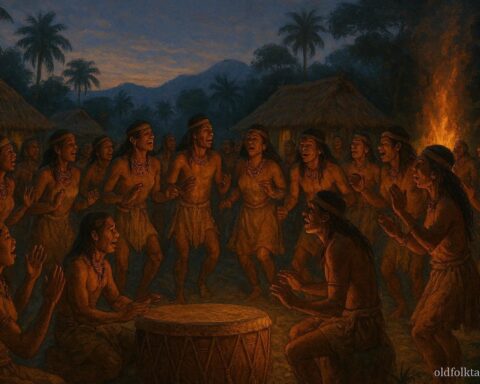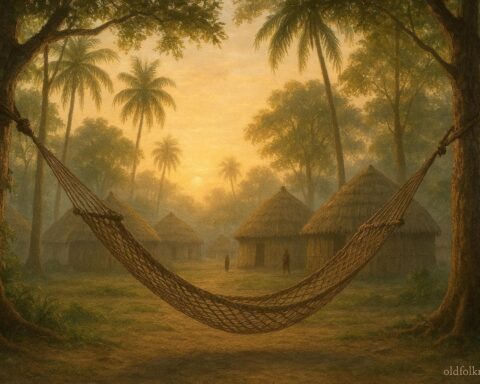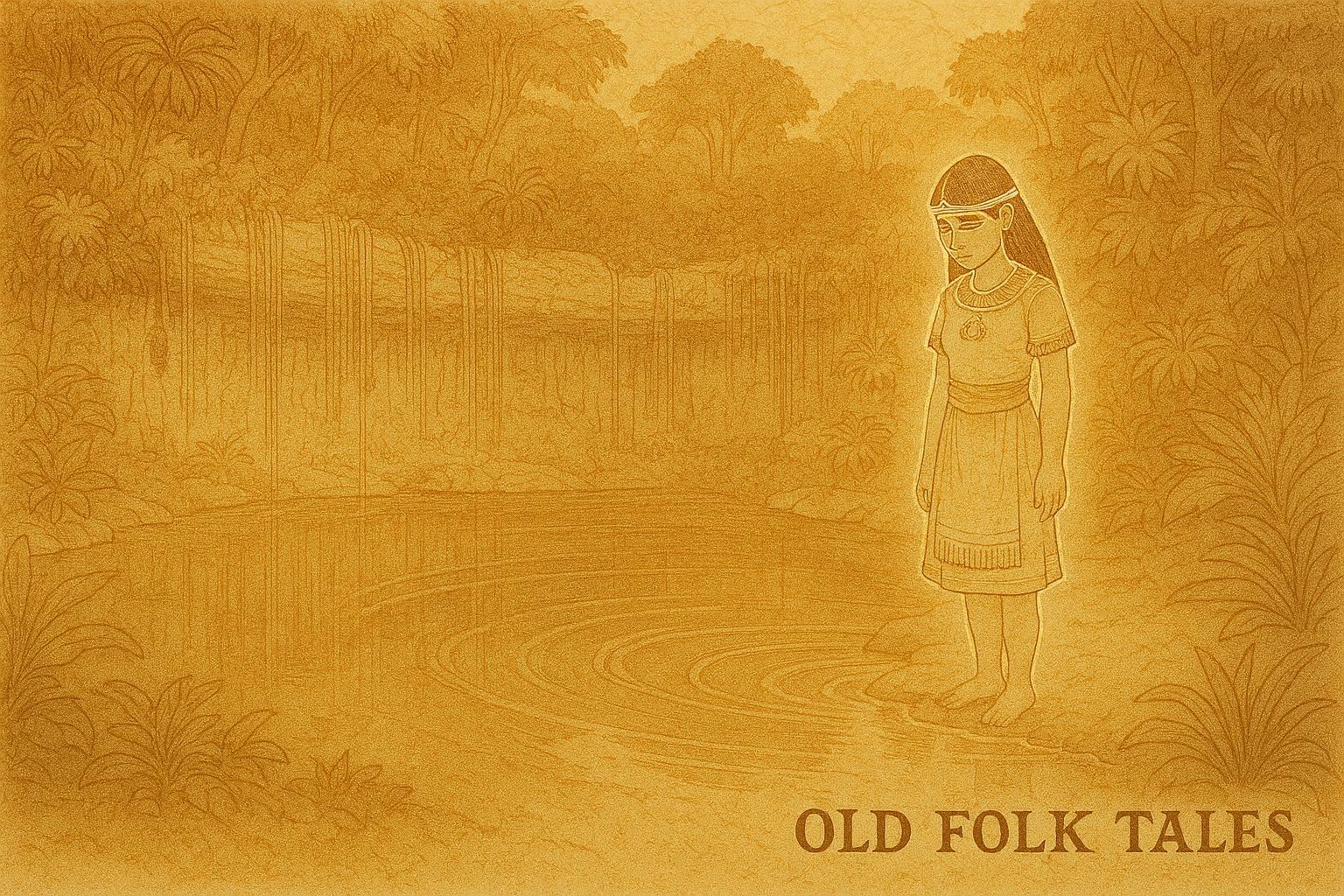
In the deep, emerald heart of the Petén rainforest, where the air hums with the life of a thousand unseen creatures and ancient stone sleeps beneath the roots of ceiba trees, there lies a cenote. This is not merely a water hole, but a sacred throat of the earth, a pool of such clarity it seems to hold a piece of the sky captive in its depths. Long ago, this cenote was the pulsing vein of an Itzá Maya community, its cool, sweet water the difference between life and dust.
A great drought descended upon the land. The sun, once a life-giver, became a relentless brass disk in the white sky. Streams vanished, leaving cracked mud. The forest itself seemed to hold its breath, its green dimming to a thirsty brown. Only the community’s cenote remained, its level dropping day by day, but still holding a precious reserve. The people guarded it with their lives, for it was their last hope.
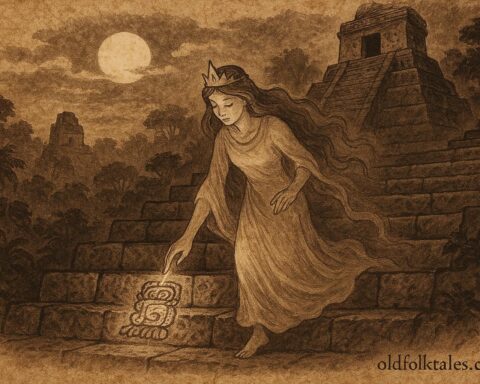
The chief’s daughter was the heart of this hope. She was beloved not only for a beauty that seemed to hold its own gentle light, but for a kindness that flowed as freely as the cenote once had. Her heart belonged to a skilled hunter, a man whose love for her was as deep and true as the forest was wide. Their future seemed written in the stars, until the shadow of malice fell.
An evil ah men, a sorcerer from a rival and envious group, coveted the cenote. He desired its power, its life, for himself alone. From a hidden place, he cast a dark, draining spell upon the sacred water. The spring that fed the pool choked. The water level, already low, began to sink with a terrible, unnatural speed. Panic gripped the people. They could see the bottom, see the final mouthful of their survival slipping away.
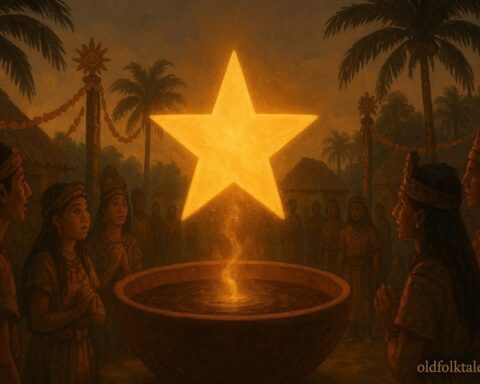
In their despair, the priests called upon the Chaacs, the mighty gods of rain and lightning. The answer came on a stifling, silent wind: the spell was a lock, and only a key of purest sacrifice could break it. To refill the cenote and save the people, a voluntary offering of a noble life was demanded. The community fell into a horrified silence. Who could make such a choice?
It was the chief’s daughter who stepped forward. Her eyes, though filled with tears for the life she would leave, were steady. She looked at her grieving father, at her beloved hunter whose face was etched with anguish, and finally at her desperate people. Her love for them was greater than her love for her own future. “I will go,” she said, her voice soft but clear as the last drops in the pool. “Let the water live, so my people may live.”
At the edge of the dwindling cenote, she turned for one last look at the world of sun and green, then dove into the shallow pool. As she sank, she did not cry out in fear, but chanted a prayer, a song of love for her people, her land, and her hunter. Her voice mingled with the water as she reached the smooth stone bottom.
A miraculous transformation began. Her skin, her hair, her simple tunic, all began to shimmer with an inner light. She did not become a lifeless corpse, but something eternal. Her body fused with the very essence of the earth, transforming into a living statue of the purest, most luminous crystal. At that moment, as the final note of her prayer faded, a deep rumble echoed from below.
The cenote sighed, and then surged. Cool, sweet, life-giving water erupted from its depths, swirling upward, filling the stone basin to its brim, and then flowing over in a grateful rush. The drought broke. The spell was shattered. The people were saved.
To this day, the cenote never runs dry. And locals say that on nights when the full moon pours its silver light directly into the water’s center, if you gaze into the profound depths with a heart free of greed and malice, you will see her. The Crystal Maiden, forever smiling, her crystalline form gently glowing in the aquatic dark, a silent, sacred guardian ensuring the water flows for all.
The Moral Lesson:
This legend teaches that the greatest love is expressed through selfless sacrifice for the greater good of the community. It elevates the value of water and natural resources as sacred trusts, suggesting that their preservation sometimes requires profound personal courage and pure intention.
Knowledge Check
Q1: What is the sacred setting of this Itzá Maya folktale from Guatemala?
A1: The story is set in a cenote, a natural water hole in the Petén rainforest, which is the sole water source for a community during a great drought.
Q2: Who is the antagonist and what does he do in the Crystal Maiden story?
A2: An evil ah men (sorcerer) from a rival group casts a spell to dry up the cenote because he covets it for himself.
Q3: What do the Chaac gods demand to break the sorcerer’s spell?
A3: The rain gods demand a voluntary sacrificial offering of a noble life to break the spell and refill the cenote.
Q4: Why does the chief’s daughter volunteer to be the sacrifice?
A4: She volunteers out of selfless love for her people and her beloved hunter, choosing to save the community and the essential water source.
Q5: What happens to the maiden when she dives into the cenote?
A5: She transforms into a living, luminous statue of pure crystal, and her sacrifice instantly causes the cenote to refill with water permanently.
Q6: What is the core cultural meaning of this Guatemalan legend?
A6: It embodies the sacredness of water in Maya culture, the ideal of self-sacrifice for communal survival, and the belief in eternal guardianship of natural resources.
Source: Adapted from oral traditions recorded from Itzá Maya storytellers in Flores, Petén, Guatemala.
Cultural Origin: Guatemala (Itzá Maya folklore of the Petén region).