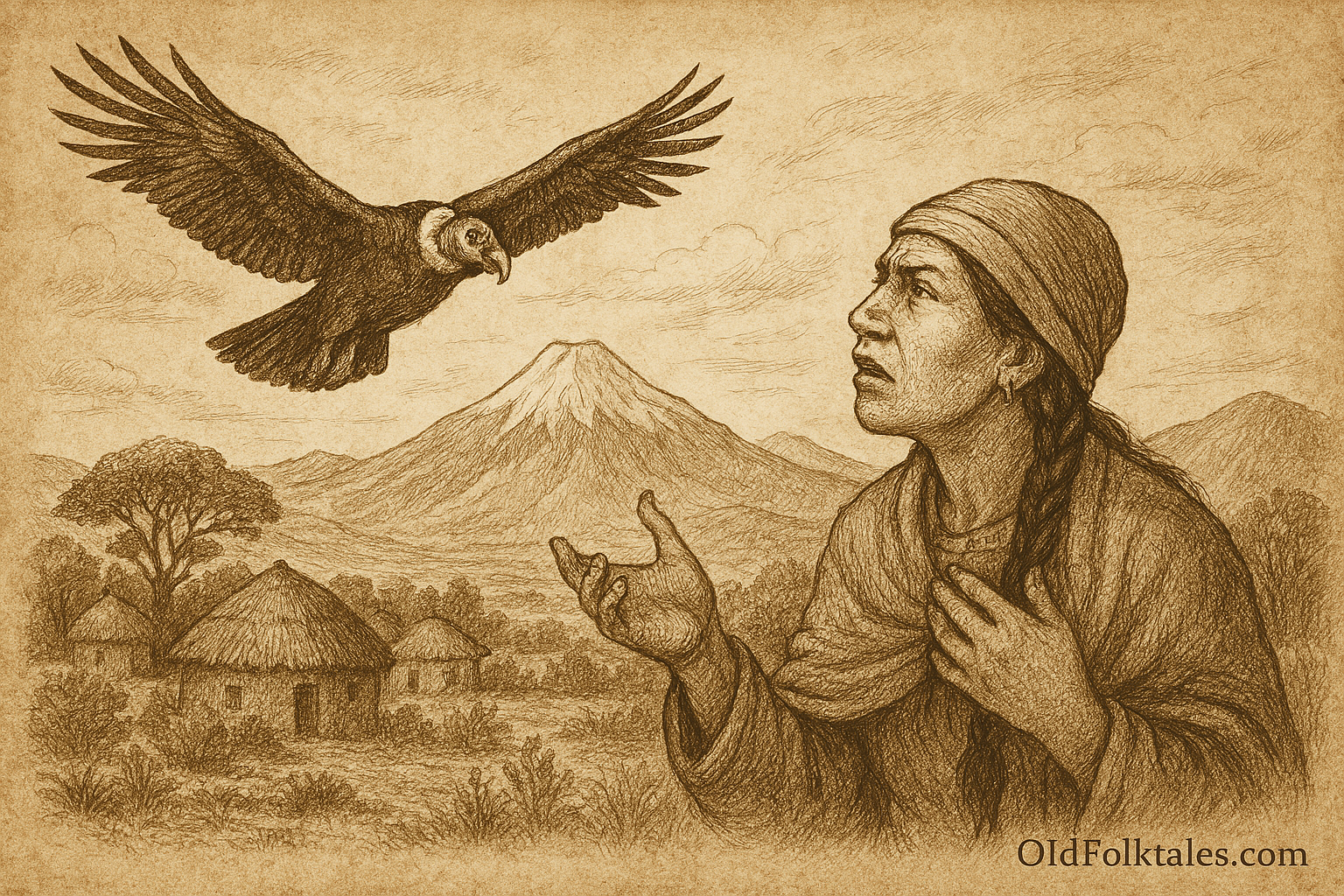
High in the Andean plateau, where the sky meets the earth in an endless sweep of blue, and the mountains stand as eternal guardians, the Aymara people have always known that they live in a world filled with witnesses. The stones remember. The wind listens. And above all, the great condor that magnificent bird with wings spanning wider than a man is tall circles endlessly between the human world below and the realm of the Apus, the sacred mountain spirits above.
In Aymara cosmology, the condor is no ordinary bird. It is a sacred messenger, a being that moves between worlds, carrying the essence of what happens on earth to the celestial powers that watch over humanity. The elders taught that the condor hears everything spoken beneath the open sky prayers and curses, truths and lies, kindness and cruelty. All of it rises on the mountain winds, and the condor, soaring on those same currents, gathers these words and carries them to the Apus, who see all and judge accordingly.
Click to read all South American Folktales — timeless stories from the Andes to the Amazon.
In a small village nestled in a valley between towering peaks, there lived a woman named Mallku. She was neither old nor young, neither rich nor poor, but she possessed something that set her apart a tongue that never rested and a mind that constantly spun stories. Mallku loved to talk, loved to be at the center of conversation, loved the feeling of having information that others did not possess.
At first, her gossip seemed harmless enough small observations about daily life, commentary on who had visited whom, speculation about why someone had traveled to the next valley. But gradually, like a stream that erodes its banks, her talk began to carry a more destructive current. When she didn’t know the full truth of a situation, she would fill in the gaps with invention. When a simple explanation existed, she would suggest something more dramatic, more scandalous, more likely to provoke reaction.
She told one neighbor that another had spoken ill of their farming methods. She whispered to a young woman that her betrothed had been seen talking intimately with someone else. She suggested to a family that their relatives in the next village were spreading rumors about them. None of these stories were entirely true some were complete fabrications, others were distortions of innocent events twisted into something sinister.
When people questioned her sources or challenged the accuracy of her tales, Mallku would shrug and say, “I only repeat what I’ve heard. Words are just air, here one moment and gone the next. What harm can they do?” She believed, or pretended to believe, that spoken words simply vanished into the thin mountain atmosphere, leaving no trace, creating no consequences.
But the consequences were very real. Trust between neighbors began to crack like dry earth. Families that had cooperated for generations started to eye each other with suspicion. Old friendships cooled. When communal work parties were organized the traditional mink’a where everyone contributed labor to help one family, knowing that help would be reciprocated fewer people attended, unsure who to trust, uncertain whose company to keep.
A marriage that had been in preparation for months fell apart when Mallku’s whispered insinuations reached the bride’s family. Two brothers who had shared land peacefully for years began to quarrel after Mallku told each that the other planned to claim more than his fair share. The village, which had once been characterized by the Andean principle of ayni reciprocity and mutual support became fractured and suspicious.
The elders watched this disintegration with growing alarm. They recognized the source of the poison spreading through their community. One evening, as the sun set behind the peaks and painted the sky in shades of purple and gold, they called the village together at the community space where important matters were discussed.
The oldest among them, a woman whose face was carved with the lines of eight decades of highland life, spoke in Aymara, her voice carrying clearly in the thin air. “Something is killing our community as surely as drought kills crops,” she began. “But this is not a drought of water, it is a drought of trust, brought on by a flood of false words.”
Her gaze found Mallku in the crowd. “There is one among us who believes that words are weightless, that they vanish like breath in winter air, that they create no consequences. But this belief is as false as the stories she spreads.”
The elder gestured toward the sky, where a great condor was visible, riding the thermal currents above the valley. “Do you see the condor? Our ancestors knew what some have forgotten that the condor is the messenger between our world and the realm of the Apus. Every word spoken under the open sky rises on the wind. The condor gathers these words truth and lies, kindness and cruelty and carries them to the mountain spirits who watch over us.”
She paused, letting the weight of this settle over the gathering. “The Apus hear everything. They know when we speak truth and when we speak falsehood. They know when our words build community and when they destroy it. And they respond not always immediately, not always obviously, but they respond. A village poisoned by false words will find itself abandoned by the blessings of the mountains. The rains may fail. The crops may wither. Unity may crumble. These are not punishments sent by angry gods they are the natural consequences of breaking the sacred bonds that hold communities together.”
Mallku felt the eyes of the village upon her. For the first time, shame began to penetrate her heart. She had thought herself clever, entertaining, important. She had enjoyed the power that came from being the source of information, the one people came to for news and gossip. But now she saw the devastation her words had created friendships destroyed, families divided, a community that had functioned smoothly for generations now broken and mistrustful.
The elder continued, her voice gentler now but no less firm. “Words are not air that vanishes. They are seeds that grow. They are stones that start avalanches. They are fires that can burn down everything we have built together. The condor carries them all our prayers and our slander, our blessings and our curses. And the Apus, who maintain the balance of our world, respond to what they receive.”
That night, as Mallku lay sleepless beneath the brilliant stars that seemed close enough to touch in the high altitude, she heard the rushing sound of great wings passing overhead. She looked up to see the silhouette of a condor against the moon, and for the first time, she truly understood. Her words had not vanished. They had risen, been carried, been witnessed. The damage could not be undone simply by stopping it would require the much harder work of truth-telling, of confession, of seeking forgiveness and rebuilding trust one painful conversation at a time.
In the days that followed, Mallku began that difficult work. She went to each person she had wronged and confessed her lies. She explained to the young woman that her betrothed had been faithful, that the “intimate conversation” had been about buying a gift for her. She told the brothers that neither had plotted against the other. She unraveled, strand by strand, the web of falsehood she had woven.
It was humiliating. Some forgave her quickly; others needed time. Some relationships healed; others remained permanently scarred. But gradually, as truth replaced lies, the village began to breathe easier. Trust slowly rebuilt. The mink’a work parties resumed. The wedding that had been cancelled was rescheduled. The fabric of community, though damaged, began to mend.
Mallku never forgot the lesson. In later years, when she felt the old temptation rising the urge to embellish a story, to share an unverified rumor, to fill gaps in knowledge with dramatic invention she would look up at the sky. Often, there would be a condor circling above, its massive wings outstretched, riding the invisible currents of air. And she would remember: the condor carries everything. Words are not weightless. False words travel farther than intended, borne on wings to powers that see all and from whom nothing is hidden.
Click to read all Andean Highland Folktales — echoing from the mountain peaks of Peru, Bolivia, and Ecuador.
The Moral Lesson
This Aymara tale teaches that words, once spoken, cannot be recalled and travel far beyond our control or intention. Mallku’s belief that words were “just air” that vanished harmlessly was dangerously false in reality, words are powerful forces that create real consequences in communities and relationships. The condor symbolizes the reality that our speech does not disappear but is witnessed, remembered, and has effects that ripple outward. In Aymara cosmology, this witnessing is literal the sacred messenger carries all words to the mountain spirits, but the moral applies universally, false words poison trust, destroy relationships, and fracture the social bonds that communities depend upon for survival. The story reminds us that we are accountable for what we say that gossip and falsehood cause genuine harm, and that rebuilding trust destroyed by lies requires far more effort than the careless moment it took to speak to them.
Knowledge Check
Q1: What is the sacred role of the condor in Aymara cosmology?
A1: In Aymara belief, the condor is a sacred messenger that moves between the human world and the realm of the Apus (mountain spirits). The condor is believed to gather all words spoken under the open sky prayers and curses, truths and lies and carry them to the mountain spirits who watch over humanity. This makes the condor a witness to human behavior and speech, symbolizing the belief that nothing we say or do goes unnoticed by the spiritual forces that maintain balance in the world.
Q2: What false belief did Mallku hold about her gossip and lies?
A2: Mallku believed that words were “just air” that vanished harmlessly into the atmosphere without lasting consequences. She thought that because spoken words seemed to disappear in the moment, they created no real effects and caused no harm. This allowed her to spread false stories and gossip without feeling responsible for the damage she caused, dismissing concerns by saying that words were weightless and temporary, here one moment and gone the next.
Q3: What consequences did Mallku’s false words create in the village?
A3: Mallku’s lies and gossip destroyed the social fabric of the village. Trust between neighbors cracked, families became suspicious of each other, old friendships cooled, and communal cooperation like the traditional mink’a work parties began to fail. A prepared marriage fell apart, brothers began quarreling over land, and the principle of ayni (reciprocity and mutual support) that characterized Andean community life deteriorated. The village transformed from a harmonious, cooperative community into a fractured, mistrustful one.
Q4: What wisdom did the elders teach about words and the condor?
A4: The elders taught that words are not weightless or temporary but powerful forces with lasting consequences. They explained that the condor carries all spoken words to the Apus, who hear both truth and falsehood and respond accordingly. Words are described as seeds that grow, stones that start avalanches, and fires that can destroy everything built together. The elders emphasized that a community poisoned by false words will lose the blessings of the mountains a way of saying that lies destroy the foundations of communal wellbeing.
Q5: How did Mallku attempt to repair the damage she had caused?
A5: Mallku undertook the difficult work of going to each person she had wronged and confessing her lies. She explained the truth behind each false story telling the young woman her betrothed had been faithful, informing the brothers that neither had plotted against the other, and systematically unraveling the web of falsehood she had created. This process was humiliating, and some relationships remained scarred, but her honest confessions and truth-telling allowed trust to slowly rebuild and the community to begin healing.
Q6: What cultural values about speech and community does this Andean story convey?
A6: The story embodies Aymara values emphasizing accountability for speech, the interconnectedness of individual actions and communal wellbeing, and the spiritual dimension of human behavior. It reflects the Andean principles of ayni (reciprocity) and the belief that communities survive through trust and mutual support, which can be destroyed by careless or malicious speech. The tale teaches that we live in a cosmos where actions and words are witnessed by spiritual forces, that speech carries moral weight and real consequences, and that maintaining communal harmony requires truthfulness and careful use of words.
Source: Adapted from Aymara oral traditions documented in Andean cosmological folklore studies.
Cultural Origin: Aymara people, Andean Highlands (Bolivia and Peru)