Under the blazing sun of rural Guerrero, a weary farmer bent over his dry field. His back ached from years of labor, and his crops seemed to mock him, thin stalks and brittle leaves barely worth the sweat that fed them. The earth, once generous, had grown stingy. Each day, he dreamed of resting under the shade of a full harvest, his barns filled and his debts gone.
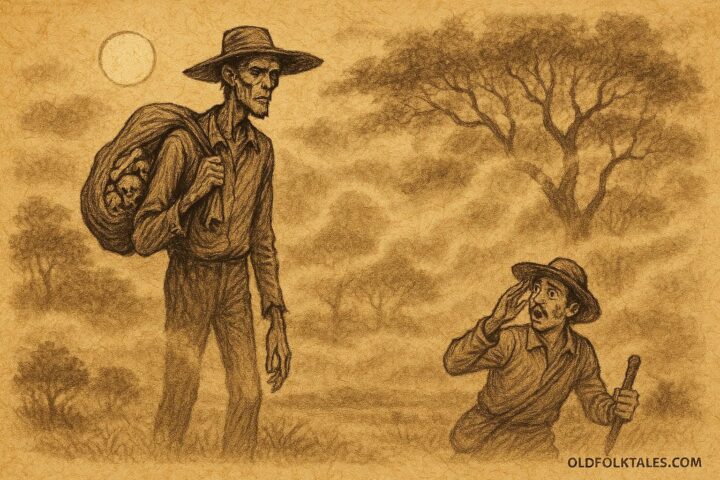
One afternoon, while the farmer sat beneath a scraggly mesquite tree, a figure approached along the dusty path. He was tall, cloaked in black, his boots unstained by dust. His face was pale but smiling, and his eyes glimmered like coals.
“You work hard for so little,” the stranger said smoothly. “What if I told you there was a way to have everything you desire, fields of gold corn, oxen strong as bulls, and wealth enough to make the governor jealous?”
The farmer’s heart leapt. “And what would it cost me?” he asked, half in jest.
The man in black chuckled, tipping his hat. “Only something small,” he said. “Your soul. I’ll give you seven years of fortune, and when the time is up, I’ll come for you.”
The farmer laughed nervously, but greed and exhaustion spoke louder than fear. He thought of his empty granary, his wife’s worn shawl, and the mocking whispers of richer men in the marketplace. Slowly, he pricked his thumb and pressed it to a scrap of parchment the stranger held out.
The stranger smiled, a wide, toothy grin, and vanished in a swirl of hot wind.
That year, everything changed.
Rain fell on his land while others prayed for it. Corn grew taller than a man, and beans twisted thick along their poles. His oxen grew fat, his barns overflowed, and his name became known across the valley. People called him El Afortunado, the lucky one.
He built a fine house with tiled roofs and bright walls. He hosted feasts, where musicians played and guests drank until dawn. For a while, he forgot the deal he had made. But time is a quiet thief, and the seven years passed like a gust of wind through dry stalks.
As the last year neared its end, the farmer’s laughter faded. He began to see shadows where none should fall, and when the wind howled, it seemed to whisper his name. One night, unable to sleep, he rode to the village chapel and poured out his fear before the old priest.
“Father,” he said, trembling, “I made a deal with a stranger, a man in black. He promised me riches, and now my time is almost up.”
The priest crossed himself, eyes solemn. “You’ve made a pact with the Devil,” he said. “But not all is lost. Do as I tell you, and perhaps God will have mercy.”
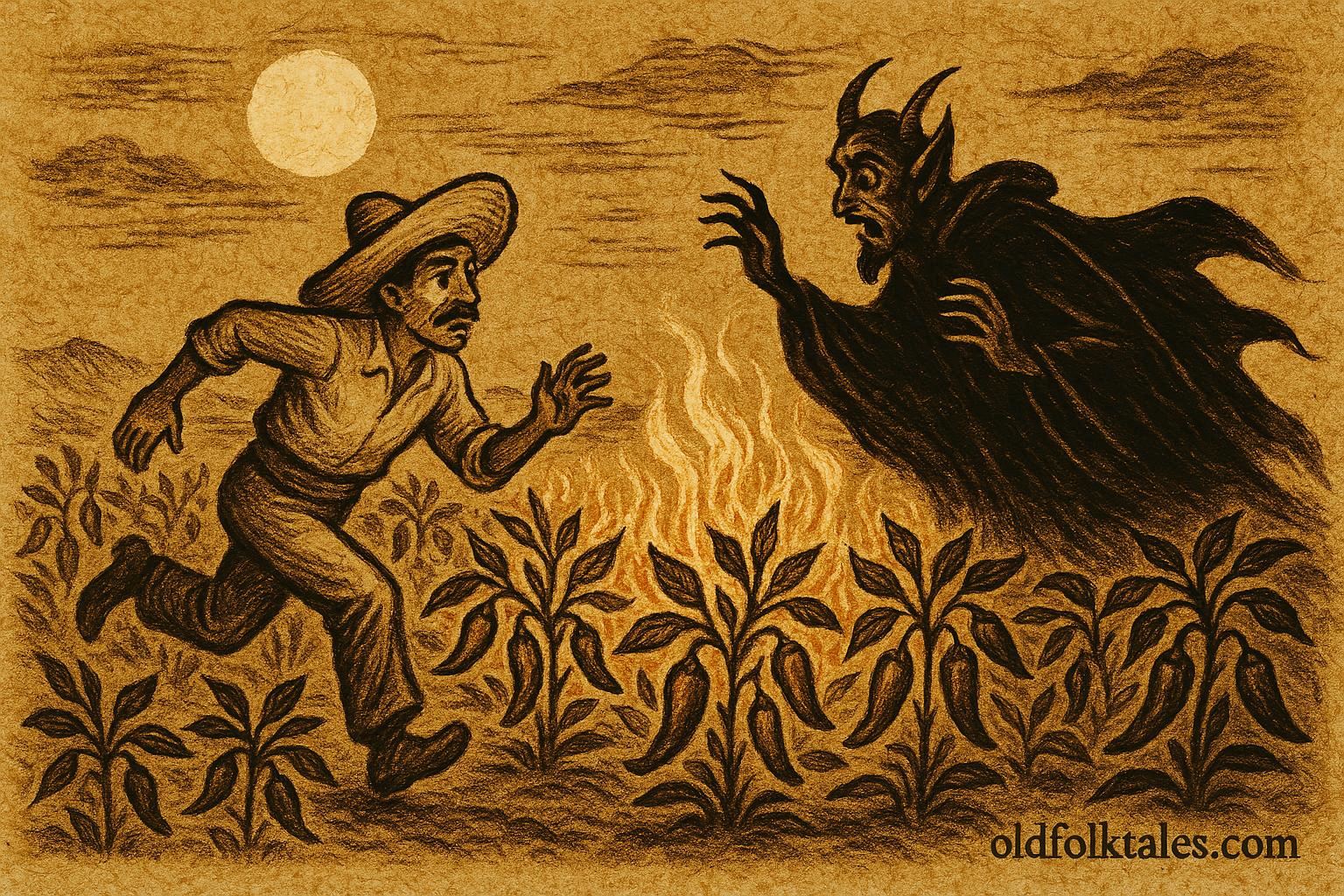
The priest handed him two vials, one of holy water, one empty. “Tomorrow, sow a field of chili peppers and sprinkle holy water on another. When the Devil comes, run between them. He will not cross what has been blessed by faith or what burns with nature’s fire.”
At dawn, the farmer worked feverishly. Sweat ran down his brow as he scattered chili seeds in one field and blessed another with the holy water. He prayed as he worked, each word a plea for mercy.
That night, the moon hung red and swollen, and the air grew heavy. The dogs would not bark. The wind carried a low hiss, and then the Devil appeared, his form darker than the night itself, eyes burning like embers.
“Your seven years are done,” he said, his voice a growl. “Now your soul is mine.”
The farmer fled, heart pounding, across the field of chili peppers. The plants seemed to come alive, their fiery scent filling the air. The Devil leapt after him, but the moment his feet touched the peppers, he howled in rage. Flames licked his boots, and smoke rose from the earth.
The farmer turned and dashed toward the second field, where drops of holy water still glistened on the leaves. The Devil chased him to its edge, but there he stopped, snarling. A white light shimmered across the rows like a silver thread, and each step the Devil took forward burned him with invisible fire.
“Curse you and your priest!” he roared. With a final scream, he vanished into the dark, leaving only a smell of sulfur behind.
The next morning, the village awoke to find the farmer on his knees outside the chapel, tears streaking his dusty face. He gave thanks to God, then walked home and gathered all his gold. One by one, he gave it away, to the hungry, the sick, and the widowed. He repaired the chapel roof and planted fresh flowers by its door.
From that day on, he worked as he had before the deal, slowly, honestly, and with gratitude. His crops were smaller, but they tasted sweeter. The people no longer called him El Afortunado, but El Humilde, the humble one.
Discover Mexico’s timeless tales blending Indigenous roots and Spanish tradition
Moral Lesson
This story teaches that greed can blind even the hardworking, but faith and humility can redeem the soul. True wealth lies not in possessions, but in integrity, gratitude, and the courage to face one’s own mistakes.
Knowledge Check
- Who offered the farmer wealth in exchange for his soul?
The Devil, disguised as a man in black. - What did the farmer use to sign his deal?
He signed the pact with his own blood. - How long was the farmer promised wealth before the Devil would return?
Seven years. - What two fields did the priest instruct the farmer to prepare?
One of chili peppers and one sprinkled with holy water. - Why couldn’t the Devil cross the fields?
The chili field burned him with natural fire, and the holy water field was protected by divine blessing. - What moral values does the story teach?
It warns against greed and pride and upholds faith, humility, and repentance as paths to redemption.
Source: Adapted from the Nahua folktale “El Campesino y el Diablo” in Oapan Nawa Folktales, collected by J. de G. Michel (2010, University of Pittsburgh).
Cultural Origin: Mexico (Nahua, Guerrero State).