In the quiet countryside of Honduras, when the night grows deep and the wind sighs through the trees, villagers speak in hushed tones about a mysterious spirit known as the Cadejo. The tale has been told for generations, a story of faith and fear, of the eternal battle between light and darkness that walks the same roads as humankind.
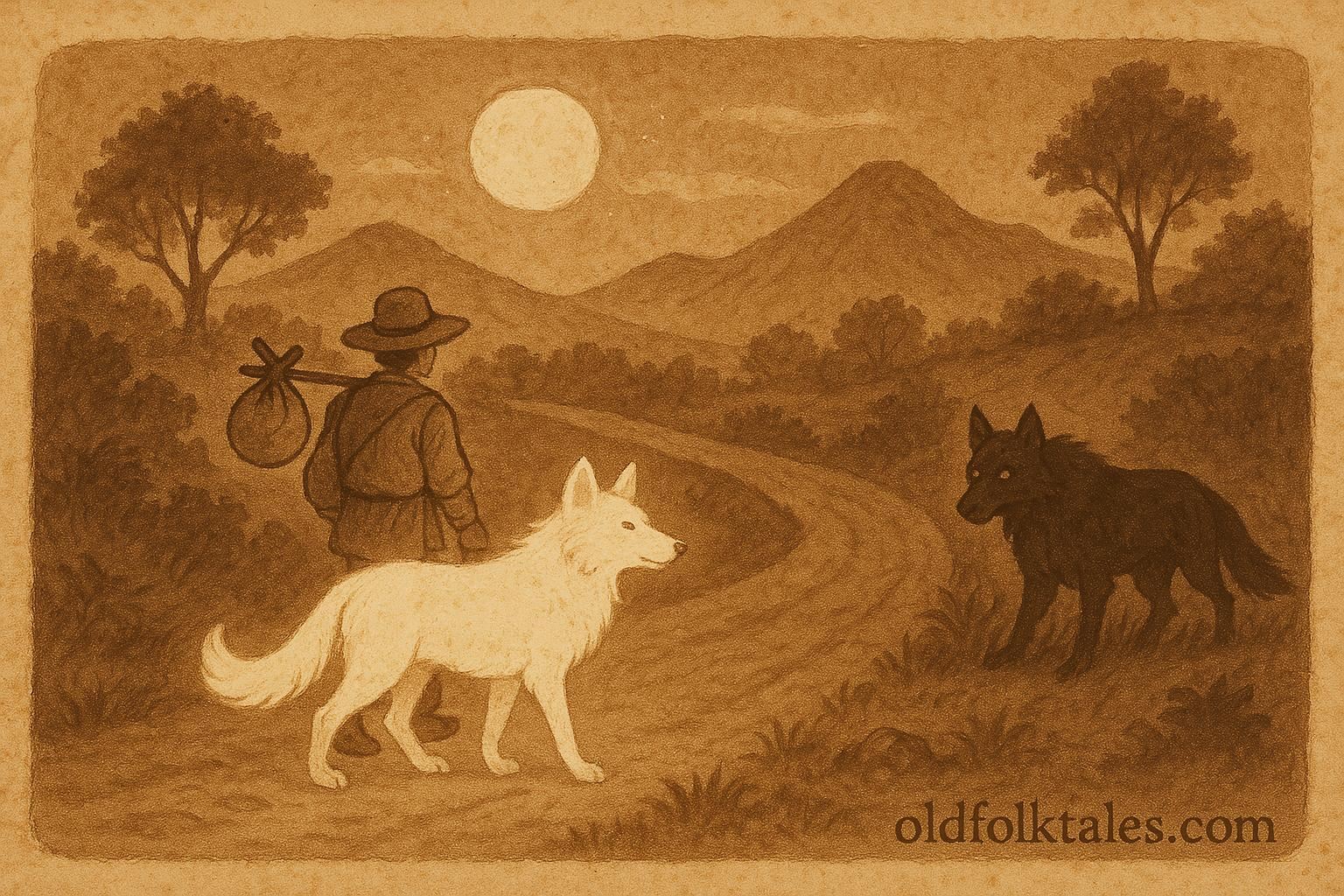
The elders say there are two Cadejos that wander the paths when the moon rises. One is pure and white as morning light; the other, dark as the deepest night. The white Cadejo brings protection to good-hearted travellers. The black Cadejo, on the other hand, brings torment to those who stray from the path of virtue.
Click to read all South American Folktales — timeless stories from the Andes to the Amazon.
Where these spirit dogs come from, no one truly knows. Some say they are the guardians of the soul, sent by God and the Devil themselves. Others claim they are the spirits of ancient beings who could not find peace, cursed to walk the earth forever.
In every village, people share the same warning: be careful where you walk after sunset.
When a man of good heart journeys home after a long day, weary but honest, the white Cadejo follows him silently. The man never sees its glowing fur or hears its soft steps, but when he reaches his door unharmed, he may feel a sudden sense of warmth, the blessing of a divine companion who has guided him through the darkness.
But for the wicked, the night holds a different presence. A drunkard stumbling home, or a liar who has broken trust, may find himself face to face with a black Cadejo, a monstrous dog with fiery red eyes and the stench of sulfur hanging in the air. Its growl rumbles through the ground, its teeth flash like lightning, and its breath burns like smoke.
Those who have seen it say their hearts freeze in terror. The black Cadejo circles them slowly, waiting. When the sinner tries to flee, it lunges forward, biting and clawing until the man collapses in fear or exhaustion. In the morning, he may be found unconscious on the roadside, pale, trembling, and forever changed.
Yet not all is lost, even in the darkest encounter. The old ones say that if you find the strength to pray, the white Cadejo will appear, its bright light breaking through the black one’s shadow. With a snarl of fury, the evil spirit vanishes into the night, leaving behind only silence, and the faint scent of smoke.
The next day, such a man often swears never to lie, cheat, or drink again. For he has met the Cadejo, and survived to tell the tale.
That is why parents in Honduras remind their children: “Walk straight, so the good one will walk with you.” The Cadejo, they say, is more than a spirit. It is a reflection of one’s soul, a mirror of conscience that follows every traveler, judging not by wealth or strength, but by the purity of their heart.
And so, in the stillness of the night, when crickets fall silent and the road gleams under the moon, villagers sometimes leave a whispered prayer for the white Cadejo, hoping that it, too, will walk beside them unseen.
Moral Lesson
The legend of The Cadejo reminds us that our actions shape our destiny. Goodness invites protection and peace, while deceit and vice draw punishment. Every step we take in life walks between light and shadow, and the path we choose determines which spirit walks beside us.
Knowledge Check
1. What does the word “Cadejo” refer to in Honduran folklore?
It refers to two spirit dogs, one white and good, one black and evil, that roam the roads at night.
2. What is the role of the white Cadejo?
The white Cadejo protects good and honest travellers, guiding them safely home.
3. What does the black Cadejo do?
The black Cadejo punishes drunkards, liars, and those who live in sin, frightening them or causing them to faint.
4. How can someone escape the black Cadejo?
By praying, which summons the white Cadejo to drive away the dark spirit.
5. What moral lesson does the tale teach?
It teaches that living a good, honest life protects one from evil, while sin invites misfortune.
6. What does the story symbolize in Honduran culture?
It symbolizes the moral balance between good and evil, and the spiritual consequences of one’s actions.
Source: Adapted from Honduran rural oral tradition, Folklore Hondureño (Cevallos, 1955) and Tradiciones y Leyendas de Honduras (Aguilar Paz); summarized from Postposmo: Tales of Honduras.
Cultural Origin: Honduras (Central American folklore)