In the heart of Michoacán, where the mountains cradle the deep blue lake like mirrors of the sky, the Purépecha people tell of a love that crossed the boundary between the human and the spirit world.
It happened long ago, beside the tranquil waters of Lake Zirahuén, when mist still rose like breath from the lips of the earth and the world was young enough for magic to wander freely. The fishermen of the lake often spoke of strange lights gliding beneath the surface, silvery trails that shimmered like the scales of moonlit fish. But one among them would discover that the light was not from the fish, but from a spirit who bore the face of love itself.
Click to read all South American Folktales — timeless stories from the Andes to the Amazon.
The Fisherman and the Moonlit Maiden
The fisherman’s name was Tariacuri, a quiet man who lived alone in a small hut by the lake. Each day he cast his nets and sang to the water spirits for luck, as his ancestors had taught him. His life was humble, marked by solitude and the rhythmic whisper of the waves.
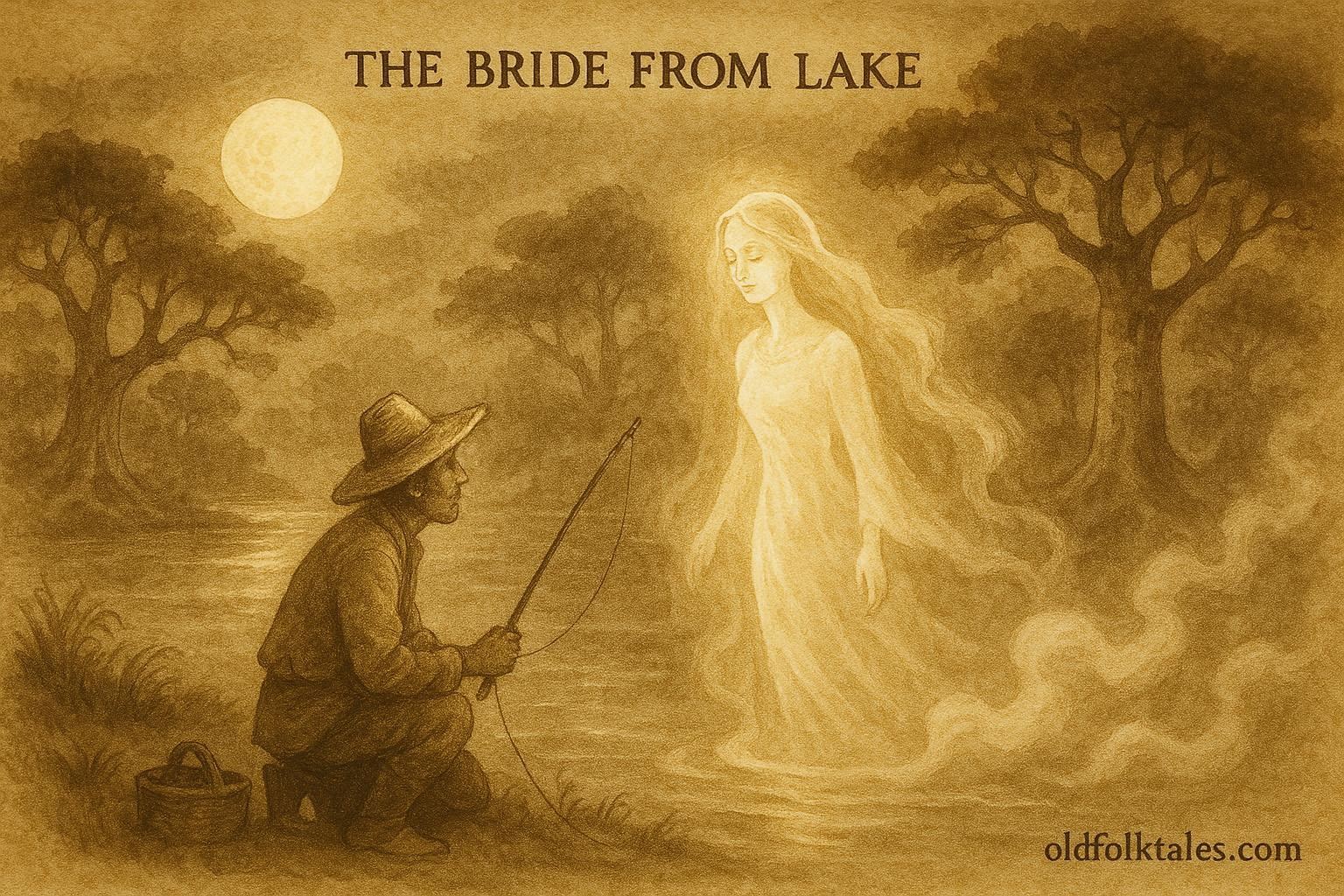
One night, as he fished under the full moon, his net grew heavy, not with fish, but with a soft, luminous shape. He pulled it in, trembling, and found before him a woman of unearthly beauty, her long black hair streaming like dark water, her eyes bright as reflected stars. She rose from the lake without sound, her skin glimmering with droplets that caught the moonlight.
“Do not fear,” she said, her voice as smooth as rippling water. “I am of the lake. You have sung to me often, and I have come to answer.”
Tariacuri fell to his knees, awed by her grace. From that night on, she came to him each full moon, emerging from the mist to sit beside him on the shore. They spoke of dreams, of the sky’s secrets, and of the depths that neither could cross fully, he of the land, she of the lake.
The Promise
As the moons passed, their hearts entwined. Tariacuri called her Xarátani, meaning “the one who glides upon the water.” She told him that she could never stay beyond dawn and that their love must remain secret. “If you ever speak my name aloud to others,” she warned, “the bond between us will break, and I must return forever to the depths.”
He promised with all his heart, sealing it with a kiss beneath the ceiba tree. From that moment, the people of the village noticed a change in him. He smiled more often, and his nets always came back full. Yet when asked about his fortune, he said nothing.
But secrets, like rivers, cannot stay still forever.
The Breaking of the Vow
One evening, during a village feast, the young men laughed and teased Tariacuri for his solitude. “Tell us, old fisherman,” one said, “is it the spirits that bring you luck, or do you have a bride in the reeds?”
Tariacuri, flushed with pride and drink, could not bear their laughter. “You mock me,” he said, “but I have a love more beautiful than any woman of this earth. Her name is Xarátani, the Bride of the Lake!”
The laughter stopped. The name fell heavy in the air. Beyond the firelight, the lake rippled, though no wind stirred. A cold mist crept up from the shore.
Realizing what he had done, Tariacuri ran toward the water, calling her name again and again. “Xarátani! Forgive me! I did not mean it!”
But only the echo of his own voice returned. The lake grew still as glass. The moonlight dimmed, swallowed by clouds. Then, from the depths, came a faint, sorrowful song, a voice like the sigh of the wind through reeds.
When dawn came, the fisherman lay upon the shore, his eyes red from weeping. The lake was calm, silent, and empty. Xarátani was gone.
The Weeping Reflection
From that night onward, every full moon, the villagers said they could see a woman’s reflection upon the lake, though no body cast it. Her image shimmered and wept, each tear rippling the water’s surface. Sometimes, fishermen heard her voice, soft, distant, like a lullaby turned to lament.
Tariacuri grew old beside the lake, waiting each month for her return. He no longer sang, nor did he fish. When he died, the villagers buried him near the ceiba tree where he had once pledged his vow. And on the night of his passing, the reflection on the water smiled, not sorrowfully, but with peace.
To this day, the people of Michoacán say that when the moon is bright and the lake is calm, you may still glimpse La Novia del Lago, her veil trailing like mist, mourning the promise broken but guarding the sacred bond between worlds.
Explore the land of La Llorona, trickster coyotes, and magical realism in Mexican folklore
Moral Lesson
The story of The Bride from the Lake reminds us that love between worlds demands respect and silence. Some mysteries are sacred, meant to be cherished rather than exposed. The fisherman’s broken vow teaches that true love is built on faith, and that once trust is lost, even the deepest devotion cannot restore what is gone.
Knowledge Check
- Who is the Bride from the Lake?
A water spirit named Xarátani who rises from the lake each full moon to meet her human beloved. - What is the fisherman’s name in the story?
Tariacuri, a humble fisherman from the Purépecha region of Michoacán. - What promise does the fisherman make to Xarátani?
He vows never to reveal her name or their love to anyone. - What happens when the fisherman breaks his vow?
Xarátani vanishes forever, and her reflection is seen weeping on the lake each full moon. - What does the lake symbolize in this tale?
The boundary between the human and spirit worlds, a place of mystery, beauty, and consequence. - What moral lesson does the story teach?
Respect for sacred promises and the humility to honor what lies beyond human understanding.
Source: Adapted from Leyendas del Lago y la Montaña by María del Carmen Cortés (1943).
Cultural Origin: Purépecha (Michoacán region, Mexico).