In the high Andean plateau of Bolivia, where the altiplano stretches vast and stark beneath an enormous sky, the Aymara people have woven textiles of breathtaking complexity and beauty for thousands of years. These are not merely practical items for warmth or decoration but vessels of cultural knowledge, visual language, and spiritual significance. Each pattern carries meaning, each color combination tells stories, and the act of weaving itself is understood not as simple craft but as participation in the fundamental ordering of the world the interlacing of threads mirroring the interlacing of cosmic forces that maintain balance and continuity.
Among the many teachings that guided Aymara weavers through generations was knowledge about timing when to weave and when to refrain, which phases of the moon favored certain work and which opposed it. The moon, in Aymara cosmology, holds particular power over activities involving cycles, growth, and transformation. Just as it influences the tides of distant oceans and the planting cycles of highland crops, it was understood to affect the work of weaving the transformation of loose fibers into ordered cloth, the creation of patterns that would endure through time.
Click to read all South American Folktales — timeless stories from the Andes to the Amazon.
The elders taught that certain lunar phases were auspicious for beginning new textiles, when the growing moon would lend its increasing energy to the work, helping threads hold together and patterns emerge strong and clear. Other phases were understood as times to avoid starting new pieces, when the waning moon’s energy could cause even skillfully woven cloth to loosen, unravel, or fail to hold its form properly. These were not arbitrary superstitions but accumulated observations refined over countless generations, part of the larger Aymara understanding that human activities succeed best when aligned with the natural rhythms and forces that govern the world.
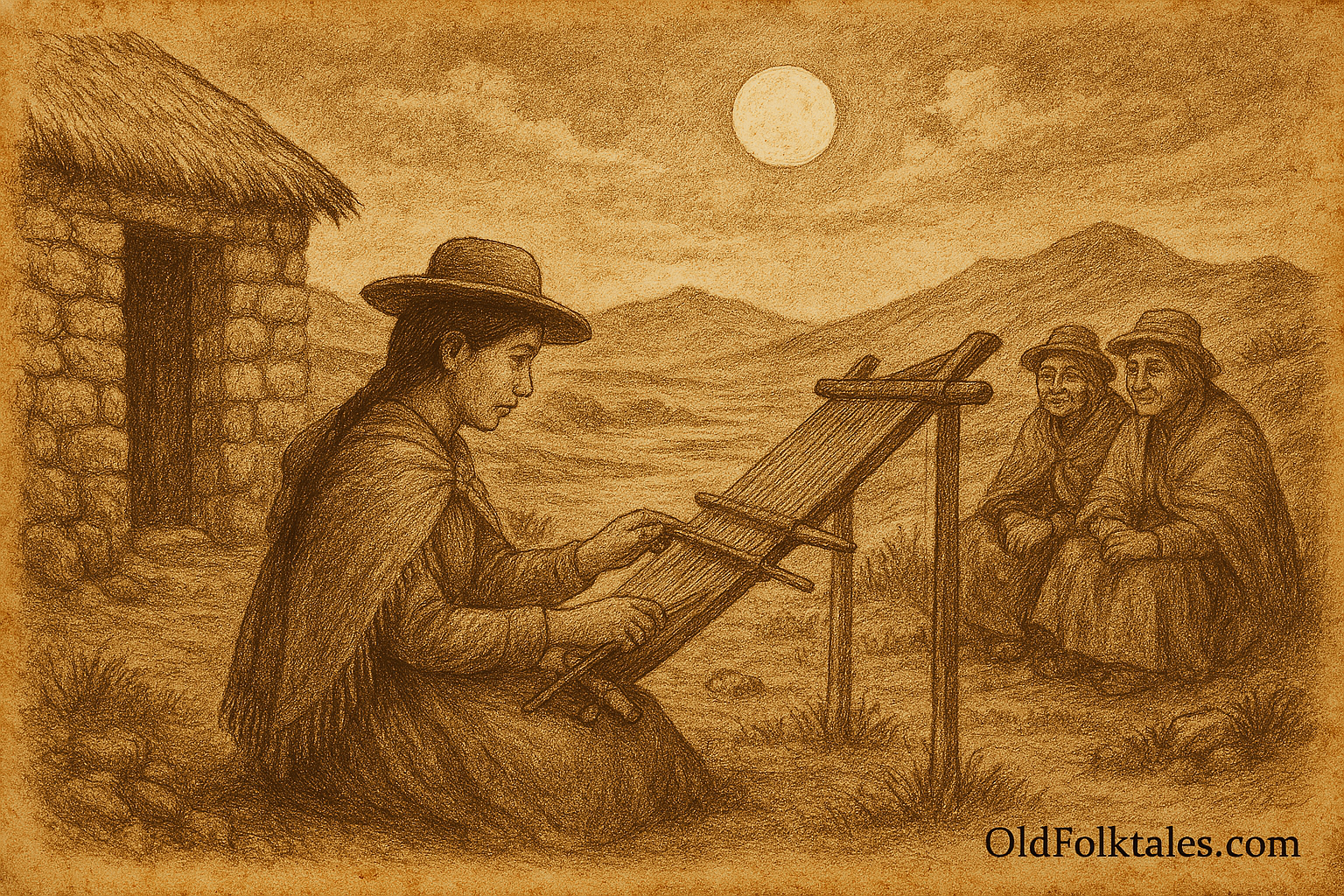
In one highland community where the houses clustered around a central plaza and the women gathered regularly to weave together, there lived a young woman named Suma whose technical skill with textile work was undeniable. Her hands moved with exceptional speed and precision, her understanding of complex patterns was advanced beyond her years, and the textiles she created showed a level of craftsmanship that even experienced weavers admired. She had learned the mechanical aspects of weaving brilliantly how to set up the tension, how to manage multiple-colored threads, how to create intricate designs with minimal errors.
But Suma had little patience for what she considered the non-practical aspects of weaving knowledge. When the elder women spoke about lunar timing, about waiting for auspicious phases before beginning new work, about avoiding certain days when the moon’s energy was contrary to successful weaving, Suma would barely conceal her skepticism. To her modern, practical mind, these restrictions seemed like meaningless tradition, obstacles to productivity, superstitious beliefs from a time when people didn’t understand natural processes.
“The moon is just a rock in the sky,” she would say dismissively when older women cautioned about timing. “It doesn’t care whether I weave or not. What matters is skill, technique, the quality of materials, and hard work. All this talk about waiting for the right moon phase is just an excuse for people who weave slowly or poorly to blame something besides their own lack of ability.”
The elder weavers would exchange glances but generally said nothing, recognizing that some lessons cannot be taught through words alone. “She will learn,” they would murmur to each other, “as we all learned through experience that cannot be argued with.”
Suma decided to prove her point definitively. During a moon phase that the elders had explicitly warned against for beginning new textiles a time when the waning moon was particularly unfavorable, she deliberately set up her loom and began an ambitious new piece. She chose her finest materials, planned a complex pattern that would showcase her technical mastery, and worked with focused intensity.
“I will create something magnificent,” she announced to the other women, “and it will prove that all this moon-timing nonsense is meaningless. Skill and hard work are what matter, not celestial superstitions.”
She wove brilliantly, her hands moving with practiced expertise, her pattern emerging exactly as planned. Hour after hour she worked, and the cloth grew beneath her skilled fingers, complex and beautiful. By the end of several days of intensive labor, she had created what appeared to be an excellent textile intricate patterns perfectly executed, colors harmoniously arranged, the work of an undeniably talented weaver.
She held it up triumphantly. “There!” she declared to the watching community. “Perfect work, created during your ‘forbidden’ time. The moon had nothing to do with it. Only my skill mattered.”
But within days, something strange began to happen. The cloth she had woven with such care started to loosen. Threads that should have been secure began to slip. The tight, crisp patterns started to blur as the weave lost its tension. She tried to repair the loosening areas, re-tightening threads and reinforcing weak spots, but the deterioration continued. Within a week, portions of the textile had actually unraveled, undoing hours of precise work. Within two weeks, the entire piece had fallen apart, reduced to loose threads and fragments despite having been woven with undeniable technical skill.
Frustrated and confused, Suma tried again. She used even better materials, worked even more carefully, paid even closer attention to tension and pattern execution. And again, the resulting textile technically perfect when completed began to deteriorate within days, loosening and eventually unraveling as if the threads simply refused to hold together despite being expertly interwoven.
She tried a third time, then a fourth, each attempt meeting the same fate. No matter how skillfully she wove, no matter how perfect the technique, the textiles created during the unfavorable moon phase would not endure. They would loosen, weaken, and eventually fall apart, as if something beyond technical execution was required for the work to truly succeed.
The elder weavers watched this process without gloating or criticism, only with the patient understanding of those who had themselves learned these lessons through experience. Finally, one of the oldest women, a weaver whose textiles were treasured across multiple communities and whose knowledge reached back to teachings from her grandmother’s grandmother, approached Suma.
“Daughter,” she said gently, “you have proven yourself a skilled weaver in terms of technique. Your hands are gifted, your understanding of patterns is sophisticated, your work ethic is strong. But you have also proven something else that skill alone is not sufficient. There are forces at work in weaving that your hands cannot control, rhythms that your technique cannot override. The moon does not care about your weaving, as you said but the moon represents cycles and forces that are real whether you acknowledge them or not.”
She continued: “When we speak of weaving during auspicious lunar phases, we are not making arbitrary rules to limit you. We are sharing knowledge about how to align your work with the natural rhythms that govern transformation and endurance. The moon influences cycles throughout nature the tides, the growth of plants, the fertility of animals, the rhythms of our own bodies. Why would it not also influence the transformation of loose fibers into enduring cloth? You cannot force your textiles to hold together through skill alone when you work against the rhythms that govern such things. You must work with these forces, not pretend they don’t exist.”
Suma felt the resistance inside her crumbling. She had been so certain that modern understanding and technical skill were sufficient, so convinced that traditional knowledge about lunar timing was meaningless superstition. But the evidence was undeniable her perfectly woven textiles had failed, not through any flaw in technique but through some quality of the work itself that technical execution could not provide.
Humbled and finally willing to learn, she asked the elder to teach her properly about lunar timing and weaving. She learned which phases favored beginning new work, which supported different types of textiles, and which were better used for other activities like planning patterns, preparing materials, or finishing and repairing completed pieces. She learned that this knowledge was not about the moon having personal interest in human activities but about recognizing that cyclical forces throughout nature affect processes of transformation and creation.
When Suma finally began a new textile during an auspicious lunar phase working with the same technical skill as before but now aligned with favorable timing the difference was immediately apparent. The cloth not only held together as she wove but seemed to strengthen as it progressed. The patterns emerged crisp and clear and remained so. When she removed the completed textile from the loom, it was solid, durable, beautiful and it remained so, maintaining its form and integrity through use and time.
She continued weaving with both her technical skill and her new understanding of proper timing, and her textiles became even more renowned than before. But she also became known for something else for her willingness to teach younger weavers not just technique but the importance of respecting the knowledge embedded in traditional practices, even when the reasoning behind them wasn’t immediately obvious to modern understanding.
“I thought I was wise because I was skilled,” she would tell her students. “I thought that mastering technique meant I understood everything important about weaving. But I learned that real wisdom involves recognizing there are forces and patterns beyond what our hands can control, and that aligning our work with these larger rhythms is not superstition but sophisticated understanding of how the world actually works. Skill without respect for the order of things leads to loss, but skill combined with proper respect creates work that endures.”
Click to read all Andean Highland Folktales — echoing from the mountain peaks of Peru, Bolivia, and Ecuador.
The Moral Lesson
This Aymara tale teaches that technical skill, no matter how sophisticated, is insufficient without respect for the larger patterns and rhythms that govern success in any endeavor. Suma’s error was believing that her mastery of weaving technique made traditional knowledge about timing unnecessary that human skill alone could overcome or ignore the natural forces and cycles that affect transformative work. The story reminds us that what may appear as superstition or meaningless tradition often embodies accumulated wisdom about working in harmony with natural rhythms rather than against them. In indigenous worldviews, success comes not from dominating nature through technique but from aligning human activity with the patterns and forces that govern the world.
Knowledge Check
Q1: What is the spiritual and cultural significance of weaving in Aymara highland culture?
A1: In Aymara culture, weaving is not merely practical craft but participation in the fundamental ordering of the world. Textiles are vessels of cultural knowledge and visual language, with each pattern carrying meaning and each color combination telling stories. The act of weaving the interlacing of threads is understood to mirror the interlacing of cosmic forces that maintain balance and continuity. Weaving is therefore both a practical and spiritual activity, connecting the weaver to larger patterns of order and creation that extend beyond simple cloth production to encompass cosmic principles.
Q2: What traditional knowledge did Aymara elders teach about lunar timing and weaving?
A2: Elders taught that the moon, which influences cycles throughout nature, also affects weaving work. Certain lunar phases were auspicious for beginning new textiles, when the growing moon would lend increasing energy to help threads hold together and patterns emerge strong and clear. Other phases particularly certain waning moon periods were understood as unfavorable for starting new pieces, when the moon’s energy could cause even skillfully woven cloth to loosen, unravel, or fail to hold form. This knowledge represented accumulated observations refined over generations, part of understanding that human activities succeed best when aligned with natural rhythms and forces.
Q3: Why did Suma dismiss the traditional teachings about weaving timing?
A3: Suma, despite her exceptional technical skill, had little patience for what she considered non-practical aspects of weaving knowledge. She viewed lunar timing restrictions as meaningless tradition, obstacles to productivity, and superstitious beliefs from people who didn’t understand natural processes. With her modern, practical mindset, she believed that skill, technique, quality materials, and hard work were all that mattered that “the moon is just a rock in the sky” that didn’t care about weaving. She saw the timing teachings as excuses used by slower or less skilled weavers to blame something besides their own lack of ability.
Q4: What happened to the textiles Suma wove during unfavorable lunar phases?
A4: Despite being woven with undeniable technical skill and perfect execution, the textiles Suma created during unfavorable moon phases would not endure. Within days of completion, the cloth would begin to loosen, with threads that should have been secure starting to slip and tight patterns beginning to blur as the weave lost tension. Within a week, portions would unravel, undoing hours of precise work. Within two weeks, entire pieces would fall apart completely, reduced to loose threads and fragments. This pattern repeated through multiple attempts with increasingly better materials and more careful work technical perfection could not prevent the deterioration.
Q5: How did the elder weaver explain the failure of Suma’s technically perfect textiles?
A5: The elder explained that while Suma possessed exceptional technical skill, skill alone is insufficient because there are forces at work in weaving that hands cannot control and rhythms that technique cannot override. She taught that the moon represents real cycles and forces affecting transformation and endurance throughout nature influencing tides, plant growth, animal fertility, and human body rhythms. Lunar timing knowledge is not arbitrary restriction but accumulated understanding about aligning work with natural rhythms that govern transformation. Working against these forces means even perfect technique cannot create cloth that endures weavers must work with these rhythms, not pretend they don’t exist.
Q6: What cultural values about knowledge, tradition, and harmony with nature does this Bolivian highland story convey?
A6: The story embodies Aymara values emphasizing that technical skill must be combined with respect for natural rhythms and traditional knowledge, that what appears as superstition often contains sophisticated accumulated wisdom, and that success comes from aligning human activity with larger patterns governing the world rather than attempting to dominate through technique alone. It reflects indigenous understanding that traditional practices encode deep observations about how natural forces work and that dismissing such knowledge without understanding leads to failure regardless of individual skill. The tale teaches that real wisdom involves recognizing forces beyond human control, that respecting the order of things is essential for enduring success, and that mastery requires both technical excellence and humility before the larger patterns within which that technique operates.
Source: Adapted from Aymara lunar and textile traditions documented in highland folklore records and ethnographic studies of Aymara weaving practices, cosmology, and the relationship between craft work and natural cycles
Cultural Origin: Aymara people, Andean Highlands (Altiplano), Bolivia