Alvarado is a name that still carries weight in the ruins of Ciudad Vieja, where stone foundations lie half-swallowed by earth and memory. Long after Pedro de Alvarado’s campaigns ended and his life was lost during the Mixtón War in 1541, people began to speak of something that returned in his place. It did not wear armor or carry a sword. It walked on four legs.
During his conquests, Pedro de Alvarado was known not only for his brutality but for his massive black war dog, called Becerrillo or Leoncico in the chronicles. The animal was trained for battle and feared deeply by the Kaqchikel people, who saw it unleashed as a weapon of terror. The dog obeyed only Alvarado and followed him without hesitation, even into violence.
Click to read all South American Folktales — timeless stories from the Andes to the Amazon.
When Alvarado died, the dog disappeared from record. Yet the land itself did not forget.
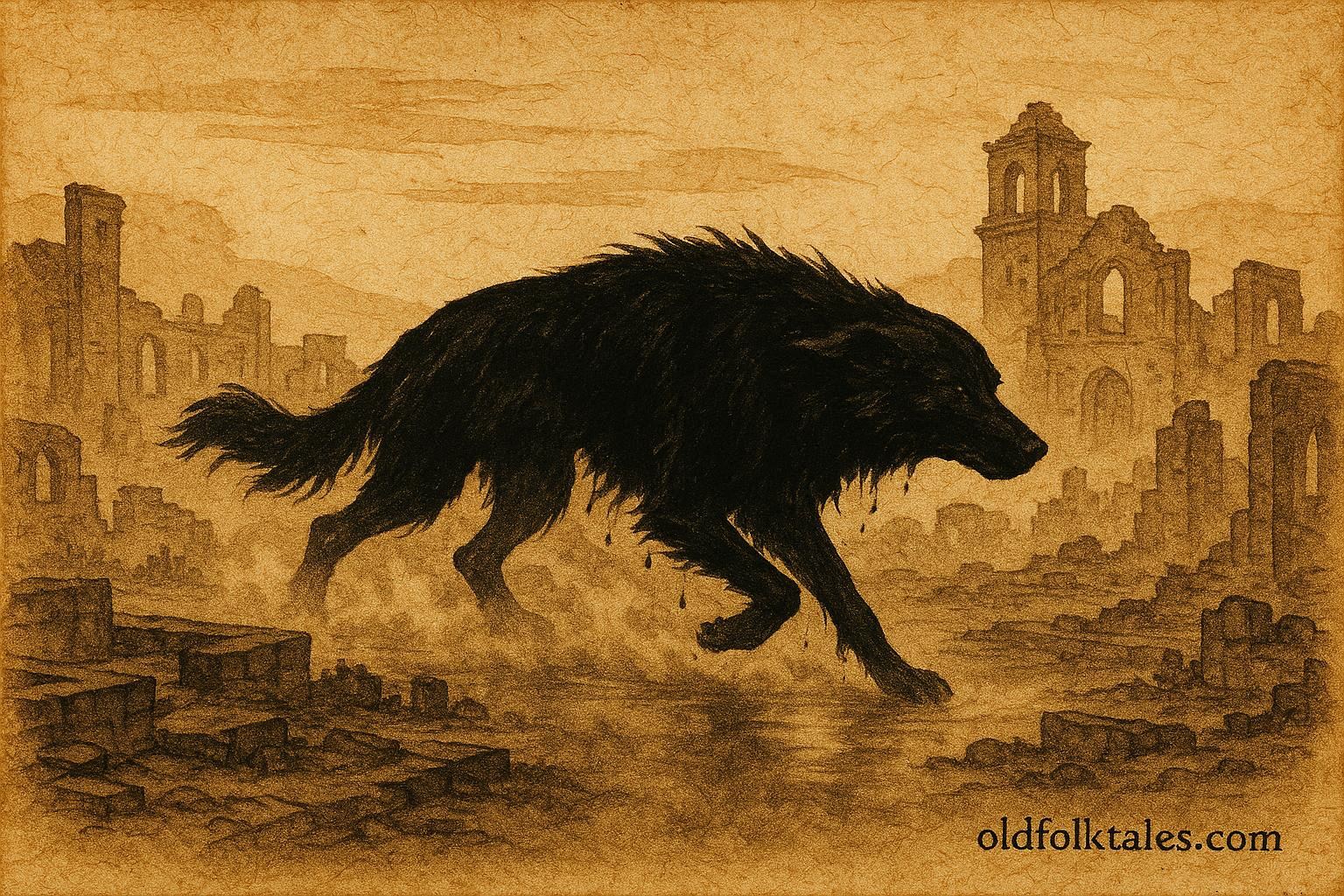
Each year, on the anniversary of the catastrophic mudflow that destroyed Ciudad Vieja in 1541, witnesses report the same vision. As dusk settles over the abandoned streets and the air grows heavy, a large black dog appears among the ruins. Its fur hangs wet, as if soaked by rain or buried floodwater. Its mouth is open in a silent snarl, teeth bared, eyes fixed forward.
The dog runs.
It charges through the remnants of the old capital, across stone paths where homes once stood, past churches that collapsed beneath mud and grief. Though it moves fast, its paws make no sound. No barking follows. Only motion, urgent and relentless.
Those who see the dog feel dread rather than fear. The animal does not attack. It does not chase. It runs as if warning the land itself. Elders say that when the phantom dog appears, floods, landslides, or earthquakes soon follow. The sighting is taken as a sign to prepare, to leave vulnerable areas, to listen to the ground.
Some believe the spirit is the ghost of Alvarado’s war dog, bound to the site of colonial violence and destruction. Others tell a different version in hushed tones. They say the dog is not the conqueror’s companion at all, but the transformed spirit of a Kaqchikel warrior. In death, the warrior took the shape of the feared beast, reclaiming it as a guardian rather than a weapon.
In this telling, the dog runs not to threaten but to protect, circling the ruins where trauma was first etched into the land. Its silence is deliberate. Its warning is visual, not spoken. Those who understand its meaning survive. Those who dismiss it often do not.
Ciudad Vieja remains uninhabited, its fate sealed by history and earth alike. And each year, when the date returns and the ground grows restless, people watch the ruins carefully. If the black dog of Alvarado runs again, they know the land is remembering.
Moral Lesson
The legend teaches that history leaves marks not only on people but on places, and that ignoring warnings born of past trauma invites repetition of disaster.
Knowledge Check
Q1: Who was Pedro de Alvarado?
A1: A Spanish conquistador involved in the colonization of Guatemala.
Q2: What animal appears in the legend after his death?
A2: A massive black war dog seen as a phantom.
Q3: Where does the dog appear?
A3: In the ruins of Ciudad Vieja, Guatemala’s first capital.
Q4: When is the dog most often seen?
A4: On the anniversary of the 1541 mudflow disaster.
Q5: What does the dog symbolize?
A5: A warning of impending natural disaster and unresolved colonial trauma.
Q6: What alternative origin is suggested for the dog’s spirit?
A6: That it may be the transformed spirit of a Kaqchikel warrior.
Cultural Origin and Source
Source: Colonial Ladino folktale, Guatemala
Rooted in 16th-century chronicles and oral history from Ciudad Vieja.