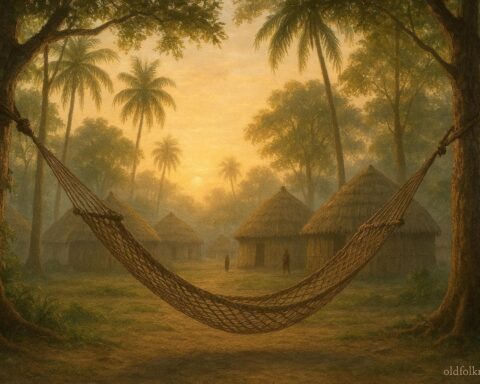
In the beginning, before the sound of rushing water or the song of the frogs, the earth lay dry beneath a heavy sun. The people of the world lived on cracked soil, their crops failing, their throats dry. No river flowed through the forest, and the wind carried only the dust of thirst.
The elders gathered in the open clearing, their faces painted with earth and ash. They prayed to the Sky Spirits for water, burning resin and whispering the ancient songs of calling. For seven nights, the people waited. On the eighth, the sky began to change.
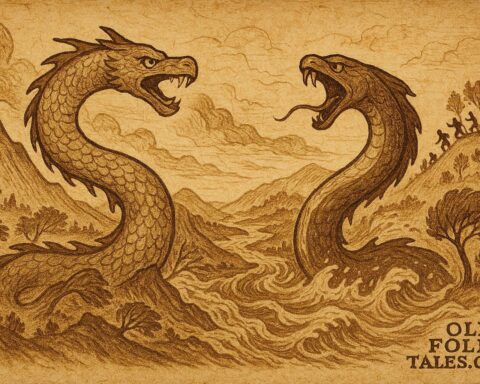
A shimmer appeared above the mountains, glowing with colors of green and gold. The clouds thickened, and thunder rolled across the empty land. From the heart of the sky descended a great serpent, her scales glinting like emeralds wet with rain. She was the Anaconda Spirit, guardian of life and keeper of the waters.
Explore myths and legends from Brazil, Peru, and Argentina rooted in spirit and survival
Her eyes, deep as forest pools, looked upon the people. “You call to me with thirst in your voices,” she said. “But water is not a gift easily given. It is life itself. To receive it, you must promise to protect it.”
The elders bowed and placed before her baskets of seeds, bright feathers, and fruit from their last harvest. “We promise,” they said. “Teach us, and we will remember.”
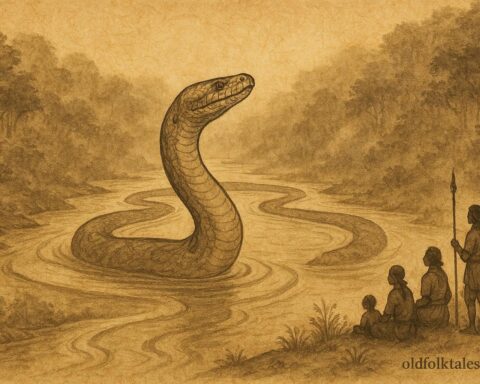
The great serpent nodded. She turned her immense body toward the forest and began to move. With every glide, her belly carved a deep path through the land. Where her body touched the ground, cool water poured out, bubbling up from the earth. The people gasped as they watched streams form and merge, weaving together into a vast, winding river.
“The water follows my body,” the Anaconda Spirit said. “It will give you food, it will give you life. But if you forget its sacredness, it will also take life away.”
The people danced along the new riverbank. They washed their faces in the cool current and laughed with joy. The trees grew thick and tall. Birds returned to the forest, their songs mingling with the rush of water. The Anaconda Spirit smiled, then slipped beneath the surface. Her body shimmered once more and disappeared into the depths, leaving only ripples behind.
For generations, the people kept their promise. They sang to the river every dawn, thanking the spirit for her gift. Hunters asked permission before crossing the water, and fishers offered the first catch back to the current. The children learned to greet the river by touching its surface with both hands, whispering, “May you flow forever.”
But as time passed, the world began to change. The people grew in number. They cut down trees and built large fires that burned day and night. They threw their waste into the river and laughed when the elders warned them. “The river is endless,” they said. “It will clean itself.”
The water began to darken. Fish floated lifeless to the surface, and the plants along the banks turned yellow. Still, the people paid no mind until one season, the rains did not come. The sky remained cloudless, and the river began to shrink.
One evening, a young girl named Amaíra sat beside the drying river. Her grandmother had told her stories of the Anaconda Spirit, but Amaíra had never seen her. She closed her eyes and placed her ear to the ground. From deep within the earth came a low, rhythmic sound—like the beating of a heart.
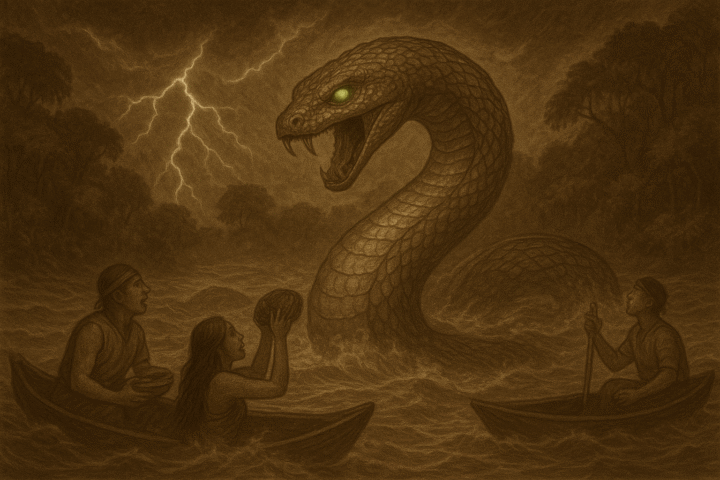
Then the riverbed trembled. The water swirled and rose, forming a dark shape. The Anaconda Spirit emerged once more, her scales dimmed, her voice filled with sorrow.
“You have forgotten me,” she said. “You have taken without care, and now the river will sleep.”
Before anyone could speak, she coiled her immense body, sealing the river’s source beneath her. The water ceased to flow. The people’s wells ran dry. The crops withered, and the forest grew silent.
Amaíra could not bear it. She walked along the empty river path, following the trail of cracked earth until she reached a spring hidden beneath an ancient tree. There, she saw the serpent lying still, her body curved around the spring like a ring of stone.
The girl knelt beside her and began to sing. Her voice was small, but the song carried far:
“Mother of waters, return to us,
Forgive our hearts that turned to dust.
Flow again and make us new,
River of life, we honor you.”
The serpent stirred. Her eyes opened slowly, gleaming with a faint green light.
“You remember the song,” the Anaconda Spirit whispered. “One voice in truth is stronger than many in forgetfulness.”
She lifted her head, and from beneath her coils came a rumble like thunder. The spring burst open, and clear water poured forth. The river surged once more, racing through the forest, filling the valleys, bringing life back to the land.
When Amaíra returned home, she carried a bowl of river water in her hands. She poured it onto the roots of a dying tree, and green leaves began to grow. The people saw this miracle and wept. They gathered by the riverbank and sang the old songs once again.
From that time on, the people never forgot the promise. Each year, they held a festival for the river, decorating its banks with flowers and fruit. Children learned Amaíra’s song, and the elders told of the great serpent who gave them life.
Deep beneath the shimmering current, the Anaconda Spirit sleeps, her body curled around the source of the river. Her heart beats slowly, in rhythm with the pulse of the earth, waiting for the day when her children might forget again and for the voice that will remind them to remember.
Explore the ancestral legends of Canada, Mesoamerica, and South America’s Indigenous tribes.
Moral Lesson
Nature gives freely, but only to those who treat it with respect. The river, like life itself, continues to flow when humanity remembers its sacred duty to protect the world that sustains it.
Knowledge Check
1. Who is the central spirit in this story and what does she create?
The Anaconda Spirit, a divine serpent, creates the first river to bring life to the dry earth.
2. What promise do the people make to the Anaconda Spirit?
They promise to honor and protect the river as a sacred gift of life.
3. Why does the Anaconda Spirit stop the flow of the river?
Because the people forget their promise, polluting and neglecting the river.
4. How does Amaíra restore the river’s flow?
She sings a song of apology and remembrance that awakens the Anaconda Spirit.
5. What does the river symbolize in this folktale?
It symbolizes life, renewal, and the connection between humans and nature.
6. What is the cultural origin of this story?
This story comes from the Tukano people of the northwestern Amazon in Colombia.
Source: Adapted from Tukano oral traditions in Myths of the Upper Rio Negro by Gerardo Reichel-Dolmatoff (1971), Bogotá: Instituto Colombiano de Antropología.
Cultural Origin: Tukano (Northwestern Amazon, Colombia)