In the cacao-rich lowlands of southern Belize, the Alux is spoken of with quiet respect. Among the Mopan Maya, the Alux is not merely a mischievous forest spirit, but a guardian of balance, drawn to care, generosity, and sacred labor. This is the story of how an Alux came to protect a young woman whose chocolate carried the power of the forest itself.
Ixchel lived in a small Mopan Maya village in the Toledo District, where cacao trees grew beneath towering canopies and the air carried the earthy scent of rain and leaves. She was known throughout the region as the finest chocolate-maker anyone had ever known. Each morning, she roasted cacao beans over a low fire and ground them slowly by hand on stone, mixing them with water to create chacau haa, the traditional bitter chocolate drink. Her movements were careful and rhythmic, guided by patience and respect for the crop that fed both body and spirit.
Click to read all South American Folktales — timeless stories from the Andes to the Amazon.
As dusk settled each evening, the rich aroma of cacao drifted beyond her kitchen and into the forest. It was this scent that caught the attention of an Alux, a small, unseen being who watched over the land and its hidden paths. Night after night, drawn by curiosity and delight, the Alux slipped silently into Ixchel’s home while she slept. He drank small sips from her gourds of freshly prepared chocolate, careful not to leave a trace.
At first, Ixchel thought nothing of the missing drink. But when it continued night after night, her patience wore thin. She suspected an animal or a thief and decided to act. One evening, she placed a shallow bowl of honey beside the gourds, knowing that no creature could resist its sweetness.
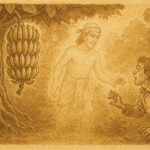
That night, the Alux returned as usual. Reaching eagerly for the honey, he became stuck fast, his hands and feet caught in the golden trap. When morning came, Ixchel discovered him struggling helplessly. Instead of fear or anger, she laughed. Seeing the small spirit’s distress, she gently washed him clean with warm water, freeing him from the sticky honey.
The kindness surprised the Alux. Moved by her laughter and mercy, he vowed to repay her. When the next cacao harvest arrived, he appeared again, this time leading Ixchel deep into the forest along paths only spirits knew. There, hidden among ancient trees, grew cacao pods of an extraordinary kind. Their beans, he told her, held a rare strength. When ground into chocolate, they could ease sorrow and soften even the heaviest heart.
Ixchel followed his guidance. The chocolate she made from those beans was unlike anything before. Word of her gift spread far beyond the village, reaching traders and merchants from distant towns. Among them was a Spanish merchant, driven by greed and suspicion. He demanded to know the source of her cacao. When Ixchel refused to betray the forest’s secret, he accused her of witchcraft.
The accusation spread quickly. The night before Ixchel was to be taken away, the Alux returned. This time, he summoned every snake and wasp from the forest. Together, they descended upon the merchant’s storehouse, destroying his goods and leaving him ruined. By dawn, the accusations fell apart, and Ixchel fled into the forest.
It is said she never returned to the village. Instead, guided by the Aluxob, she and her descendants continued to make chocolate in hidden clearings, sharing it only with those whose hearts were pure.
Moral Lesson
This folktale teaches that kindness invites protection, and that sacred knowledge must be guarded with humility and respect rather than exploited by greed.
Knowledge Check
1. Who is the Alux in the story?
A forest spirit and guardian in Mopan Maya tradition.
2. Why was the Alux drawn to Ixchel?
The scent of her cacao and her respectful labor.
3. How did Ixchel capture the Alux?
By setting a honey trap beside her chocolate gourds.
4. Why did the Alux decide to help her?
Because she treated him with kindness instead of anger.
5. What power did the hidden cacao pods possess?
They produced chocolate that could ease heartache.
6. What led to Ixchel’s disappearance into the forest?
False accusations driven by a jealous Spanish merchant.
Source and Cultural Origin
Source: Mopan Maya folktale, Belize
Documented in linguistic and cultural studies from the University of Belize
Cultural Origin: Mopan Maya tradition linking aluxob to cacao stewardship