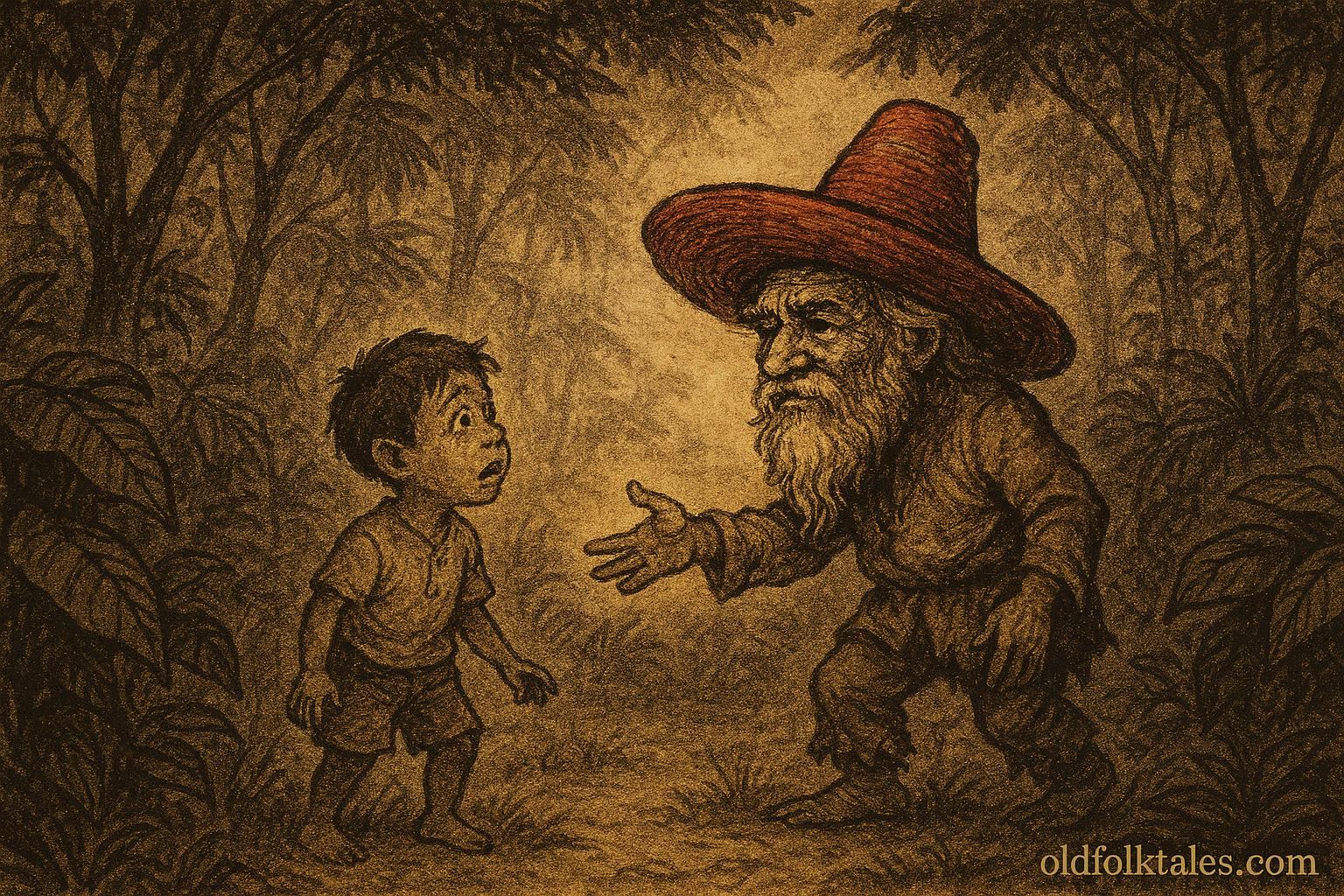
Deep within the lush, green heart of the Belizean bush, where the calls of howler monkeys echo and sunlight fights through a thick canopy, the rules are different. They are not made by people, but by the ancient keeper of the wild, a spirit known as Tata Duende. He is a small, old man with a face as wrinkled as old bark and a long, gray beard. He wears a large, signature red sombrero that hides his wise, watchful eyes. But his two most important features are what he lacks: he has no thumbs on his hands, and his feet are turned backwards on his legs.
These are not accidents, but symbols of his purpose. His missing thumbs mean he cannot grip a machete to cut down a tree or tie a rope to trap an animal. His backwards feet leave confusing tracks in the mud, leading hunters in circles, away from the heart of his domain. He is the guardian, the balance, the voice of the bush itself.
One afternoon, a young boy, full of restless energy and ignoring the stern words of his grandmother, decided to venture deeper into the jungle than he ever had before. His grandmother had warned him, “Do not go deep into the bush to hunt the birds. That is Tata Duende’s place.” But the boy, armed with a simple slingshot, was lured by the flash of colorful feathers and the thrill of the chase.
He followed a trogon, then a parrot, darting off the known trails. The forest grew denser, the light grew greener and dimmer. When he finally stopped to catch his breath and looked back, his heart sank. The path he had followed was gone, swallowed by ferns and vines. Every direction looked the same—a wall of green. He was hopelessly lost.
Panic set in as the shadows lengthened. The friendly chirps of day birds gave way to the unsettling rustles of night creatures. Just as the first true dark of dusk began to fall, he saw a flicker of red beneath a towering, dark chechem tree. There, sitting on a root, was a tiny, ancient-looking man with a large red hat.
“Boy,” the old man said, his voice like dry leaves. “Help an old man. Crack this nut for me.” He held out a hard, round seed.
Relieved to see anyone at all, the boy stepped forward and took the nut. As he did, his eyes fell on the old man’s hands. They were gnarled and strong, but where the thumbs should have been, there were only smooth stumps. A cold terror shot through the boy. He knew the stories. He was face-to-face with Tata Duende.
The boy stumbled back, dropping the nut. Tata Duende stood, not much taller than the boy himself, but his presence filled the clearing.
“Yu no hear yu granny tell yu fi no come deep inna bush fi kill mi bird dem?” the spirit scolded, his voice now sharp with authority. “Dis is my place. You come here with your slingshot to break my peace.”
The boy could only tremble, tears of fear and shame in his eyes.
“Now you are lost,” Tata Duende said, not unkindly, but with firm finality. “I give you a choice. You can stay lost in my bush forever. Or, I can take your thumbs, like mine. Then you will never hold a slingshot again to trouble my creatures. Choose.”
The thought of being lost forever in the endless green was a terrifying void. But the idea of losing his thumbs, of never being able to hold a tool, or his grandmother’s hand, was a different kind of horror. The boy fell to his knees.
“Please, no!” he begged. “I am sorry! I should have listened! I promise, I will never hunt your birds again. I will never disrespect the bush. Please, show me the way home!”
He pleaded with all his heart, his earlier disobedience washed away by pure, true remorse. Tata Duende watched him for a long, silent moment. He saw the genuine fear, and more importantly, the understanding.
“Alright, little one,” the spirit finally said, his voice softening. “I will show you. But remember this warning for your whole life. The bush is not for your play. It is a home. You are a visitor. Respect it, or you will be lost again, and next time, I will not help you.”
With that, Tata Duende pointed a thumbless hand between two specific trees. “Walk that way. Do not look back. Keep walking until you see the smoke from your grandmother’s fire.”
The boy scrambled to his feet and ran in the direction pointed. He did not look back. He ran until the trees thinned, until he saw the familiar orange glow of a hearth through the twilight, and heard his grandmother’s voice calling his name in worried tones.
He never again ventured deep into the bush without permission and respect. And whenever he told his story, he would hold up his own two thumbs, grateful for them, and remember the small man in the red hat who taught him that the wild is not a place to conquer, but a world to honor.
The Moral Lesson:
This tale powerfully enforces the dual importance of obeying parental wisdom and respecting the natural world. It teaches that the wilderness has its own rules and guardians, and that arrogance or disobedience towards these forces leads to being lost, both literally and morally. True safety and wisdom come from listening, humility, and understanding our place within a larger, living world.
Knowledge Check
Q1: Who is Tata Duende in Belizean folklore?
A1: He is the wrinkled, bearded guardian spirit of the bush or forest, a small old man who wears a large red sombrero and protects the wilderness.
Q2: What are Tata Duende’s two key physical traits and their symbolic meaning?
A2: He has no thumbs, symbolizing he cannot cut trees or trap animals, and backwards feet, which confuse trackers and hunters who enter his domain.
Q3: Why does the boy in the story get lost in the bush?
A3: He disobeys his grandmother’s direct warning and ventures deep into the jungle to hunt birds with his slingshot, straying from known paths.
Q4: What choice does Tata Duende give the lost boy?
A4: He offers the boy a choice: stay lost in the bush forever, or have his own thumbs removed like Tata Duende’s so he can never hold a slingshot again.
Q5: How does the boy secure his release and find his way home?
A5: He pleads for mercy, sincerely promises to respect the forest and never hunt the birds again, showing true remorse. Tata Duende then scolds him and shows him the way home.
Q6: What two core cultural values does this story reinforce?
A6: It reinforces ecological respect (honoring the forest and its creatures) and heeding parental/elder warnings about dangers and boundaries.
Cultural Origin: Belizean Folktale (Kriol / Belizean Creole).
Source: Core story from oral tradition, as documented in works like Busha’s Mistress by B. N. Collymore and widely repeated in NICH cultural primers.