In the green heart of Jamaica, where the earth was rich and the sun generous, there lived a clever, mischievous man named Tacoma. He was a rival to the famous Anansi in wit and appetite, but where Anansi was a planner, Tacoma was an opportunist, always with an eye for an easy meal.
One day, while wandering the forest paths, Tacoma caught a scent on the breeze that made his stomach growl, a warm, rich, savory aroma of roasted food. Following his nose, he came upon a sight that made his eyes widen. In a hidden clearing stood a magnificent banana tree, but this was no ordinary tree. Instead of green fingers of fruit, its branches hung heavy with steaming, perfectly roasted dinners: golden-brown roast yams, plantains glistening with oil, and ears of corn blackened just right over a fire. It was a magic tree, a lazy man’s paradise, producing food ready to eat.
Tacoma didn’t see a house nearby, nor a gardener. “Well, look at this,” he chuckled to himself, rubbing his hands together. “The forest itself is setting a table for me!” Without a second thought, he reached up and snatched a plump, steaming roast yam. It was the most delicious thing he had ever tasted. Night after night, he returned, feasting on the magical bounty, growing fat and bold. He never wondered who might have planted such a wonder; he only saw a prize he hadn’t earned.
But the tree did have an owner. A quiet, hardworking farmer had planted it long ago, nurturing it with care, and he had noticed the thefts. His precious magic bananas, meant to feed his family through hard times, were vanishing. Determined to catch the thief, the farmer devised a plan. He did not set a metal trap, but a cleverer one. He boiled pine resin and pitch until it was black and sticky, and from this tar he fashioned a small, silent figure, a rough doll with a head, arms, and legs. He dressed it in an old shirt and hat and placed it right beneath the lowest branch of the magic tree as a guard.
That evening, Tacoma returned, his mouth already watering. In the twilight, he saw the dim shape standing under the tree. His heart jumped into his throat. “A guard!” he thought, but he was too greedy to flee. He crept closer. The figure did not move.
“Good evening, sir!” Tacoma called out, trying to sound casual. The tar-baby said nothing. The wind rustled the banana leaves.
“I said, good evening!” Tacoma barked, a bit louder. Still, the figure was silent, a dark silhouette against the tree.
Annoyance prickled up Tacoma’s spine. “You are being very rude, you know. When a man greets you, you should answer!” The tar-baby held its peace.
Tacoma’s annoyance turned to anger. This silent sentry was blocking him from his dinner. “If you don’t move from this spot,” he warned, stepping closer, “I will have to make you move.” He raised his open hand and gave the figure a swift slap across its head.
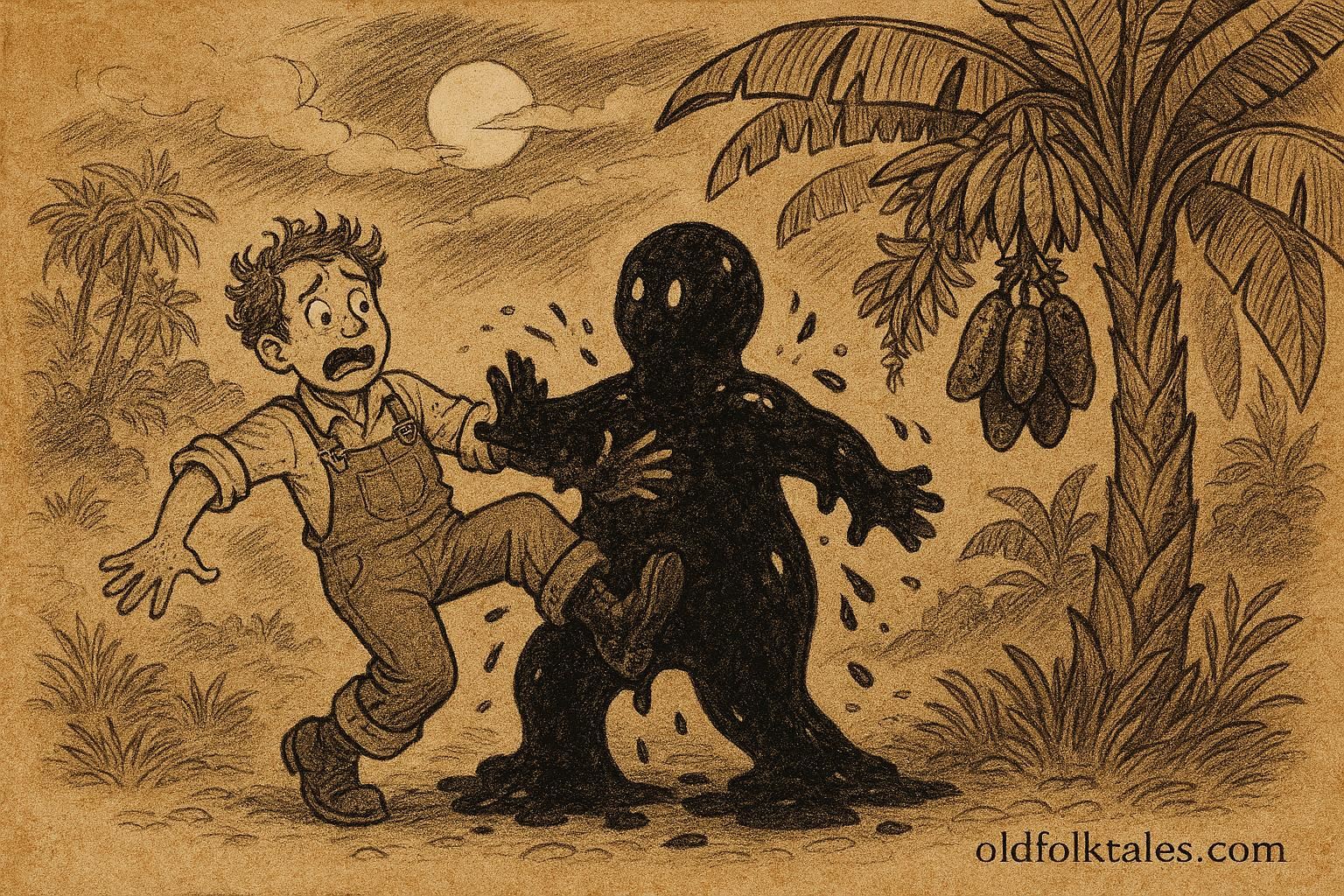
THWACK. His palm landed square on the tar-baby’s pitch-black head. It stuck fast. He tried to pull away, but the grip of the tar was like the roots of the earth itself.
“What’s this? Let go of me at once!” Tacoma yelled, his fear rising. With his free left hand, he punched the tar-baby in the chest. THUD. His left hand stuck just as fast.
Now in a panic, he began to kick. “You release me, you villain!” he cried, driving his right foot into the tar-baby’s leg. SCHLOP. His foot was trapped. Hopelessly off-balance, he brought his last free limb, his left foot, forward in a desperate shove. It, too, sank into the sticky tar.
Tacoma was utterly caught, stuck fast to the silent, smirking black figure. He twisted and pulled until he was exhausted, but he was held like a fly in honey. He hung there, arms and legs splayed, a prisoner of his own greed and temper.
At first light, the farmer returned. He found Tacoma stuck to the tar-baby, weary and defeated. The evidence was undeniable. Saying not a word, the farmer cut a stout switch from a guava tree. Then, with firm, measured strokes, he gave Tacoma the beating he deserved for his weeks of thievery. Swish-thwack! Swish-thwack! The blows fell on Tacoma’s backside as he dangled, helpless.
Only after the lesson was thoroughly delivered did the farmer use a bit of cooking oil to soften the tar and peel the humiliated thief loose. Tacoma stumbled away, his pride and his backside sore, the savory memory of the magic bananas forever spoiled by the taste of shame and sticky pine pitch.
He never went near that clearing again. And in the villages, when someone acted on greed without thinking, the old folks would smile and say, “Careful, or you’ll end up like Tacoma, arguing with a tar-baby.”
The Moral Lesson:
This humorous yet pointed tale teaches that greed and theft inevitably lead to a sticky and humiliating downfall. It illustrates the futility of fighting a problem born of one’s own misconduct and warns that silent, patient justice often catches the arrogant thief by surprise.
Knowledge Check
Q1: What is special about the banana tree Tacoma discovers?
A1: It is a magic tree that produces ready-to-eat, perfectly roasted food like yams, plantains, and corn, instead of raw fruit.
Q2: Who is the true owner of the magic banana tree, and how does he plan to catch the thief?
A2: The tree belongs to a quiet, hardworking farmer. He creates a tar-baby, a sticky figure made of pitch and resin, and places it under the tree as a silent guard.
Q3: What is the classic folkloric name for the sticky figure used to trap Tacoma, and what motif does it represent?
A3: It is called a “tar-baby.” It represents the “sticky adversary” motif, where fighting a silent, immovable, and adhesive opponent only leads to greater entanglement and defeat.
Q4: How does Tacoma ultimately become completely trapped?
A4: After the tar-baby doesn’t answer his greetings, Tacoma strikes it with his right hand, which sticks. Then he hits it with his left hand, and kicks it with both feet, each limb becoming stuck in turn until he is fully immobilized.
Q5: What is Tacoma’s punishment after he is caught?
A5: The farmer gives Tacoma a sound beating with a switch from a guava tree, delivering a physical and humiliating punishment for his theft before freeing him from the tar.
Q6: What is the primary cultural role of this story within Jamaican folklore?
A6: It serves as a humorous but sharp moral lesson about the consequences of greed, theft, and unchecked anger, using the well-known tar-baby trick to teach that crime tangles the criminal in their own misdeeds.
Cultural Origin: Jamaican Folktale (of African diaspora origin).
Source: Adapted from Story #33, “Tacoma and Anancy,” in Jamaica Anansi Stories by Martha Warren Beckwith.