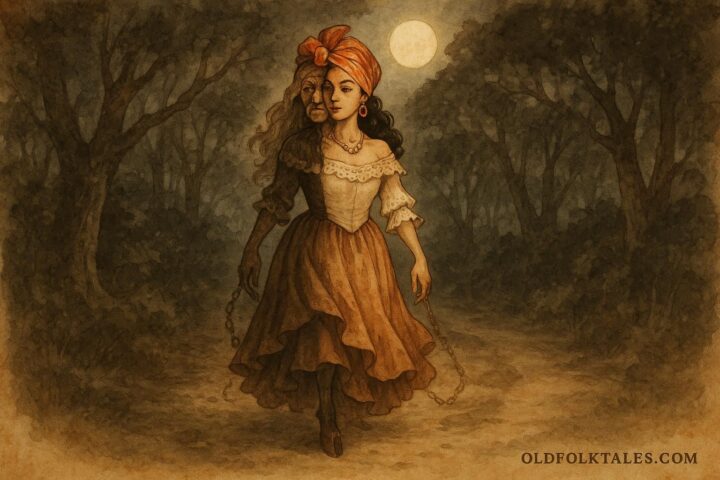
Respect was the quiet law that governed the Arima River long before men tried to master it. Among the fishermen who traveled its banks, there was an unspoken understanding that certain pools belonged not to human hands but to the River Mumma, Mama D’Leau herself, guardian of the deep water and keeper of its hidden paths. Those who ignored this truth returned home empty-handed, and those who mocked it often returned changed in ways no one wished to speak of.
Elihu was a poor fisherman, known more for his humility than for his catch. Each morning, as he walked along the river with his worn net over his shoulder, he paused when he reached the sacred pool. He never cast his line there. Instead, he removed his hat, bowed his head slightly, and greeted the water in a low voice before moving on. Others laughed at him for saluting a river, but Elihu paid them no mind. Hunger had taught him patience, and the river had taught him reverence.
One evening, as the sun lowered and turned the water copper-red, Elihu noticed something gleaming near the roots of a silk-cotton tree at the edge of the sacred pool. Tangled among the roots was a golden comb, its teeth shining softly beneath the surface. Elihu knew at once what it was. The elders had spoken of the River Mumma’s comb, the tool with which she tended her long, dreadlocked hair as she rested beneath the water. His heart quickened, but he did not reach for it. He stepped back, saluted the pool, and went home.
The next day, the comb was still there. Again, Elihu resisted the urge to touch it. On the third evening, the river ran quiet, and the comb had drifted closer to the bank. Elihu knelt, careful not to disturb the water. With both hands, he gently lifted the comb and placed it upon a clean, flat stone at the water’s edge, arranging it so it would not fall back into the current. He bowed once more and left without a word.
That night, Elihu dreamed of the river. From its depths rose the River Mumma herself, radiant and terrible in her beauty. Her skin shimmered like wet stone, and her eyes held the calm of deep water. She spoke without anger. “For your Respect,” she said, “cast your net only where you see a single bamboo leaf floating.” When Elihu awoke, the sound of running water still filled his ears.
At dawn, Elihu returned to the river. He watched carefully until he saw a lone bamboo leaf drifting slowly on the surface. He cast his net there, and when he pulled it in, it was heavy with fish. Each day after, he followed the same instruction. A single leaf. A single cast. His net was always full. His hunger faded, and his name became known throughout the valley.
But not all watched with goodwill. A rival fisherman, envious and bitter, hid among the reeds and observed Elihu’s success. He noticed the bamboo leaf and the careful way Elihu waited before casting his net. One morning, before Elihu arrived, the rival hurried to the river. He watched for a bamboo leaf and threw his net the moment he saw one. He laughed, certain he had stolen the secret.
When he dragged his net from the water, there were no fish within it. Instead, it held old bones tangled in rotting cloth and the shattered remains of a waterlogged coffin. The smell rose instantly, thick and unbearable. As he staggered back in horror, the river began to churn. A voice echoed across the water, deep and resonant. “Thief! Your hands shall always smell of the grave!”
The rival fled, but the curse followed him. No matter how often he washed, the stench of decay clung to his hands. Food spoiled when he touched it. People recoiled from him. Worse still, the river changed. The bamboo leaves no longer marked hidden bounty. The secret fishing places vanished, and the Arima River returned to silence.
Elihu continued to greet the river as he always had, but the great abundance did not return. He understood why. Gifts given by spirits were not meant to be stolen or displayed. They were meant to be honored quietly. He remained poor, but he was never hungry again, and the river never turned against him.
Moral Lesson
This folktale teaches that Respect for spiritual boundaries and traditions brings harmony, while envy and theft invite lasting consequence.
Knowledge Check
1. Who is the River Mumma in the story?
She is the guardian spirit of a sacred pool in the Arima River.
2. Why did Elihu never fish in the sacred pool?
He respected the River Mumma’s ownership of the water.
3. What was the significance of the golden comb?
It belonged to the River Mumma and symbolized her presence and authority.
4. What instruction did Elihu receive in his dream?
To cast his net only where a single bamboo leaf floated.
5. What happened to the jealous rival fisherman?
He was cursed so his hands always smelled of the grave.
6. What cultural belief does the story reflect?
That water spirits reward respect and punish greed or disrespect.
Source and Cultural Origin
Source: Recorded by C.R. Ottley in the Arima Valley
Cultural Origin: Afro-Trinidadian Creole folklore, influenced by Igbo and Mami Wata traditions