In the beginning, before the rivers glimmered and the skies turned blue, the world lay under an endless shroud of darkness. The people of the Pacific Northwest lived by the faint glows of fire and stars that barely reached them. Even the animals stumbled in the shadows, and the forests whispered in black silence. Yet, high above, in a great house at the edge of the sky, a powerful Chief possessed all the light in existence. He kept it hidden away, sealed inside beautifully carved boxes, one for the stars, one for the moon, and one for the great sun itself.
Among the creatures who suffered in the darkness was Raven, the clever, curious, and mischievous trickster of the world. Raven was not like other birds. He could shift his shape, speak with the spirits, and devise clever plans that no one else dared imagine. Yet, his hunger for discovery often led him to trouble.
Discover the blend of magic and wisdom that defines the folktales of the Caribbean islands
Raven heard tales of the Chief who hoarded the light and felt both wonder and anger. “Why should one being keep such beauty hidden?” he thought. “The world deserves to see what he hides away!” But another voice within him whispered: If I had the light, I would be powerful indeed.
So Raven hatched a plan, one that only a being as cunning as he could carry out.
He flew across mountains and over dark waters until he reached the Chief’s great house. From high above, he saw the Chief’s daughter kneel beside the water, filling her cedar cup. In that moment, Raven transformed himself into a single pine needle and floated gently into the cup. When the young woman drank, she unknowingly swallowed the trickster himself.
Time passed, and the Chief’s daughter gave birth to a baby boy, Raven reborn in human form. The Chief loved his grandson dearly and let the child play freely within the house. He was curious and bright-eyed, but there was something strange about him. He seemed to know things a child should not, and his laughter sometimes sounded like the cry of a raven in the wind.
Every day, the child pointed to the shining boxes hanging from the rafters and cried for them. The Chief, unwilling to disappoint his beloved grandchild, lowered one box after another for him to play with. Inside each was a mystery of light so beautiful that even the spirits might weep to see it.
One day, as the Chief dozed beside the fire, Raven-child opened the smallest box. A shimmer of starlight burst out and rushed through the roof’s smoke hole, scattering across the heavens. The night sky sparkled for the first time.
The Chief awoke, furious, but when he saw his grandson’s innocent face, he forgave him. “Play gently, little one,” he warned.
Days later, Raven opened the second box, and out flew the moon, glowing with cool silver light. It drifted through the smoke hole, taking its place beside the stars. The Chief scolded the child but could not bring himself to punish him harshly. The boy wept, and his tears softened his grandfather’s heart once more.
At last, only one box remained, the largest and most precious, holding the great sun. The Chief hesitated, but his grandson’s cries broke his resolve. “Only for a little while,” he said, handing it down.
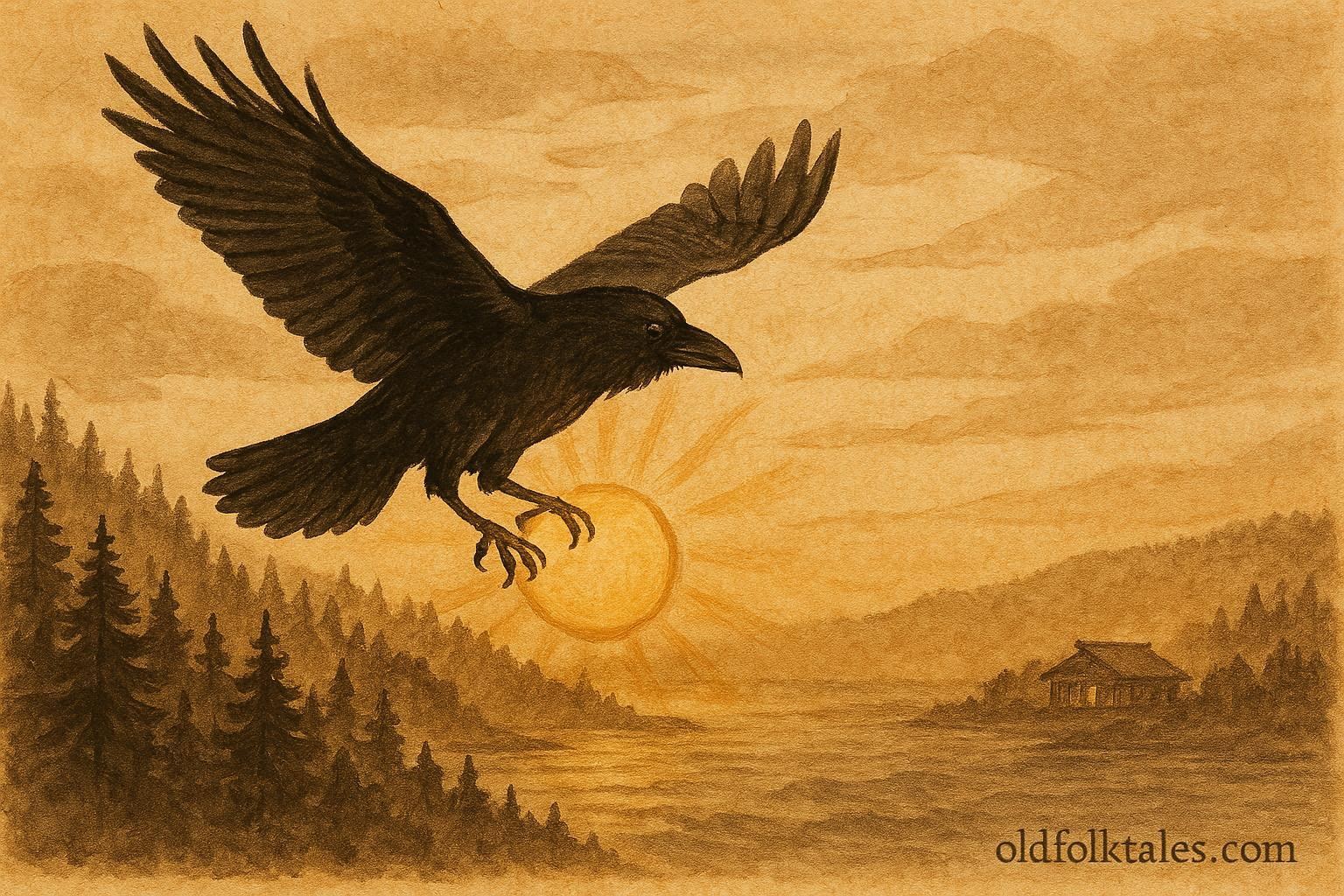
The boy barely touched the box before a blinding flash filled the room. With a burst of laughter, Raven transformed back into his true form, black feathers gleaming, wings wide, eyes filled with cunning joy. Clutching the sun in his talons, he flew through the smoke hole and soared into the dark sky.
As he flew, the sun blazed free, flooding the world with golden light. The forests glowed green, the oceans shimmered blue, and every creature lifted its head in wonder. The long night was finally over.
But the Chief’s anger shook the heavens. He shouted after Raven, “Selfish bird! You have stolen what was not yours!” Raven laughed and called back, “I have shared it with all who live!”
And so, though his act was born of trickery and pride, Raven’s deed gave the world the gift of light. The Haida and Tlingit people remember him not just as a mischief-maker but as a creator, one whose cunning changed the course of the world.
Even now, when the sun rises or the stars shimmer, people say it is Raven’s laughter echoing across the sky, reminding us that even mischief can serve a greater purpose.
Discover ancient tales passed down by the Indigenous peoples of the Americas.
Moral Lesson
This story teaches that wisdom can sometimes come from unlikely sources. Raven’s selfishness brought trouble, yet his actions also brought light to the world. The legend reminds us that every being, even a trickster, has a role in the balance of creation.
Knowledge Check
- Who is Raven in Haida and Tlingit folklore?
Raven is a trickster spirit known for his intelligence, cunning, and power to transform the world through both mischief and creativity. - What did Raven steal from the great Chief?
Raven stole the light, the sun, moon, and stars, which the Chief had kept locked away in carved boxes. - How did Raven enter the Chief’s house?
He transformed himself into a pine needle and floated into the Chief’s daughter’s drinking water, later being born as her child. - What happened when Raven opened the boxes?
He released the stars, the moon, and finally the sun, bringing light to the dark world. - What does this story symbolize in Indigenous culture?
It symbolizes transformation, the balance between light and darkness, and the creative power that can arise from cunning or imperfection. - What is the main moral of Raven’s story?
That even acts of trickery can lead to creation and growth, reminding us that light often emerges from unexpected places.
Source:
Adapted from Raven: A Trickster Tale from the Pacific Northwest by Gerald McDermott (1993) and oral traditions recorded by John Swanton (1909).
Cultural Origin: Haida and Tlingit First Nations, Pacific Northwest Coast, Canada.