In the golden hills of southern Brazil, where the wind sweeps gently over the open pampas and the air smells of grass and horses, there once lived a little Black boy known as Negrinho do Pastoreio, “The Little Black Shepherd Boy.” He was a slave, belonging to a harsh and prideful master who owned vast fields, herds of cattle, and fine horses that gleamed under the sun like polished bronze.
Negrinho was small, thin, and quiet, but his eyes carried a patient brightness, and his heart was gentle. Each day, he rode through the pastures on his master’s best horse, tending to the herd with a calm spirit. The land was wide, and his only companions were the rustling wind and the neighing of the horses.
Though the boy worked faithfully, his master treated him with cruelty. The man’s temper was as quick as fire and his heart as hard as iron. He believed punishment was the only language a slave could understand. The boy endured his master’s harshness silently, never complaining, trusting that somewhere beyond his suffering, there was mercy and justice.
The Lost Horses
One bright afternoon, as Negrinho watched over the herd, a storm began to build. The winds howled, and dark clouds gathered over the hills. Lightning cracked open the sky, and the horses, frightened, scattered in all directions. The boy rode desperately through the rain, calling after them, his small voice lost in the thunder.
When the storm finally passed, the pastures lay empty. The horses were gone.
Heart pounding, Negrinho returned to the ranch to tell his master. But the man did not listen. His eyes burned with fury.
“You lazy, worthless child!” he roared. “You will pay for this!”
And so, the master took a whip, long, black, and cruel, and beat the boy until his back was striped with pain. But Negrinho did not cry out. He only whispered through tears, “Our Lady will help me find them.”
The master, sneering, gave him one more chance. “Then find them, or you’ll learn what real punishment means.”
The Second Loss
For three long days, the boy searched the hills. He followed hoofprints across fields and valleys, calling softly to the horses he loved. His body was weak from hunger and the lashes that still burned his skin, but his faith was unbroken.
At last, he found them, every horse, safe and sound, and he led them home, proud and hopeful. But just as they reached the corral, the master’s son, careless and cruel like his father, opened the gate. The horses bolted once again into the wild.
The master’s fury returned, greater than before.
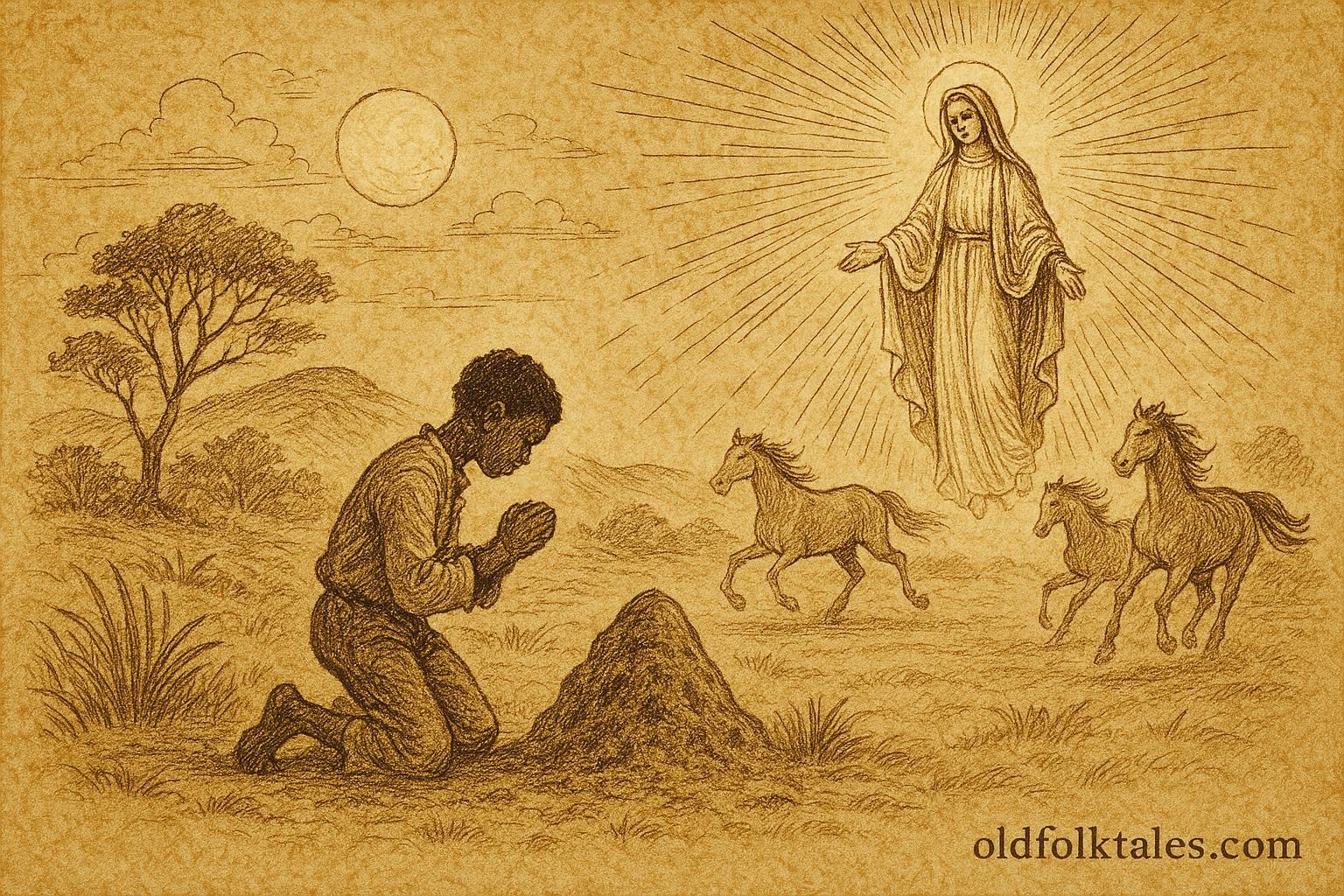
He seized the boy, shouting that no lazy slave could lose his horses twice and live. This time, he tied Negrinho’s hands and feet and dragged him to an anthill, a mound alive with biting red ants. There, he stripped the child’s shirt and left him bound under the burning sun, saying, “If your Virgin Mary loves you so much, let her come and save you!”
Then he rode away, leaving the boy to suffer alone in the heat, the cries of insects rising around him.
The Miracle in the Night
Night fell. The sky filled with stars, and the moon bathed the fields in pale silver light. The little boy lay still, his body trembling, his breath faint. Yet even as the ants crawled over him, he whispered softly, “Our Lady… help me.”
Then, a gentle glow began to spread through the darkness. A figure appeared, Our Lady, the Virgin Mary, clothed in light. She knelt beside the boy, and with a tender smile, she touched his bindings. Instantly, the ropes fell away, and the ants vanished.
Her voice was soft as the wind. “Your suffering is over, my child. Come, let us bring back what was lost.”
At her word, the horses returned from the hills, their hooves echoing like distant drums. The Virgin Mary placed the boy upon a shining white horse, and together they rode through the fields, the light of heaven surrounding them.
The Morning After
At dawn, the cruel master came to see what was left of the boy. But when he reached the anthill, he stopped in shock.
There was no blood, no sign of pain. The boy stood there, glowing with a soft, golden light. The horses grazed peacefully beside him, their manes shining like silk.
The master fell to his knees, trembling. He realized then that the child he had beaten and scorned was protected by divine grace. Overcome with fear and shame, he begged forgiveness, but the boy said nothing. Smiling faintly, Negrinho turned and vanished into the morning light, leaving only the faint sound of hooves echoing in the distance.
The Legend Lives On
From that day forward, the people of Brazil began to whisper of Negrinho do Pastoreio, the Little Black Shepherd Boy who became a holy guardian. It is said that if you lose something, a ring, a key, or even hope itself, you need only light a candle and call upon his name. Somewhere, in the unseen pastures of heaven, he will hear and help you find it.
Moral Lesson
This folktale teaches that innocence and faith can endure even in the face of cruelty. True justice does not come from power or revenge, but from compassion and divine mercy.
Knowledge Check
1. Who is Negrinho do Pastoreio in Brazilian folklore?
He is a young enslaved shepherd boy who becomes a saintly spirit helping people find lost things.
2. What event causes Negrinho’s suffering?
He is beaten and left on an anthill after losing his master’s horses during a storm.
3. How does the Virgin Mary help Negrinho?
She appears at night, frees him from his bonds, restores the lost horses, and heals his pain.
4. What does Negrinho symbolize in Afro-Brazilian culture?
He represents faith, endurance, and divine justice for the oppressed.
5. Why do people in Brazil pray to Negrinho do Pastoreio?
They invoke him to help find lost or missing things, believing his spirit offers gentle guidance.
6. What is the moral of “Negrinho do Pastoreio”?
The story teaches that goodness and faith bring redemption, even when the world is cruel.
Source: Adapted from Afro-Brazilian legend “Negrinho do Pastoreio,” recorded in 19th-century southern Brazilian oral tradition; featured in Latin American Folktales: Stories from Hispanic and Indian Traditions (ed. John Bierhorst, 2002).
Cultural Origin: Afro-Brazilian folklore (Rio Grande do Sul, Brazil)