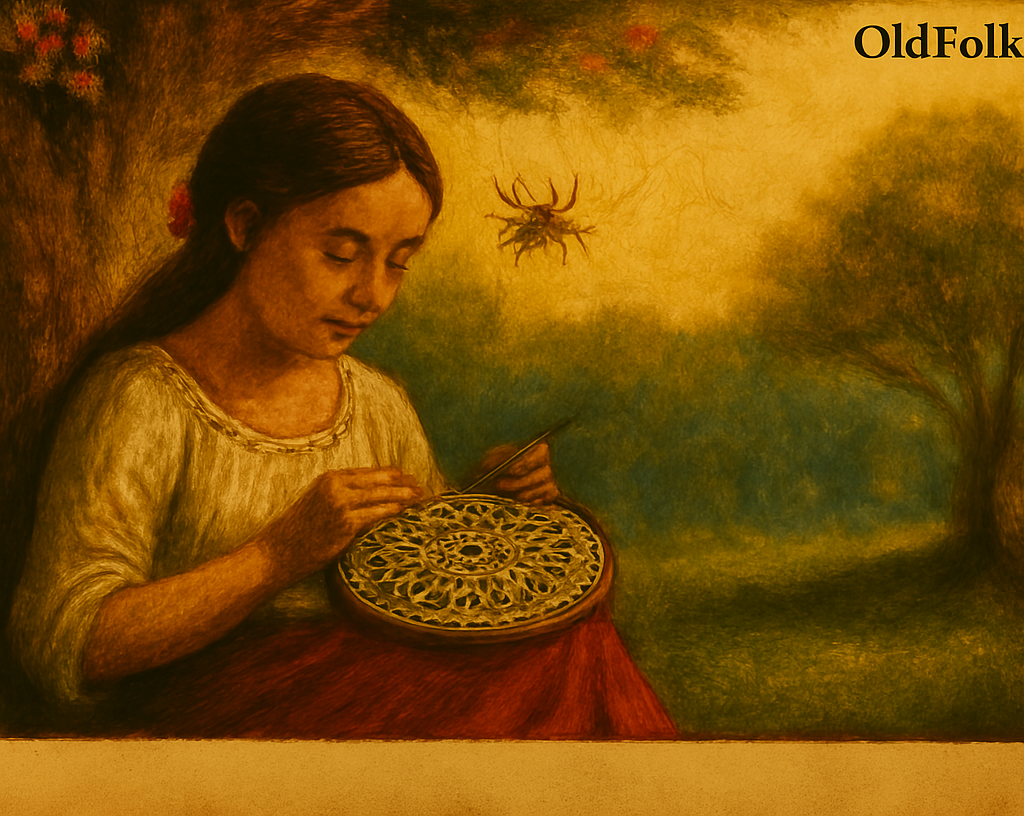
When Amalia first saw the spider suspended between two low branches of the ceibo tree, she felt an uncanny kinship with the tiny architect. The morning mist still clung to the village of Itauguá, and the air carried the cool dampness that came just before dawn broke fully over the Paraguayan countryside. The spider’s body was slender and dark, its eight legs arranged like the spokes of a living wheel, each one poised with delicate precision as it worked at its creation.
Amalia knew spiders well from watching the granary behind her family’s adobe home, where they ruled over grain and insects alike, spinning their silken traps in corners and rafters. But this one seemed almost otherworldly, touched by something beyond the ordinary. Perhaps it was the way the first rays of sunlight caught in its web, or the patient, methodical movements as it added thread after perfect thread to its design. Whatever the reason, Amalia found herself unable to look away.
Click to read all South American Folktales — timeless stories from the Andes to the Amazon.
For days afterward, she returned to the same spot as dawn broke, her footsteps silent on the dew-wet grass. She would wrap her shawl tightly around her shoulders against the morning chill, her breath quiet, her heart calm with anticipation. In the hush of sunrise, when the world seemed to hold its breath between night and day, the web unfurled before her eyes like a woven prayer offered to the heavens.
Each morning brought new revelations. The spider worked tirelessly, and Amalia watched with the devotion of a devoted student before a master. She knelt close enough to study every aspect of the web’s intricate pattern: a central spiral that drew the eye inward like a whirlpool, anchored by radial threads that stretched outward like the rays of the sun. The entire structure glinted with silver droplets of dew, each tiny bead of moisture catching and reflecting the growing light until the web seemed to be made of liquid diamonds.
The perfection of it moved something deep within Amalia’s soul. Here was art created not for pride or display, but out of pure necessity and instinct yet it was more beautiful than anything human hands had made in her village. The spider knew nothing of beauty, she realized, yet created it with every thread it spun. What if she, with her conscious mind and her seeking heart, could learn to do the same?
In careful strokes, she began to trace lines in the soft red earth beside the ceibo tree, replicating every arc and angle she observed. Her fingers drew patterns over and over until they were stained with dirt and her hands ached from the precision required. She studied how the radial threads provided structure, how the spiral threads connected them in mathematical perfection, how the whole created strength through the distribution of tension.
After days of observation and practice in the dirt, Amalia finally felt ready. With trembling fingers, she pulled a skein of fine cotton thread from the basket she had brought from home. The thread was white as clouds, soft as lamb’s wool, and she handled it with reverence. Settling herself on the ground beneath the ceibo’s spreading branches, with the spider’s web suspended above her like a blessing, she began to work.
The stitches came slowly at first, her fingers clumsy with uncertainty. She worked the thread through and around, feeling as though she were translating an ancient language written in silk and geometry a language that spiders had spoken since the beginning of time, and which no human had thought to learn until this moment. Each loop and knot required absolute focus. Her back ached from hunching over her work, her eyes strained from the precision required, but she persisted with the same patient determination she had witnessed in the spider.
Villagers passing by on their way to the fields or the well paused their morning chores to watch this strange sight. They saw Amalia kneeling beneath the ceibo tree day after day, her brow knit in fierce concentration, her lips moving in soft syllables perhaps a prayer to the Virgin, perhaps a lullaby her mother had sung to her as a child, or perhaps words of her own creation, a chant to help her fingers remember the pattern. Some shook their heads at this peculiar obsession; others felt drawn by curiosity and wonder.
Her mother brought her mate and chipá to sustain her through the long hours. Her younger sisters sat nearby, playing quietly so as not to disturb her concentration. The village elders watched from a distance, whispering among themselves about what this young woman was attempting, whether it was wisdom or foolishness that drove her.
By the third morning, as the sun rose pink and gold over the distant hills, Amalia had completed her work. She held aloft a small square of lace, delicate as a breath, strong as faith. Its design echoed the spider’s web exactly—the same radial structure, the same spiral pattern, the same mathematical precision that distributed strength throughout the whole. But it was also something more, something uniquely human: it was art made conscious of itself, nature transformed by understanding and love into something that could be held, kept, and treasured.
She raised it toward the sunrise, and the early morning light streamed through the open spaces in the lace, casting intricate shadows on the ground below. The threads quivered with light, seeming almost alive, as if they remembered their origin in the spider’s ancient art. The pattern glowed like a captured constellation, like a piece of the spider’s web made permanent and portable.
Murmurs of awe rippled through the small crowd that had gathered. People pressed closer to see this miracle that Amalia had created. They reached out tentative fingers to touch the delicate threads, marveling at how something so fine could exist, how human hands could replicate the work of nature’s smallest architect.
Women began asking Amalia to teach them. She showed them patiently, passing on what the spider had taught her—the importance of structure, the beauty of repetition, the strength that comes from proper tension. Soon, other hands were creating similar laces, each one unique yet all carrying the echo of that first spider’s web suspended between the branches of the ceibo tree.
The lace became known as ñandutí “spider web” in the Guaraní language and the village of Itauguá became famous for its production. But every piece created carried within it the memory of Amalia’s patient observation, her willingness to learn from the smallest teacher, her courage to believe that human hands could transform nature’s ephemeral gift into art that would endure far longer than any single spider’s brief life.
Woven into that first piece, and into every ñandutí lace created afterward, was the spirit of the ceibo tree that had provided the frame, the earth’s infinite patience that had taught Amalia to wait and watch, and the courage to see beauty in unexpected places and to transform observation into creation. The spider had given its gift freely, asking nothing in return and Amalia had received it with the humility and dedication it deserved.
Explore myths and legends from Brazil, Peru, and Argentina rooted in spirit and survival.
The Moral Lesson
The legend of Amalia and the spider’s gift teaches us that the greatest teachers often come in the most unexpected forms, and true wisdom requires the humility to learn from all of creation. By observing nature with patience and reverence, we can discover timeless patterns and principles that elevate our own work from mere craft to art. The story reminds us that beauty created out of necessity and instinct can inspire beauty created with consciousness and love, and that when we honor the natural world by learning from it rather than simply using it, we create something that endures and enriches generations to come.
Knowledge Check
Q1: Who is Amalia and what makes her connection with the spider special? A: Amalia is a young woman from the village of Itauguá in Paraguay who feels an uncanny kinship with a spider she observes spinning its web in a ceibo tree. Unlike others who might dismiss the spider as ordinary, she recognizes it as a master architect and teacher, seeing the potential to learn ancient patterns and transform them into human art.
Q2: What is the significance of the ceibo tree in this story? A: The ceibo tree serves as the sacred frame where the spider creates its web and where Amalia conducts her patient observation and learning. It represents the natural setting that bridges the spider’s instinctive art and Amalia’s conscious creation, and its spirit becomes woven into the first piece of ñandutí lace she creates.
Q3: How does Amalia learn to create the lace? A: Amalia returns to the spider’s web each dawn for days, studying its intricate pattern the central spiral and radial threads. She practices by tracing the design in the earth until she understands its structure, then carefully replicates it using cotton thread, translating the spider’s natural architecture into human textile art through patient observation and practice.
Q4: What does “ñandutí” mean and why is it significant? A: “Ñandutí” means “spider web” in the Guaraní language. This name is significant because it directly honors the origin of the lace-making technique acknowledging that humans learned this art by observing and replicating the spider’s natural weaving, maintaining a connection to the original inspiration.
Q5: How does the community respond to Amalia’s creation? A: Initially, villagers are curious and some skeptical, watching her strange obsession with fascination. When she finally completes the lace and holds it up to the sunrise, the crowd responds with awe and wonder. Women begin asking her to teach them, leading to the spread of ñandutí lacemaking throughout the village of Itauguá.
Q6: What cultural legacy does Amalia’s learning from the spider create? A: Amalia’s patient observation and replication of the spider’s web creates the tradition of ñandutí lace, for which the village of Itauguá becomes famous. Every piece of this lace carries the memory of learning from nature, representing the Guaraní values of patience, reverence for the natural world, and the transformation of observation into enduring art.
Source: Adapted from Paraguayan oral tradition and folklore regarding the origin of ñandutí lace, t
Cultural Origin: Guaraní People and Mestizo Culture, Itauguá, Paraguay