Long before the sun ever touched the high plains of the Altiplano, in the time the Aymara call Nayra Pacha the age of the first people there existed a civilization unlike anything the world has known since. These were the chullpa, the ancient ones, who lived in a world of perpetual twilight where the moon was sovereign and the stars hung low in the black velvet sky.
The chullpa were a people perfectly adapted to the darkness. Their eyes glowed faintly with an inner light that allowed them to see as clearly by moonbeams as we see by day. Their skin was pale as starlight, their movements graceful and silent as shadows. They had built great towers and underground dwellings across the Altiplano, structures whose purposes and construction methods remain mysterious to this day.
Click to read all South American Folktales — timeless stories from the Andes to the Amazon.
But the most extraordinary aspect of chullpa life the detail that truly separated them from all who would come after was how they managed their daily sustenance. The chullpa had no need for fire. They cooked with moonlight.
In every chullpa household, special vessels were kept pots and bowls made from a peculiar stone that no longer exists in the world. These vessels had the remarkable property of absorbing lunar energy, concentrating the cold light of the moon until it became hot enough to cook food. The process was slow and required patience, but the chullpa had nothing but time in their endless night.
When it was time to prepare a meal, a chullpa woman would take her cooking pot outside and set it on a smooth stone platform designed to catch the moon’s rays. She would fill the vessel with quinoa or potatoes, add water from the mountain springs, and place it carefully in the path of the moonlight. Then she would sit beside it, sometimes for hours, watching as the pale light gradually warmed the contents. The food cooked slowly, gently, infused with the cold fire of the moon itself.
The chullpa homes were arranged to maximize exposure to moonlight. Their doorways faced the directions of the moon’s rising and setting. Their cooking areas were positioned on rooftops or in open courtyards where no shadow would fall to interrupt the precious lunar rays. The entire rhythm of domestic life was organized around the moon’s phases fuller moons meant faster cooking and more efficient preparation of food, while new moons required careful rationing of previously cooked provisions.
Children learned from an early age how to orient their cooking vessels to catch the optimal angle of moonlight. Young women were taught the subtle art of reading the moon’s intensity, knowing exactly when to begin cooking so that the meal would be ready at the desired time. The elders could predict, by observing the moon’s color and position, how long any particular dish would take to prepare.
This was the way of the chullpa world cold, serene, orderly, governed by the gentle rhythms of lunar cycles. They knew no other existence and desired none. Their food, though cooked slowly, was perfectly prepared. Their lives, though lived in darkness, were rich with meaning and tradition.
But the universe held secrets the chullpa did not suspect. The cosmic order was not fixed it was evolving. And in realms beyond their comprehension, something new was being born. The sun, which had never existed, was coming into being.
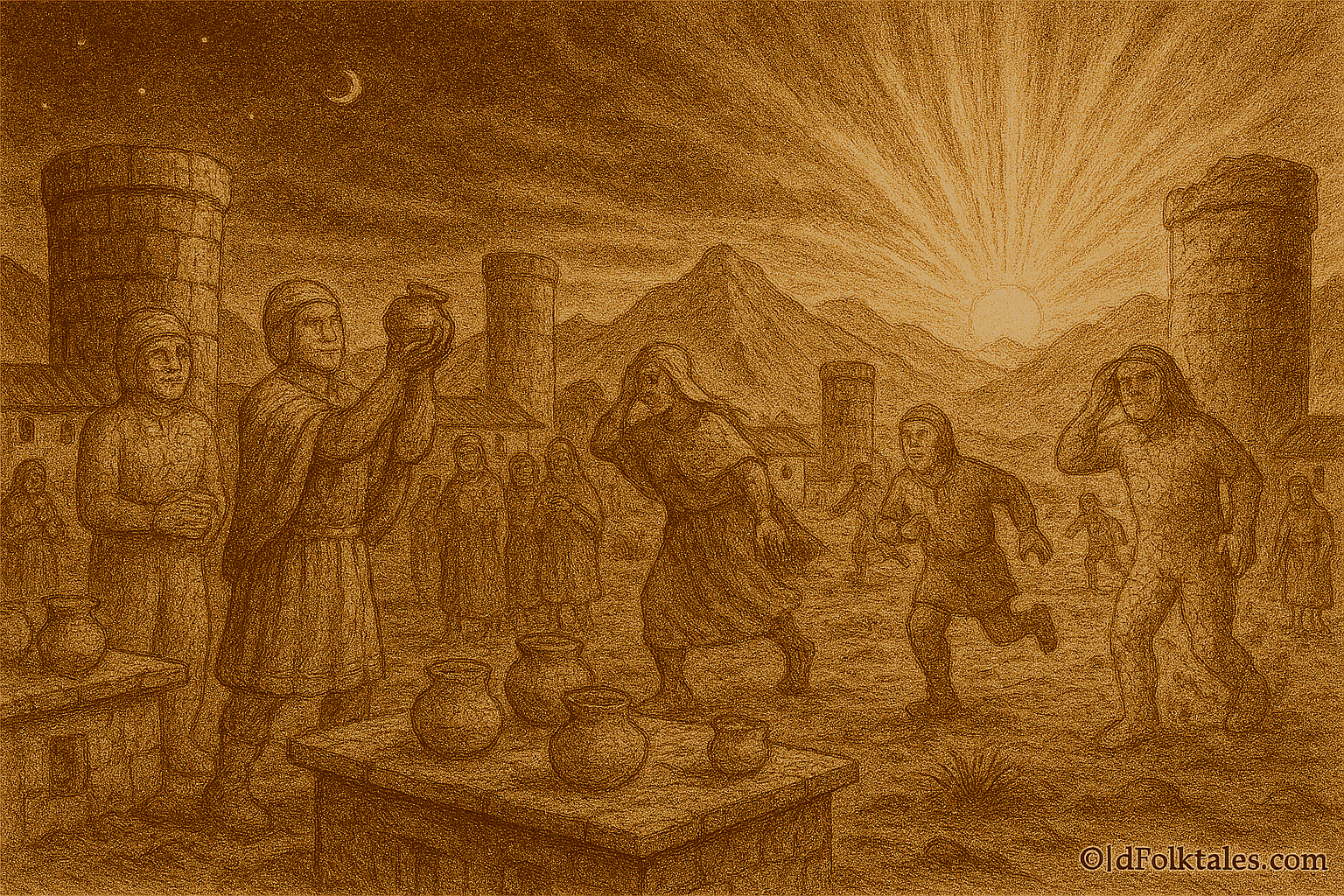
On what would be the last night of the old world, the chullpa went about their routines as always. Throughout the scattered settlements of the Altiplano, families prepared their evening meals. Cooking pots filled with quinoa, potatoes, and chuño sat arranged in neat rows on rooftop cooking platforms, absorbing the light of the waning moon. Women tended their vessels, children played in the shadows between the stone towers, and men returned from tending their llama herds under the star-filled sky.
No one noticed the faint, unprecedented glow beginning to build on the eastern horizon. Why would they? The concept of a horizon glow was meaningless to people who had never seen dawn.
As the night progressed, the strange light intensified. The chullpa began to take notice, pointing and murmuring with confusion. The stars were fading, something that should not happen. The quality of the darkness was changing, becoming less absolute, touched by an alien radiance that grew stronger moment by moment.
Then, with no further warning, the sun burst over the edge of the world.
The effect was instantaneous and catastrophic. The chullpa, whose eyes were designed for starlight and moonshine, were blinded by the terrible brilliance. They screamed and covered their faces, stumbling in panic as the light they had never imagined flooded across the Altiplano.
But the sun’s first rays were more than light they carried a transformative power, the force of a new cosmic order imposing itself upon the old. Everything the sunlight touched began to change in ways both subtle and profound.
The cooking vessels, still sitting in their neat rows on rooftops and courtyards, were caught in mid-function. They had been designed to absorb and concentrate moonlight, to work in harmony with lunar energy. When the sun’s rays struck them, the incompatible energies created a reaction the vessels could not withstand. They began to harden, their molecular structure locking into permanent rigidity. The quinoa and potatoes inside them, half-cooked by moonlight, froze in their current state and turned to stone along with their containers.
The chullpa themselves fared no better. Their bodies, adapted over countless generations to the cold light of moon and stars, could not process the sun’s heat and intensity. Some, caught outside in the full force of that first sunrise, felt their skin beginning to stiffen. They tried to run for shelter but found their legs growing heavy, their movements sluggish. Within moments, they had become statues stone figures frozen in poses of flight and terror, arms raised to shield eyes that would never see again.
Those who had been inside their homes when the sun rose faced a different fate but no less terrible. The stone walls of their dwellings, which had always provided cool shelter from the night winds, now began to absorb the sun’s heat. The interiors grew hot, stifling, unbearable. The chullpa trapped inside suffocated in the changing air, their bodies hardening as they collapsed, becoming one with the stone floors and walls of their own homes.
Some tried to hide in their underground chambers, in the cool depths where they had stored food and buried their dead. But even there, the sun’s influence penetrated. The very air changed its nature, becoming hostile to beings designed for a different world. Those who sought refuge in darkness found that darkness itself had been transformed and could no longer protect them.
By the time the sun had fully risen, climbing higher into a sky that had never known its presence, the chullpa civilization had ended. Across the entire Altiplano, stone figures stood or lay where living people had been moments before. Stone cooking vessels sat on rooftops with stone food inside them. Stone homes held stone occupants. An entire world had been petrified in an instant.
When the Aymara people emerged in this new sun-filled world, they found the evidence of what had come before. They discovered the mysterious stone towers, the chullpas that gave the ancient people their name. They found inexplicable stone vessels on rooftops, containing stone food that had never finished cooking. They encountered stone figures that looked disturbingly human, frozen in postures of panic and flight.
The Aymara elders, preserving the ancient memory, explained to their children: “These are the chullpa, the moon-people who lived before the sun. They cooked with moonlight because they knew nothing of fire or daylight. When the sun rose for the first time, it destroyed them and their entire way of life. Everything they were their bodies, their homes, their food, their cooking vessels all turned to stone in that first terrible dawn.”
To this day, if you travel across the Bolivian Altiplano and examine the ancient chullpa ruins carefully, you can sometimes find stone vessels with strange contents, and stone formations that look almost like cooking platforms arranged to catch light from above. The Aymara people say these are the remains of the last meal the chullpa tried to prepare, the food that was cooking in moonlight when the sun destroyed their world forever.
Click to read all Andean Highland Folktales — echoing from the mountain peaks of Peru, Bolivia, and Ecuador.
The Moral Lesson
This distinctive Aymara legend teaches about the fragility of civilizations built upon singular adaptations and the catastrophic consequences when fundamental cosmic conditions change. The chullpa’s dependence on moonlight for even basic survival functions like cooking demonstrates how complete adaptation to one environment can mean total vulnerability when that environment transforms. The story reflects the Andean understanding of pachakuti world-turning transformation and reminds us that what sustains life in one age may become the instrument of destruction in another. It also preserves cultural memory of actual archaeological mysteries, explaining inexplicable stone artifacts and ruins as remnants of a fundamentally different world-age that ended when the sun first rose.
Knowledge Check
Q1: How did the chullpa people cook their food in this Aymara legend? The chullpa cooked their food using moonlight instead of fire. They had special stone vessels that could absorb and concentrate lunar energy until it became hot enough to cook. They would place pots filled with quinoa, potatoes, or other foods outside in the moonlight, sometimes for hours, allowing the cold light of the moon to gradually warm and cook the contents. This moon-based cooking was central to their entire domestic way of life.
Q2: What made the chullpa’s cooking vessels unique in Bolivian mythology? The chullpa’s cooking vessels were made from a peculiar stone that no longer exists in the modern world. These vessels had the extraordinary property of absorbing lunar energy and concentrating moonlight until it generated enough heat to cook food. They were designed specifically to work with cold lunar light rather than fire, making them perfectly adapted to the moonlit world but completely incompatible with sunlight.
Q3: How was chullpa society organized around moonlight according to this tale? Chullpa society was entirely organized around lunar rhythms and moonlight functionality. Their homes were built with doorways facing the moon’s rising and setting directions, cooking areas were positioned on rooftops or open courtyards for maximum moon exposure, and their daily schedules followed lunar phases. Fuller moons meant faster cooking and more efficient food preparation, while new moons required rationing of previously cooked food.
Q4: What happened to the chullpa cooking vessels when the sun rose? When the sun’s rays struck the cooking vessels for the first time, they underwent catastrophic transformation. The vessels, designed to work with moonlight, could not withstand the incompatible solar energy. They hardened into permanent stone, and the food inside them quinoa, potatoes, and other items half-cooked by moonlight froze in their current state and turned to stone along with the containers, creating the mysterious stone artifacts still found today.
Q5: Why couldn’t the chullpa survive the first sunrise in this Altiplano legend? The chullpa were completely adapted to a moonlit world and had bodies designed for cold starlight and lunar energy. When the sun rose, their darkness-adapted eyes were blinded by its brilliance, and their bodies could not process the sun’s heat and intensity. The solar energy was fundamentally incompatible with their physiology, causing them to petrify some turning to stone while fleeing, others suffocating in their homes as the air itself transformed.
Q6: What distinguishes this Aymara version from Quechua sun-origin stories? This Aymara legend uniquely emphasizes moon-based domestic life, particularly the detail of cooking with moonlight rather than fire. This element is not present in Quechua tellings of the first sunrise, which focus more on general solar worship and transformation. The Aymara version provides specific details about daily life in the pre-solar world, especially domestic practices, reflecting distinct Aymara cultural memory and cosmological perspectives about the chullpa ancestors.
Source: Adapted from Les ancêtres des Andes by Thérèse Bouysse-Cassagne and regional Aymara oral accounts (Bolivia)
Cultural Origin: Aymara Indigenous Peoples, Altiplano Region of Bolivia