Long ago, when Costa Rica was still under Spanish rule and the streets of San José were narrow cobblestone paths lined with clay-tiled roofs, travelers often spoke in whispers of a strange woman who haunted the night roads. Her name was La Segua, a being of terrible beauty and terrifying truth.
In those early colonial years, the nights were dark and deep. Candles burned low behind shuttered windows, and the sound of horses’ hooves echoed through the misty countryside. Men returning late from taverns or from secret visits to their lovers often rode home under the pale moon, their thoughts clouded with wine and desire. It was on such nights, they said, that La Segua appeared, standing alone by the roadside.
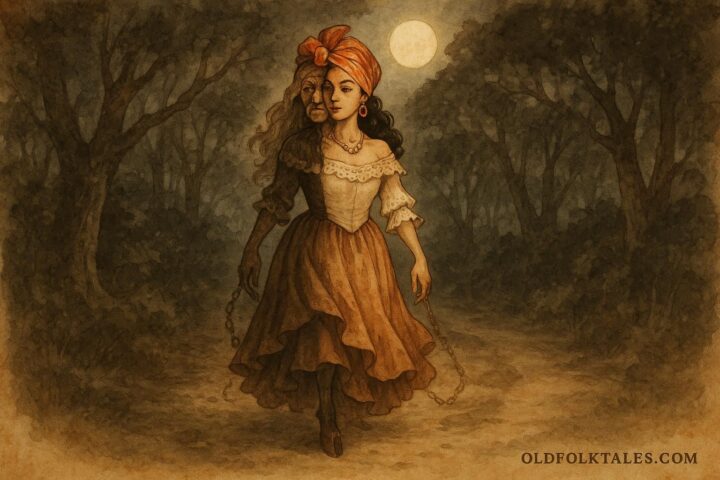
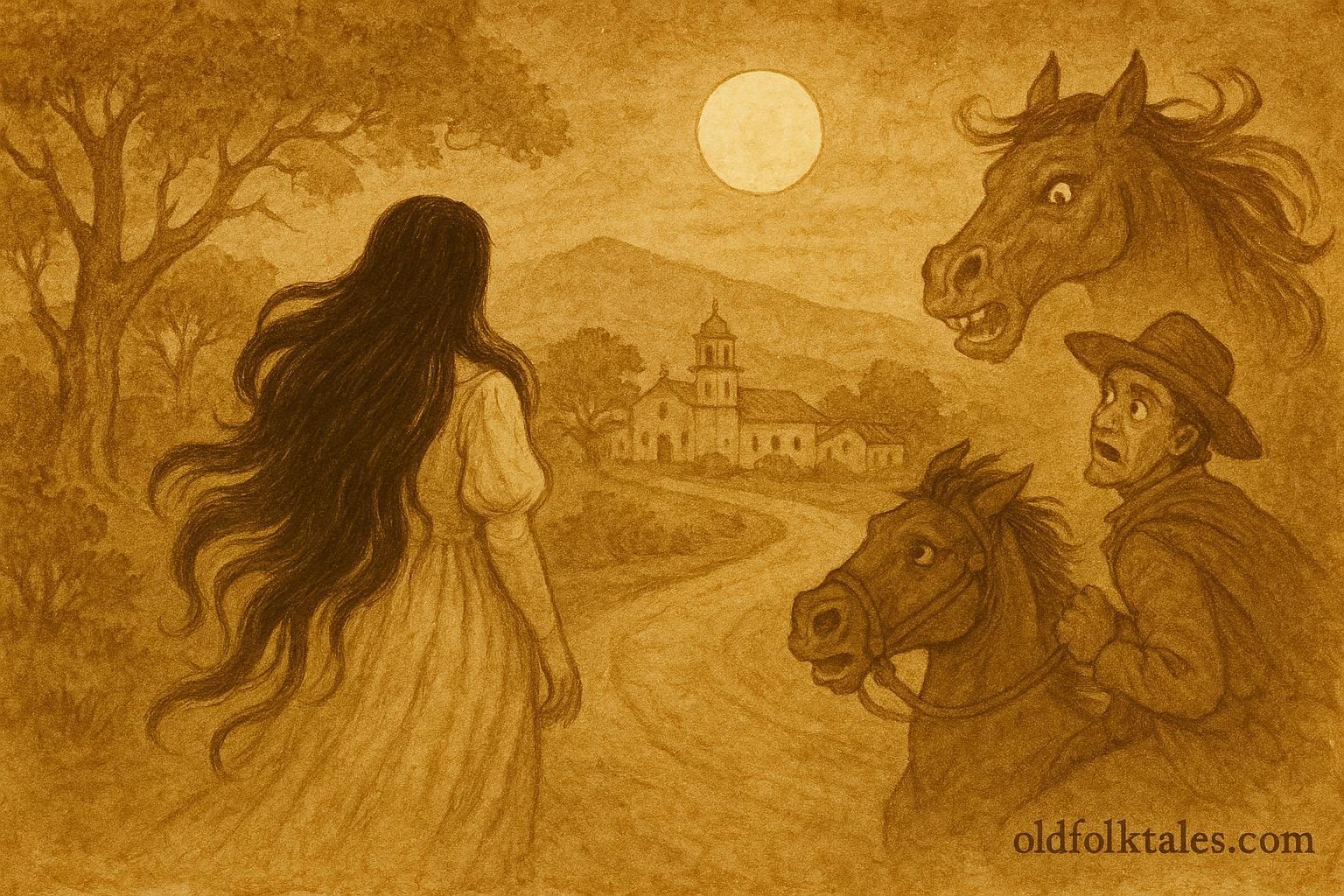
She seemed human enough at first. Her dress shimmered like silver in the moonlight. Her skin was pale as ivory, her long black hair fell like a river of ink over her shoulders, and her eyes shone with an otherworldly allure. To any wandering caballero, she looked like a vision from heaven itself. Her voice was soft and musical as she spoke:
“Caballero… will you give me a ride?”
The tired or boastful traveler, flattered by such beauty and trusting in his own courage, always agreed. He would reach down a hand, and the woman would climb gracefully onto the horse behind him. She sat close, her arms light around his waist, her perfume sweet and intoxicating. Sometimes she laughed, a silvery, lilting sound that sent a thrill down the rider’s spine.
But if he was foolish enough to glance over his shoulder and meet her gaze, that was when the enchantment shattered.
The woman’s face had changed. Where once there was beauty, now there was horror: her features stretched and twisted, her skin gray and dead, her eyes glowing red like burning coals. From her mouth hung the dripping muzzle of a rotting horse, foam and blood spattering her torn lips. The once-sweet perfume turned to the stench of decay.
Then came the scream, a shrill, piercing cry that tore through the night, half woman, half beast. The terrified horse reared, throwing the man to the ground. He would awake trembling, drenched in cold sweat, his heart pounding. Some ran home muttering prayers to the Virgin. Others were found wandering aimlessly, mad with fear. And a few, they said, never returned at all.
The Origin of La Segua’s Curse
No one knew for certain who La Segua had been in life. But the elders told a tale passed down from the earliest days of the colony.
Once, there lived in Cartago a young woman of rare and perfect beauty, the daughter of a wealthy Spanish official. Her name is lost to time, but her vanity was remembered well. Every morning she stood before her mirror, admiring her face and hair, her delicate skin and bright eyes. Every suitor who came to her door was measured by his rank, his clothing, and the fineness of his horse.
“If he is not noble,” she would say, “he is not worthy of me.”
The humble farmers, the mestizo soldiers, and the poor artisans who admired her from afar were met with laughter and scorn. “Do you think such a one as I could love a man who smells of earth and sweat?” she mocked.
One day, a young soldier, brave but poor, came to ask for her hand. She humiliated him before all her friends, saying cruelly that she would sooner marry a mule than such a man. The soldier left with tears in his eyes, his heart broken, and according to some versions, his mother, an old healer devoted to the saints, called down divine judgment on the girl’s pride.
Not long after, the beautiful maiden vanished. Some said she fell ill and died of fever. Others whispered she had been lured by a dark spirit to her doom. But soon, men riding at night began to see her figure on the roads, beautiful from afar, monstrous up close. The curse had taken its full shape.
Now she wandered between the worlds, neither living nor dead, doomed to tempt the vain and punish the lustful, forever wearing the face of what she had mocked: the beast within her soul.
The Warnings of the Elders
In towns and villages throughout Costa Rica, people learned to speak her name only in whispers. Mothers warned their sons:
“Do not follow beauty on the dark road, for it may be La Segua come to claim another vain heart.”
Priests spoke of her as a lesson from Heaven, a punishment for arrogance, a reminder that true beauty lies not in the face but in the heart. And every traveler who passed the lonely roads of Cartago or San José crossed himself and prayed softly before entering the mist.
Some claimed to hear her laughter carried by the wind near the Río Virilla or on the old roads to Heredia. Others saw hoofprints in the mud where no horse had passed. To this day, when night falls and fog drifts through the valleys, the old ones say La Segua still rides, waiting for the next proud soul who mistakes her curse for love.
Moral Lesson
The story of La Segua teaches that pride and vanity can twist even the most beautiful spirit into something monstrous. Outward beauty fades, but cruelty and arrogance leave marks that no mirror can hide. In the end, it is virtue and humility, not wealth or appearance, that protect the heart from corruption.
Knowledge Check
- Who is La Segua in Costa Rican folklore?
La Segua is a ghostly woman who appears as a beautiful maiden but transforms into a horse-faced monster to punish vain or lustful men. - What is the origin of the La Segua legend?
The tale comes from colonial-era Costa Rica, blending Spanish and Catholic moral storytelling with local Central American folklore. - What does La Segua symbolize?
She represents divine punishment for vanity, lust, and pride,moral flaws that corrupt the soul beneath physical beauty. - Why is La Segua’s face that of a horse?
The horse face reflects her inner arrogance and cruelty, revealing the beastly nature hidden behind her human beauty. - What moral lesson does the story of La Segua teach?
It warns that true beauty is found in virtue, and that arrogance and sin lead to spiritual ruin and eternal punishment. - How does La Segua compare to similar Latin American legends?
Like La Lloronaand La Sayona, La Segua is part of a tradition of ghostly women used to enforce moral and spiritual caution.
Source: Adapted from Tradiciones Costarricenses by Manuel María de Peralta (1889) and Leyendas de mi Tierra by Ricardo Fernández Guardia (1896).
Cultural Origin: Costa Rica (Spanish-Colonial, Afro-Hispanic and Catholic folkloric tradition)