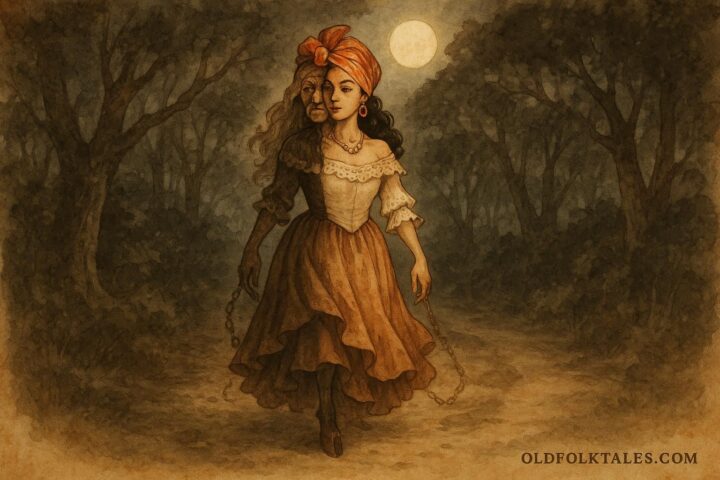
In the quiet rural towns of Honduras, where streets empty after nightfall and faith shapes the rhythm of daily life, there is a sound feared more than silence itself. It is the sharp, metallic echo of iron horseshoes striking stone, heard only at midnight when the world seems suspended between the living and the dead. This sound announces the presence of La Mula Herrada, a cursed spirit whose story has endured for generations.
La Mula Herrada is believed to be the spirit of a woman who, during her lifetime, violated sacred moral duties. In some tellings, she mistreated her parents, showing cruelty or neglect toward those who gave her life. In others, she engaged in immoral behavior that defied the religious values of her community. Whatever the precise transgression, her actions were considered severe enough to invite divine punishment rather than forgiveness.
After her death, the woman is said to have returned not in human form, but as a black mule marked by iron horseshoes. Her body is dark and imposing, her eyes burning with an unnatural awareness. Unlike ordinary animals, La Mula Herrada moves with purpose, her presence heavy with judgment. The iron shoes fixed to her hooves strike the ground with a ringing sound that carries far through empty streets, waking those who hear it and filling them with dread.
She appears only at midnight, the hour when spiritual boundaries are believed to weaken. Villagers say that when her hoofbeats echo through the town, doors are shut tightly and prayers are whispered in the darkness. No one dares to follow the sound, for to see La Mula Herrada is to confront fear itself. Those who have claimed to glimpse her speak of overwhelming terror that leaves them shaken long after she has passed.
In certain versions of the legend, La Mula Herrada is not merely a wandering spirit, but an active force of punishment. She is said to chase or trample those who live in sin, targeting individuals whose behavior mirrors her own past offenses. Her sudden appearance serves as a violent reminder that immoral actions do not go unseen. In other tellings, she does not attack at all. Instead, she passes through the streets without touching anyone, her role limited to warning rather than vengeance.
Regardless of the version, her purpose remains the same. La Mula Herrada exists to remind the living of divine justice. Her cursed form reflects the weight of her sins, and her endless wandering represents the consequence of moral failure left unrepented. She cannot speak, cannot rest, and cannot escape the punishment assigned to her.
The towns she visits are often described as deeply religious places where respect for family and moral conduct form the foundation of community life. In these settings, the legend of La Mula Herrada carries particular force. Parents tell the story to children as a lesson in obedience and gratitude. Elders repeat it to reinforce the importance of honoring one’s parents and adhering to religious teachings.
The mule’s iron horseshoes hold strong symbolic meaning. Iron is associated with permanence and severity, emphasizing that her punishment cannot be softened. Each strike of her hooves against the ground is a reminder that consequences endure long after actions are taken. The sound itself becomes a form of judgment, announcing her presence without mercy.
La Mula Herrada does not belong to one specific town. Her legend travels across rural Honduras, adapting slightly with each retelling while preserving its core message. Some say she vanishes at the edge of town before dawn. Others claim she dissolves into shadow when the first church bells ring. Yet no story allows her release. Her fate is eternal wandering.
Though terrifying, La Mula Herrada is not remembered solely as a monster. She is a cautionary figure, shaped by belief and fear, meant to guide behavior through example rather than instruction. Her story transforms moral values into a living image that cannot be ignored.
Even today, when midnight passes quietly and no hoofbeats are heard, the legend remains alive. The fear of La Mula Herrada continues to shape conduct, reminding communities that respect, faith, and family are obligations not to be broken lightly.
Moral Lesson
The tale of La Mula Herrada teaches that disrespect toward family and immoral behavior carry lasting consequences. It reinforces the importance of moral responsibility, religious values, and honoring one’s parents.
Knowledge Check
1. Who is La Mula Herrada in Honduran folklore
She is the spirit of a woman punished after death for immoral behavior or mistreating her parents.
2. What form does La Mula Herrada take
She appears as a black mule wearing iron horseshoes.
3. When does La Mula Herrada appear
She is said to roam rural towns at midnight.
4. What sound announces her presence
The loud echo of iron horseshoes striking the ground.
5. What actions does La Mula Herrada take in some versions
She attempts to trample sinners as a form of punishment.
6. What lesson does the legend of La Mula Herrada teach
It reinforces respect for family, faith, and moral conduct.
Source: Hondurastips folklore compilations; oral tradition
Cultural Origin: Honduras
Adapted from rural Honduran oral traditions